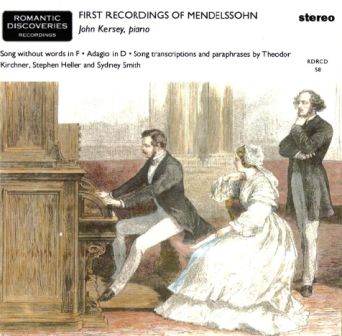
First recordings of Felix Mendelssohn
Original works and transcriptions by his contemporaries
John Kersey, piano
RDR CD58
Total time: 76 mins 46 secs
1. Felix Mendelssohn (1809-47): Song without words in F (1’56”)
2. Stephen Heller (1813-88): Caprice caracteristique on two themes by Mendelssohn, op 76 (7’11”)
3. Mendelssohn transc. Dietrich Krug (1821-80): Auf Flügeln des Gesanges (On Wings of Song) (6’31”)
4. Sydney Smith (1839-89): Mendelssohn’s Two Part Songs – reminiscence, op 141b (5’43”)
Mendelssohn transcribed Theodor Kirchner (1823-1903): Songs
5. Bei der Wiege (By the Cradle) (2’09”)
6. Frühlingslied (Spring Song) (1’16”)
7. An die Entfernte (To the Distant Beloved) (2’13”)
8. Reiselied (Journeying Song) (1’20”)
9. Reiselied (2’45”)
10. Suleika I (4’18”)
11. Suleika II (4’10”)
12. Schilflied (Reed Song) (3’51”)
13. Venetianisches Gondellied (Venetian Gondola Song) (2’43”)
14. Volkslied (Folk Song) (4’19”)
15. Stephen Heller: 3 Melodies of Mendelssohn, op 72: no 2 – Chant du Troubadour (Song of the Troubadour) (4’25”)
16. Mendelssohn: Adagio in D (ca. 1820) (6’56”)
17. Stephen Heller: Saltarello on Mendelssohn’s Finale from the “Italian” Symphony, op 77 (4’55”)
18. Sydney Smith: Transcription of Mendelssohn’s “O for the Wings of a Dove”, op 244 (9’07”)
We are grateful to Dr. Klaus Tischendorf and the Sydney Smith Archive for supplying copies of scores for use in this recording.
Notes on the music
Mendelssohn’s bicentennial in 2009 provides a long-awaited opportunity to celebrate this most extraordinary of nineteenth-century composers. To some extent, he continues to suffer from Wagner’s anti-Semitic attacks on him, but his relative neglect today has deeper roots. Mendelssohn is a composer for whom the balance of form and emotion are crucial, and where drama is frequently intimate rather than large-scale. He only rarely offers us the excess of temperament that is Schumann’s stock-in-trade, and often achieves his effects with great subtlety. Such was Mendelssohn’s influence during and beyond his lifetime that many features apt to be dismissed today as nineteenth-century clichés actually began fresh and new in Mendelssohn’s own work, to be taken up with varying degrees of success by his followers.
Posterity has distrusted Mendelssohn’s prolific output, his multiple talents (he was a watercolourist of professional standard in addition to his accomplishments as teacher and executant musician) and in particular his adherence to a religious style that has come to be seen as the epitome of comfortable mid-century Anglicanism. In reality, Mendelssohn’s spiritual life was much more complex, his father’s wholesale conversion of his family to Christianity in 1816 (he and his wife followed in 1822) causing Felix to be balanced on the cusp of the two faiths rather than wholly contained within one or the other. His musical style, often labelled as conservative, is in fact more introspective than genuinely unprogressive, and also has a rhetorical aspect which is strongly of its time but which has fallen from fashion since. Like Mozart before him, Mendelssohn’s outward heart-on-sleeve style masks deeper undercurrents and calls for more insight in interpretation than is sometimes afforded by overly boisterous readings. And Mendelssohn is, even when at his most light-hearted, a sincere composer of deep integrity and poetic feeling. He offers sentiment, not sentimentality, and that we should mistake those two is more of an indictment on the standards of our own age than on those of Mendelssohn.
There is still a good deal of Mendelssohn’s music that is unpublished and unrecorded, and little of the unpublished music is available to performers either in facsimile or in modern editions. Here are two pieces on this disc: firstly an Adagio written aged eleven or so in the white heat of Mendelssohn’s early creativity, and which already shows his style to be well-developed, and secondly a Song without Words that has somehow escaped from the published sets.
The heart of Mendelssohn’s emotional expression is in the songs, but it is rare that performances expose the intensity and even the psychodrama of these short works. The transcriptions by Mendelssohn’s pupil Theodor Kirchner are works of tremendous craft and pianistic invention, not designed like those of Liszt to transcend the originals, but rather to illuminate them from a different angle. Playing the Volkslied, one senses that Wagner’s jealousy of Mendelssohn may well have stemmed from the latter’s highly accurate pre-empting of his harmonic and melodic style. When one puts these transcriptions by the side of the more conventional if no less enjoyable work of the pedagogue Dietrich Krug one can see Kirchner’s achievement starkly delineated.
This Volkslied formed the basis for the extended Fantasy-Sonata op 69 by Stephen Heller, who was during his lifetime considered one of Mendelssohn’s most significant peers. Heller’s extreme Romantic sensibility and similar stylistic adherences to Mendelssohn again caused him to be eclipsed by the Wagner school. His writing for the piano is ingenious, virtuosic and shows considerable understanding of his sources. His transcriptions are not literal and often recast the melodic material into an interesting etude or exercise making use of pianistic effect – but, like Henselt’s writing, this feature is often obvious only to the performer, the audience remaining unaware of considerable difficulties that are written to sound easy. Heller’s Caprice on 2 themes is perhaps his most distinctive interpretation of the Mendelssohn style; recalling the G minor concerto, his writing exploits the full range of the instrument.
Sydney Smith was during the first part of his lifetime tremendously celebrated as an English touring virtuoso, having studied at the Leipzig Conservatoire under Moscheles and Plaidy from 1855. His many transcriptions of Mendelssohn show a respect for that composer which is reflected in their relative restraint and reliance on their original material for their effect. Like Heller, Smith found himself out of fashion in the later years of his life, and died stricken by illness and largely forgotten by the musical establishment.

 Romantic Discoveries Recordings
You must be logged in to post a comment.