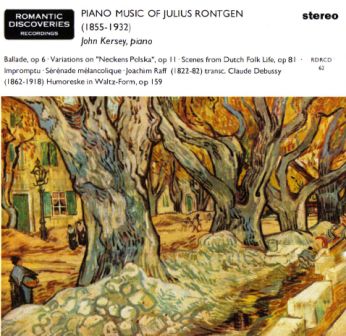
Piano music of Julius Röntgen (1855-1932)
John Kersey, piano
RDR CD62
Total time: 67 mins 49 secs
1. Ballade in D minor, op 6 (7’04”)
2. Impromptu (4’38”)
3. Variations on the Swedish folk song “Neckens Polska”, op 11 (16’04”)
4. Sérénade mélancolique (2’42”)
Scenes from Dutch Folk Life (Uit Neerlands Volksleben), op 81:
5. Spring Dance (3’17”) 6. Easter Bells (2’15”) 7. Lazybones (1’15”) 8. Wedding Dance (1’12”) 9. Easter Song (1’29”) 10. Polish Sara (2’33”) 11. Cramignon I (1’31”) 12. Cramignon II (1’54”) 13. Procession (2’05”) 14. Dance of the Cobblers (00’42”) 15. Scotch Dance (1’38”) 16. An English Melody (1’34”) 17. The Carillon of Sneek (00’46”) 18. The May Flute (1’18”) 19. Flight of the Seagulls (1’55”)
Joseph Joachim Raff (1822-82) transc. Claude Debussy (1862-1918)
Humoreske in Waltz Form, op 159 (11’11”)
We are grateful to Dr. Klaus Tischendorf for supplying copies of scores for use in this recording.
Notes on the music
Julius Engelbert Röntgen was the son of the first violinist in Leipzig’s Gewandhaus Orchestra and showed musical gifts from an early age, studying under Carl Reinecke. Aged fourteen, Röntgen visited Liszt in Weimar and played for him, and returning home, he was introduced to Brahms by his friend Heinrich von Herzogenberg. Piano studies continued under the aged Franz Lachner, who had known Schubert.
From 1877, Röntgen based himself in Amsterdam, where he taught at the music school and gave concerts, including a performance of Brahms’ second concerto under the composer’s baton. He was together with Coenen and de Lange founder of the Amsterdam Conservatoire in 1883, and the following year was involved in the foundation of the Concertgebouw. However, he was passed over for selection as the Concertgebouw’s first Director, and thereafter concentrated on composing and working as a collaborative pianist. Among his duo partners was the young Pablo Casals.
The First World War brought about conflict for Röntgen, since one of his sons was taken prisoner by the Germans. In 1919 he took Dutch citizenship, before retiring in 1924. This retirement in fact prompted a burst of creativity in composition, with over one hundred works (mostly chamber music and songs) produced. The last year of Röntgen’s life saw him begin to experiment with atonality, and he wrote a bitonal symphony which has yet to be published.
Röntgen’s work has received limited attention since his death, and only parts of his compositional legacy are represented on disc today, with the solo piano music being particularly little-known. As this present issue shows, Röntgen wrote with considerable facility for the instrument and was in many respects a successor to his teacher Reinecke as well as to Brahms himself. Röntgen’s obituary in The Times, by Donald Francis Tovey, contained the following endorsement, “Röntgen’s compositions, published and unpublished, cover the whole range of music in every art form; they all show consummate mastery in every aspect of technique. Even in the most facile there is beauty and wit. Each series of works culminates in something that has the uniqueness of a living masterpiece.”
Of the piano works collected here, the variations on “Neckens Polska” are probably the most ambitious, showing a thorough absorption of Brahm’s style as well as some individuality in the treatment of form and texture. The seriousness of the work in maintaining an atmosphere of persistent melancholy is notable. The early Ballade in D minor inhabits similar ground within a more direct and less complex treatment.
The two shortest works are also the most forward-looking. The Impromptu becomes entangled in an almost Regerian counterpoint before subsiding in a shocked aftermath. The Sérénade mélancolique displays a typical mock-orientalism for its period, but also destabilises the tonal centre to the point where the uncertainty of the improvisatory melodic line sounds authentically Eastern.
The suite Scenes from Dutch Folk Life inhabits similar ground to Röntgen’s Six Old Netherlands Dances, once popular and recorded by the Concertgebouw and Willem Mengelberg in 1940. Here are brief tone-pictures of a varied rural life, inhabiting similar territory to Grieg’s Lyric Pieces and demanding a similar range of pianistic equipment. Of particular note are the second, an impressionistic evocation of bells mixed with a traditional hymn, and the two Cramignons, a peasant dance of varied character.
Röntgen was a particular admirer of Debussy, and it is perhaps fitting that this disc should close with one of Debussy’s few transcriptions of music by another composer, his version for two hands of Raff’s four-hand Humoreske. This work was first recorded on disc and released on Romantic Discoveries Recordings RDR20 (now deleted), having escaped the attention of even “complete” sets of Debussy’s piano works, and is here presented in a new recording made in 2008. The work is a chain of waltzes, contrasting in character and featuring some ingenious pianistic (and unpianistic) writing that places it among the more technically awkward of Debussy’s works. Its considerable charm makes its revival all the more welcome.

 Romantic Discoveries Recordings
You must be logged in to post a comment.