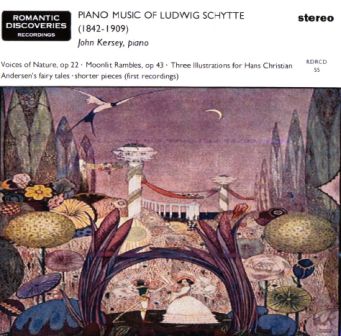
Piano music of Ludvig Schytte (1848-1909)
John Kersey, piano
RDR CD55
Total time: 78 mins 66 secs
Three Illustrations for Hans Christian Anderson’s fairy tales:
1. Elves on a Hill (2’19”) 2. The Nightingale (5’34”) 3. The Steadfast Tin Soldier (3’19”)
4. Poème lyrique, op 80 no 2 (5’36”)
Moonlit Rambles, op 43:
5. Moderato (2’55”) 6. Andantino (3’21”) 7. Allegro moderato (1’33”) 8. Moderato (2’28”) 9. Allegretto (2’57”) 10. Allegro molto (2’35”)
11. Valse-caprice, op 13 (5’16”)
12. Nocturne (3’03”)
Voices of Nature, op 22:
13. In the Woods (2’54”) 14. At the Gulf (2’28”) 15. To the Mountains (1’47”) 16. At the Lake (3’17”) 17. Down the River (2’59”) 18. On the Sea (2’21”) 19. Over the Steppe (2’16”)
20. Impromptu (2’41”)
Two Waltzes, op 102
21. Valse capriccietto (2’16”) 22. Valse noble (4’05”)
23. Barcarole from “Piazza del Popolo” – Little Italian Suite, op 110 no 3 (3’50”)
24. Polonaise from Ambroise Thomas’ “Mignon” (5’34”)
We are grateful to Dr. Klaus Tischendorf for supplying copies of scores for use in this recording.
Cover picture: Illustration for Hans Christian Andersen’s “Thumbelina” by Harry Clarke (1889-1931)
Notes on the music
Let us deal with the name first. In his native Danish it is Skütte, pronounced rather like the English “scooter”. In transliteration this became the German Schytte, with the hard “k” somehow mistakenly replaced with the soft “ch” and the final “e” pronounced, rather than elided as in English. “Scooter” may then be an unusual name for the English speaker, but it is devoid of the scatological connotations which denigrators of Schytte have not been slow to apply over the years – “aptly named” says one commentator seeking to do him down. As this disc will show, there is more to Schytte than this, and his neglect is unjustified.
Born in Aarhus, Schytte was a pupil of Gade and Neupert, before studying with Liszt in Germany in 1884. The intervening years had seen him qualify as a pharmacist to insure against the uncertainties of a musical career, but from 1886 he established himself as a teacher in Vienna, moving to Berlin for his final two years.
Schytte’s musical style shows a clear influence of Gade but also a wider European outlook in such works as the Piazza del Popolo suite and his isolated Nocturne. His writing for piano is notable for its command of texture and technique (a number of his works are didactic in nature) and it generally avoids the commonplace in favour of a subtle distinction of feeling and nuance.
Early works, such as the Valse-caprice, op 13, show Schytte the youthful virtuoso desirous of making an impression. As Schytte matured as a composer, a focus on melody and a lyrical, long-breathed style came to overtake effect for its own sake, and the set Voices of Nature, op 22, is notable for its concentration on the creation of character and for a number of well-thought-out melodic ideas presented attractively. The finale, Over the Steppe, achieved some popularity as an encore piece (included in the repertoire of Sophie Menter, in particular) and has a more pronounced etude-like character.
Schytte’s pieces inspired by the fairytales of Hans Christian Andersen show him at his imaginative best. Here he writes with delicacy and charm and preserves a formality that distinguishes his style from the more rhapsodic of his contemporaries, such as Grieg. For Schytte, clear structure is of importance, and ensures that his ideas do not outstay their welcome or become over-complex in their development.
As well as original music, Schytte also contributed to the literature of the virtuoso transcription. The comic opera “Mignon” by Ambroise Thomas enjoyed great popularity, with the thousandth performance taking place in 1894. Schytte sets the opera’s most famous moment – the Polonaise – in a style that shows that he had absorbed much from Liszt’s paraphrases. The themes are treated with considerable elaboration in the grand virtuoso style to produce an effective homage to the work.

 Romantic Discoveries Recordings
You must be logged in to post a comment.