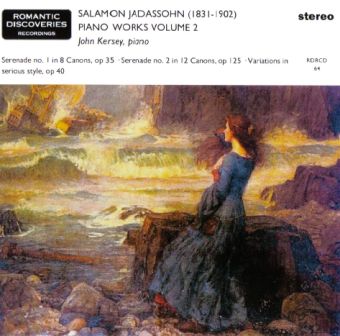
Piano music of Salomon Jadassohn (1831-1902) volume 2
John Kersey, piano
RDR CD64
Total time: 73 mins 54 secs
Serenade no. 1 in 8 Canons, op 35
1. Marsch (4’50”) 2. Adagio (4’24”) 3. Scherzo (2’31”) 4. Steyrisch (4’11”) 5. Intermezzo (1’19”) 6. Andantino (5’04”) 7. Minuetto (4’19”) 8. Finale (4’44”)
9. Variations in serious style upon an original theme, op 40 (17’30”)
Serenade no. 2 in E major in 12 Canons, op 125
1. Allegretto amabile (2’34”) 2. Andantino (2’02”) 3. Allegretto scherzando (1’48”) 4. Humoreske (1’19”) 5. Andante (1’18”) 6. Appassionato (2’11”) 7. Adagio (3’32”) 8. Capriccietto (2’00”) 9. Minuetto (2’46”) 10. Intermezzo (1’01”) 11. Allegretto grazioso (1’22”) 12. Allegretto di marcia (2’01”)
We are grateful to Dr. Klaus Tischendorf, Prof. Luca Chierici and Peter Cook for supplying copies of scores for use in this recording.
Notes on the music
According to Jadassohn scholar Klaus-Peter Koch, there are two major reasons why the music of Salomon Jadassohn is not better known today. One is that, as a Jew, he was a victim of the anti-Semitism of Wilhelmine Germany, in which critics labelled his music as academic and dry, and the other is that he was overshadowed by his colleague at the Leipzig Conservatoire, Carl Reinecke.
As this recording hopefully shows, Jadassohn was far from dry, instead being a composer of melodic felicity and great harmonic imagination, with his unexpected use of chords at times drawing parallels with Alkan and Jadassohn’s own pupil Busoni. There are around 140 works in total, written for every medium from symphonic works to lieder and characteristic pieces for the piano.
Jadassohn studied with Moritz Hauptmann and Moscheles at the Leipzig Conservatoire and also for three years (1849-51) with Liszt in Weimar. He admired the music of Liszt and Wagner greatly. In 1893 he was awarded a professorship at the Leipzig Conservatoire, a post which he held until his death. His pupils included Grieg (some of whose Lyric Pieces show a Jadassohn influence), Busoni, Delius and Karg-Elert. He was considered a master of counterpoint.
Jadassohn’s works vary in form and tone from broadly Schumannesque tone-pictures to more ambitious extended works, and to some extent this disc showcases both of these aspects of his creative personality.
We are used to meeting masters of the fugue form among post-Beethovenian Romantics, but there are few (with the exception of Schumann) who turned their hand to the complexities of canon form.
Jadassohn’s two Serenades are examples of his inventiveness and consummate craft. Collections of canons might appear to the outsider to be merely dry, academic exercises, but with Jadassohn the truth is more complex. Jadassohn sees in canon form a key to the creation of effective designs that work almost like an elaborate aural and visual puzzle as lines intertwine, self-reference and mirror each other. The effect is music that can be appreciated on several levels at the same time; firstly as attractive melodic material often full of life, and secondly as a quasi-architectural accomplishment satisfying to the intellect and fully deserving of the phrase “compositional virtuosity”. Many of the pieces have the appealing quality of Beethoven’s Bagatelles, treating a novel motif or phrase in a way that transcends its apparent limitations, but with the additional rigour imposed by the canonic form. For Jadassohn, what would in other hands become a straitjacket becomes a challenge to be surmounted, and if anything his second Serenade achieves an even greater liberation and subtlety than the first.
The Variations in serious style, op 40, see Jadassohn in serious mode, treating a theme of his own composition that is dark and harmonically rich, lying some way between Schumann and Brahms. This work shows Jadassohn’s abilities within an extended structure requiring both overarching unity and variety between its constituent sections. There is a pleasing balance between passion and reflection, although as is usual with Jadassohn, formal clarity takes precedence ahead of more visceral concerns. The energetic figurations in the finale are a no-doubt conscious reminiscence of Mendelssohn’s Variations serieuses of some years earlier.

 Romantic Discoveries Recordings
You must be logged in to post a comment.