December 26, 2009 11:45 pm
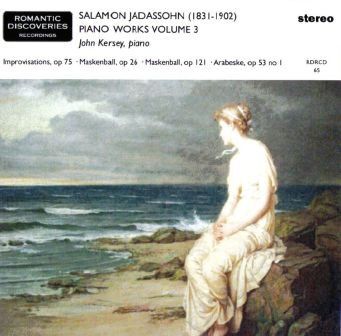
Piano music of Salomon Jadassohn (1831-1902) volume 3
John Kersey, piano
RDR CD65
Total time: 74 mins 12 secs
Maskenball (Masked ball): 7 Airs de Ballet, op 26:
1. Tempo di bolero (3’45”) 2. Allegretto un poco vivo (1’44”) 3. Andantino quasi Allegretto (2’47”) 4. Mouvement de valse (2’56”) 5. Tempo di mazurka (3’10”) 6. Allegro moderato (2’22”) 7. Molto Allegro agitato (3’00”)
Improvisations, op 75:
8. Bolero (5’07”) 9. Ländler (3’21”) 10. Zwiegespräch (Duologue) (3’57”) 11. Frühlingslied (Spring Song) (2’07”) 12. Bitte (Entreaty) (2’44”) 13. Capriccio (3’14”)
Maskenball: 7 Characterstücke, op 121
14. Entrata (4’15”) 15. Arlecchino (4’34”) 16. Intermezzo (1’24”) 17. Promenade (4’00”) 18. Divertimento (6’52”) 19. Siciliana (1’52”) 20. Finale (4’12”)
21. Arabeske, op 53 no 1 (reconstruction by John Kersey) (5’40”)
We are grateful to Dr. Klaus Tischendorf, Prof. Luca Chierici and Peter Cook for supplying copies of scores for use in this recording.
Notes on the music
According to Jadassohn scholar Klaus-Peter Koch, there are two major reasons why the music of Salomon Jadassohn is not better known today. One is that, as a Jew, he was a victim of the anti-Semitism of Wilhelmine Germany, in which critics labelled his music as academic and dry, and the other is that he was overshadowed by his colleague at the Leipzig Conservatoire, Carl Reinecke.
As this recording hopefully shows, Jadassohn was far from dry, instead being a composer of melodic felicity and great harmonic imagination, with his unexpected use of chords at times drawing parallels with Alkan and Jadassohn’s own pupil Busoni. There are around 140 works in total, written for every medium from symphonic works to lieder and characteristic pieces for the piano.
Jadassohn studied with Moritz Hauptmann and Moscheles at the Leipzig Conservatoire and also for three years (1849-51) with Liszt in Weimar. He admired the music of Liszt and Wagner greatly. In 1893 he was awarded a professorship at the Leipzig Conservatoire, a post which he held until his death. His pupils included Grieg (some of whose Lyric Pieces show a Jadassohn influence), Busoni, Delius and Karg-Elert. He was considered a master of counterpoint.
Jadassohn’s works vary in form and tone from broadly Schumannesque tone-pictures to more ambitious extended works. This disc focusses on the former style, with his two Masked Ball sets paired with the mid-period Improvisations
The depiction of the masked ball in music has a noble antecedent in Schumann’s Carnaval, and Jadassohn’s essays in this form show this influence clearly, particularly in the op 121 set with its reference to Arlecchino of commedia dell’arte fame. The op 26 set begins boldly with a Bolero, one of the few dance forms that Schumann did not exploit to any extent, and already the lyrical quality of Jadassohn’s inspiration makes itself felt in a cantabile central section. Familiar dances such as the waltz and mazurka follow, but are placed alongside novelties such as the sixth piece, a study in rapid arpeggios that is both arresting and distinctive. The last piece is more mordant in tone than its predecessors; a darkly syncopated chase through a sometimes-aggressive minor tonality.
The set op 121 is explicitly marked as a successor to op 26, and its miniatures, now titled, are rather more extended and deeper than their predecessors. The emotive Divertimento is particularly notable, interrupted by rapid passagework in a way that is purely Schumannesque. Jadassohn’s finale also has something of the swagger of Schumann’s conclusory movements, although he is more concise in expression as well as more refined in his use of pianistic texture and effect.
Jadassohn’s Improvisations, op 75, are mature character-pieces forming an effectively varied set. The duologue that forms the third piece reminds us of Jadassohn’s particular prowess in canon form. Elsewhere, we are met by a composer whose understated style had reached a point of maturity and assurance, so that his works were at once capable of appreciation for their attractive melodic qualities and capable of satisfying on a deeper compositional level as supremely well-written works of their era.
The Arabeske is the first of three forming op. 53. The only score available for this recording is missing most of the recapitulatory section and so this has been reconstructed, assuming a literal repeat of the opening.
Posted by johnkersey
Categories: Catalogue
Tags:
Mobile Site | Full Site
Get a free blog at WordPress.com Theme: WordPress Mobile Edition by Alex King.