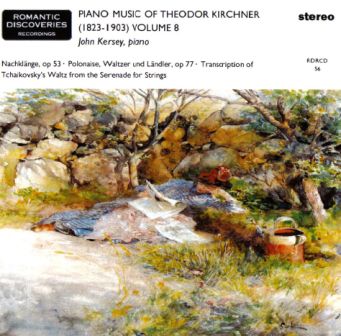
Piano music of Theodor Kirchner (1823-1903), volume 8
John Kersey, piano
RDR CD56
Total time: 70 mins 53 secs
Nachklänge, op 53:
1. Non troppo vivace (3’27”) 2. Poco lento (3’15”) 3. Animato (4’37”) 4. Andante (poco lento) (2’42”) 5. Kräftig, nicht zu schnell (5’46”) 6. Dolce animato (4’32”)
Polonaise, Walzer und Ländler, op 77
7. Im Polonaisen-Tempo (3’53”) 8. Comodo (2’27”) 9. Animato (3’22”) 10. Comodo (2’22”) 11. Comodo (2’07”) 12. Comodo (1’51”) 13. Animato (2’05”) 14. Allegretto (2’31”) 15. Comodo (1’21”) 16. Comodo (1’01”) 17. Allegretto (00’41”) 18. Comodo (1’16”) 19. Poco vivace (1’33”) 20. Comodo (00’51”) 21. Comodo (2’06”) 22. Poco Allegro (1’08”) 23. Poco lento (2’15”) 24. Poco vivace (2’15”) 25. Comodo (2’39”) 26. Allegro (2’46”)
27. Transcription of Tchaikovsky’s Waltz from the Serenade for Strings (4’32”)
We are grateful to Dr. Klaus Tischendorf for supplying copies of scores for use in this recording.
Notes on the music
Fürchtegott Theodor Kirchner, a pupil of Mendelssohn at the newly-founded Leipzig Conservatoire, composed over 1,000 original works for piano, most of which are sets of miniatures. Kirchner expert Dr. Klaus Tischendorf, who has kindly provided the scores for these recordings, has described Kirchner as “the piano miniaturist of the Romantic era”.
Kirchner was recommended by Mendelssohn for the post of organist of Winterthur in Switzerland in 1843, and remained there for the next twenty years. The position gave him the opportunity to travel throughout Germany, and there he came into contact with Brahms and the Schumanns (he had first met Robert Schumann aged fourteen), who recognised in him an arch-Romantic and kindred spirit. He appears to have had a brief affair with Clara Schumann in the 1860s.
In 1862, Kirchner became director of the subscription concerts in Zurich, but remained there for only three years before returning to freelance life. He was appointed court pianist at Meiningen in 1872 and became director of the conservatoire in Würzburg the following year. Again, he did not stay long, and in 1876 moved to Leipzig for seven years, before going on to Dresden, where he taught score-reading. The year 1890 was a climactic one for him, for he abandoned his wife and family and went to live in Hamburg, where he was looked after by a former pupil. Four years later he suffered the first of two strokes that left himparalysed, and began to go blind.
“In his character there is no stability” wrote Clara Schumann. Kirchner’s career suffered because of his addiction to gambling and an extravagant lifestyle that was beyond his means, and his musical friends had periodically to bail him out from financial ruin. In 1884 a group including Brahms, Grieg, Gade and von Bülow raised thirty thousand marks to help him pay off his gambling debts.
The art of Kirchner has been almost completely overlooked because his talent was expressed in miniature form, yet the age which determined Wagnerian bombast preferable to Mendelssohnian intimacy has passed by and enabled us to re-evaluate the miniaturist on something approaching his own terms rather than those of his artistic opponents. Viewed from any angle, Kirchner’s achievement is remarkable. One might expect his works to be commonplace and unexceptional because of his prolific nature, yet the opposite is the case. Kirchner is the master of intimate expression; of scale above all, because he knows how to manipulate the interior monologue to evoke fantasies that can turn from charm to poignancy to anguish in a mere moment.
To listen to Kirchner is to be drawn into a world whose parameters may at first seem strange. Sometimes we have less than a minute to get our bearings, and a casual listener may miss the nuance that becomes second nature to the Kirchner initiate. Kirchner’s language is rich and diverse; it is full both of self-references and echoes of others; here of Schumann, or of Mendelssohn, or (particularly in op 77) of Schubert. Like his successor Webern, the music is distilled and represents concentration as well as economy: Kirchner does not waste notes or strive for effect at the expense of substance. What he offers is a continual engagement with one of the greatest problems for a creative artist; the capture of the elusive moment – of an overheard voice, a perfume, a half-glimpsed scene – rather as would be addressed in very different ways by Fauré and Debussy in due course. Kirchner’s world is not public and external – rather it is like browsing through a confessional and intimate diary (indeed diaries and sketchbooks were to feature in several of his compositions). In an age that fears intimacy, Kirchner is a challenge indeed.
Often with Kirchner it is the most outwardly ordinary and unassuming of titles that hide the most interesting music. Kirchner hardly whets the appetite with the drily descriptive “Polonaise, Walzer und Ländler”, but within is an intriguing set that continues a form that fascinated Schubert – the set of contrasting, not-quite-interlinking but nevertheless emotionally and sometimes motivically connected waltzes or ländler – which would eventually produce such grand offerings as Jensen’s Ländler aus Berchtesgaden (available on RDR CD 48) and Ravel’s knowing homage Valses Nobles et Sentimentales. Kirchner’s waltzes are stylised even beyond the examples of Schubert and Chopin, with any strain of rustic populism viewed (as so often in his music) as if at a remove of some distance. Some, indeed, are the perfect personification of introversion in music, seeming as if to listen too closely would result in their wholesale disappearance into the ether. Others are more boisterous, playing with their intertwined material as if caught up in the compositional equivalent of a crossword solution.
Kirchner’s Echoes, op 53, are somewhat more extended tone-pictures, and if Schumann is called to mind in the obsessive dotted rhythm of the first piece and the steadfast Davids-band procession of the fifth, this is probably entirely intentional. So often with Kirchner it is the central sections of pieces that are used for the opening of the emotional heart of the work, and so it is with these works. The sixth, however, is pure Kirchner, an exquisite piece based on a motif that is disarming in its simplicity but stays in the mind long after its last notes have died away.

 Romantic Discoveries Recordings
You must be logged in to post a comment.