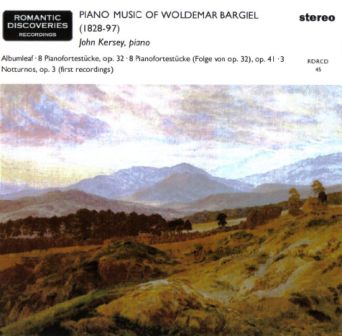
 Piano music of Woldemar Bargiel (1828-97)
John Kersey, piano
RDR CD45
Total time: 75 mins 58 secs
Albumleaf in B flat major (1’23”)
Acht Pianofortestücke, op 32
1. Allegro con grazia (1’47”) 2. Andante con moto (5’43”) 3. Presto (2’37”) 4. Lento (6’15”) 5. Allegretto, un poco Allegro (1’49”) 6. Allegro commodo (1’53”) 7. Andante sostenuto (5’53”) 8. Con moto grazioso (2’25”)
Drei Notturnos, op 3
1. Allegretto (8’38”) 2. Andante (2’39”) 3. Andante (7’40”)
Acht Pianofortestücke (Folge von op. 32), op 41
1. Tempo di Menuetto (2’03”) 2. Allegro, non troppo (2’11”) 3. Andante, molto cantabile (3’11”) 4. Con grazia (1’40”) 5. Con moto (5’12”) 6. Presto e leggierissimo (1’46”) 7. Andante (5’59”) 8. Allegro molto (3’46”)
We are grateful to Dr. Klaus Tischendorf for supplying copies of scores for use in this recording.
Woldemar Bargiel was not a prolific composer, but his works deserve greater attention than the almost complete neglect they fell into in the years immediately following his death. Similarly, if he is known at all these days, it is as the half-brother of Clara Schumann (as a result of her mother’s second marriage to music teacher Adolf Bargiel), with the implication that not only was the success of his career due to this connexion (which was undoubtedly the case) but also that such reputation that he enjoyed was merely the result of this nepotism (which was certainly not so).
Bargiel studied under Moscheles, Hauptmann, Rietz and Gade at the Leipzig Conservatoire (being noted among the younger generation in Schumann’s Neue Bahnen in 1853) and from 1859 took up a teaching position as a theorist at the conservatoire in Köln. 1866 saw him move to Rotterdam where he concentrated on conducting and musical direction, and 1874 (at the invitation of Joachim) back to Berlin (where he had taught privately throughout the 1850s) as professor of composition at the Royal Hochschule. He attained the peak of professional recognition as a senator of the Akademie der Künste, teaching up until his death at the age of sixty-nine.
Bargiel’s well-crafted and distinctive music enjoyed wide popularity during his lifetime. As well as piano music, he wrote a number of chamber works, songs, and orchestral pieces. His Notturnos date from 1853 and show a command of the Gothic style he had inherited from Schumann, but in the first, particularly, adding a rhetorical element that creates an individual impression. This, however, was not to be a major feature of his later works, and in the major piano sets opp. 32 and 41 he looks to Brahms and Mendelssohn for inspiration.
The set op 32, dating from November 1865, is ambitious in its uniting of diverse moods and textures. Beginning with the Mendelssohnian no. 1 (Allegro con grazia), the second piece (Andante con moto) recalls the funeral marches of both Beethoven and Schumann (in the Piano Quintet). Bargiel’s economy of texture in the initial section is notable. This is followed by an energetic Presto perpetuum mobile that keeps the hands desynchronised throughout. Such activity is followed by the Schubertian D minor Lento (no. 4) which surely has the slow movement of the B flat major sonata (D.960) in mind for its initial rhythmic idea. The central material expands in texture in a more Schumannesque style. The piece that follows might have been termed by Brahms Intermezzo; it treats a scalic idea strongly reminiscent of him. This is succeeded by the brief and flowing Allegro commodo (no. 6), republished on its own as “Pensee fugitive”. The penultimate piece of the set, an Andante sostenuto marked molto espressivo e cantabile is typical of Bargiel’s musical language, moving from the declamatory opening melody into a more ardent E minor central section. The cycle ends with a landler-like movement in D minor that plays to some extent with interior voice effects.
Following in August 1877, the cycle op. 41 was designated a successor to op. 32 and expands those pieces with a number that explore more extrovert textures. Beginning with a grand minuet with plentiful octave scoring, the second piece (Allegro, non troppo) is full of fire and determination, packing a good deal of development into its compact form, and demonstrating an able command of Brahmsian virtuoso effect. Its octaves and chords are replaced by the calm Andante, molto cantabile (no. 3) which has the effect of quartet writing. Although folk music is not a major influence on Bargiel’s style, the fourth piece has a rustic feel to it and foreshadows Dvorak’s Slavonic Dances. Bargiel then gives us an extended scena in the following Con moto, whose passionate central section alternates octave and chordal writing with a Schubertian chromatic tremolo in double-notes. Such seriousness needs pause, and this is provided by the Mendelssohnian Presto e leggierissimo, demanding staccato effects achieved through a haze of pedal and occasionally emerging in clarity. The seventh piece is a C minor Andante that would be worthy of any sonata slow movement; its triplet central section is fused with the opening melody on its return. The finale, although not developed to any great extent, is a bright and fast-moving rondo with plenty of personality and an emphatic conclusion.
The short and charming Albumleaf dates from November 1871 and provides an effective summation of Bargiel’s best qualities of melodic invention and textural command.

 Romantic Discoveries Recordings
You must be logged in to post a comment.