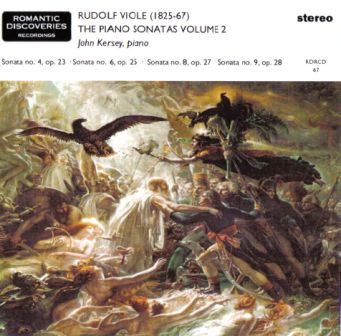
Rudolf Viole (1825-67): The Piano Sonatas vol. 2
John Kersey, piano
RDR CD67
Total time: 75 mins 41 secs
Sonata no. 4 in F major, op 23 (dedicated to Franz Brendel):
1. Allegretto con moto (7’00”)
2. Moderato giusto (6’59”)
3. Presto agitato (3’56”)
Sonata no. 6 in B minor, op. 25 (dedicated to Carl Tausig):
4. Romanze – Andantino cantabile (3’12”)
5. Intermezzo – Allegro scherzando – Trio (5’33”)
6. Allegro appassionato (11’50”)
Sonata no. 8 in E major, op. 27 (dedicated to Dionys Pruckner):
7. Allegro (15’20”)
8. Romanze – Andantino con moto (4’05”)
9. Presto (5’23”)
8. Sonata no. 9 in F minor, op 28 (dedicated to Richard Wagner) (11’51”)
We are grateful to Peter Cook for supplying copies of scores for use in this recording.
Notes on the music
(continued from volume 1)
Where the Third Sonata had begun with determined objectivity, treating its first subject as if it were early Beethoven, its concluding perpetuum mobile surely represented a ne plus ultra of obsessive triplet-figuration finales for Viole. How to follow something so seemingly final? Well, the Fourth Sonata begins with an enigmatic but insistent figure over a pedal point, at once establishing harmonic instability and making it clear that we have moved forward in our stylistic purview to a definite Romanticism. Changing figurations, but not interrupting the constant movement of quavers, Viole introduces dolorous scalic cantilenas that will provide the main motivic material of the exposition, contrasting this with mini-episodes of staccato accompaniment and melody. Later on, the texture will expand to positively symphonic proportions with angular octaves followed by the return of the pedal point in a tense tremolando. As will become common with Viole, development is more or less integrated within the exposition and recapitulation.
Viole’s issues with slow movements have already been noted. Here there is no slow movement at all, but in fact a very similarly paced foil for the opening, marked Moderato giusto. This odd movement is built around a similar legato figuration to that seen previously, and indeed it feels like a continuation of that movement’s development, such is the thematic kinship.
The movement eventually develops into a dramatic virtuoso peroration, decorating the melody with rapid arpeggios, octaves and chords, before quickly dying away into nothing. Then Viole returns to the compound-time triplet finale of which he had shown such mastery in the Third Sonata. This time there is an added twist, for the main theme of the first movement swiftly returns in the new movement’s figuration, to be followed by allusions to previous motifs within more developmental episodes. Again, the perpetual motion rarely lets up, even if the Germanic formality of the motivic style adopted rather dispels otherwise-tempting comparisons with Chopin’s finale from op 58, for example. On paper, this is a long movement, and even though its Presto pace means that it passes by quickly, it remains packed with ideas and events so that it acquires a greater emphasis in the overall structure than is usual for a finale. A rather Brahmsian figuration introduces a coda replete with virtuoso double octaves and increasing in pace to the concluding prestissimo bars.
After the dramatically unified Fifth Sonata, Viole’s Sixth appears more conventional, and indeed evokes the approach of Schumann, Hiller and Mendelssohn to that form. Beginning with a short Romanze that resembles a Mendelssohnian Song without Words both in its cantilena style and brevity of treatment, this leads after just two pages into a scherzo-like Intermezzo. Here we are reminded of both Mendelssohn, and of Schumann’s scherzino from op. 26. The trio is more exploratory and introduces material of greater emotional depth and harmonic richness.
In the Fourth, the import of the work had been more equally shared with the finale than is usual; in the Sixth that feature is exaggerated, with the finale being the only developed movement and encompassing a full dramatic argument. This movement recalls Heller’s Second Sonata (also available on RDR) with which it shares a key and much else stylistically. Based on two motifs, the second of which gives rise to variants in both dotted and triplet rhythms, the texture and material are varied to a greater extent than hitherto. The writing at times approaches the Lisztian orchestral style that had been suggested in the Fifth, but throughout with a feeling of formal restraint. An interesting passage based on shifting pedal points and leading to a chromatic descent is somewhat reminiscent of Alkan. Yet the work does not end in this energetic mood, but with a quiet, still coda that, like Liszt’s Sonata, suggests significant major/minor ambiguity.
The Eighth Sonata steps beyond Mendelssohn’s world and can, at least in its first movement, be seen as a response to the first movement of Chopin’s op. 58 in its embracing of the rhapsodic style. Here the concentration is much more on cantabile than hitherto, with the mood one of greater emotional warmth and informality of approach. The varied textures noted in the Sixth are prominent here within a grand design that stretches out over a fifteen-minute span. Both the exposition and recapitulation codas end with restrained chordal passagework marked cantabile religioso – a fitting contrast to the activity that had preceded them.
Just as the Fourth had followed a first movement with one that is very similar in mood and tempo, so Viole’s central Romanze in the Eighth does not break the spell, but sees it from a different perspective, here from the tonic minor. The form is ternary, but with variation of the melody taking the place of significant development (another Chopinesque feature). Where the first movement had mostly concentrated on intensity, this movement is relatively simple and direct by comparison.
No such simplicity attends the finale, a complex and extremely demanding fugato whose subject plays with the alternation between major and minor in a forward-looking way. The movement can be seen as a study in double-notes; not merely the commonly-found sixths and thirds, but chains of fourths and diminished fifths abound. A maestoso central episode in the remote key of E flat major presents the subject in a chordal guise, before the opening material returns and leads to an expanded coda. Despite its ambiguity, the movement concludes triumphantly in the major.
The Ninth Sonata is dedicated to Wagner, and something of that composer’s style can be felt in the mood and execution of the piece. The work begins with a dramatic cadenza in martellato double octaves guaranteed to daunt all but the hardiest virtuosi (the infamous transition passage in Liszt’s Sonata is probably a model for this). Then we begin the movement proper, with the central theme treated under extended triplets which do not loose their grasp until the second cadenza. The succeeding Allegretto con moto, which follows without a break, is again concerned with treating the theme against triplets, but this time more developmentally, leading to a memorable chordal climax against a series of pedal points. After a return to the initial texture, Viole treats the theme in octaves against sweeping arpeggios in the manner of Liszt, leading to a third cadenza and the recapitulation of the opening theme, treated fully and with plenty of allusions to the previous textural explorations. A dramatic succession of trills and tremolandi leads to the final explosion of arpeggios.

 Romantic Discoveries Recordings
You must be logged in to post a comment.