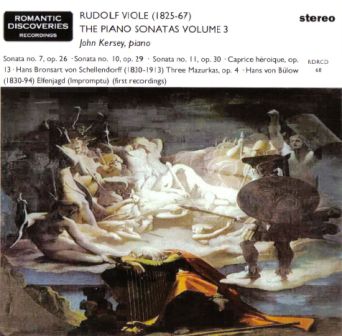
Rudolf Viole (1825-67): The Piano Sonatas vol. 3
John Kersey, piano
RDR CD68
Total time: 77 mins 50 secs
Sonata no. 7 in D minor, op 26 (dedicated to L.A. Zellner):
1. Allegretto (9’53”)
2. Andantino grazioso, Allegro scherzando (7’03”)
Sonata no. 10 in F sharp minor, op. 29 (without dedication):
3. Allegretto (10’00”)
4. Andantino (4’01”)
5. Allegro agitato molto (5’48”)
6. Sonata no. 11 in E flat major, op. 27 (dedicated to Franz Liszt):
Allegro affrettando – Maestoso – Allegro con agilita – Moderato recitativo – Allegro (12’25”)
7. Caprice héroique, op 13 (5’57”)
Bronsart: Three Mazurkas, op 4
8. Allegretto capriccioso (3’02”)
9. Moderato (5’10”)
10. Allegro ma non troppo (6’39”)
11. Bülow: Elfenjagd: Impromptu (7’17”)
We are grateful to Dr Klaus Tischendorf and Peter Cook for supplying copies of scores for use in this recording.
Notes on the music
(continued from volume 2)
The Seventh Sonata, not unlike Beethoven’s op. 54, represents a hiatus between the fully worked-out dramas of the Sixth and Eighth Sonatas and a return to a smaller canvas. There are passages here that suggest a simple rusticity, particularly in the finale, but overall the harmonic cast is definitely of Viole’s mature period. Much in the opening movement suggests an extended meditation and, as would be made most clear in the Eighth, the rhapsodic element starts to come to the fore in passages that are openly exploratory. The lack of variety in the movement (again an issue that would be addressed in the Eighth) contributes to a somewhat dour impression overall, but equally is representative to the quality of obsessive concentration that distinguishes Viole’s style from that of his contemporaries.
The second movement has something of the feeling of a minuet; its development is brief and like other Viole central movements it feels terse and somewhat odd. It soon leads into the finale, which is based on the opening theme of the work, but now develops that theme with the aid of a rhapsodic episode and an extended coda.
If the free fantasia, song and dance structure of the Seventh did little to suggest the expansiveness of the Eighth or the intense drama of the Ninth, the Tenth is surely one of Viole’s finest mature compositions. The mood of the opening is tragic and meditative, beginning with a left hand recitative and developing into an agitated cantilena that introduces a development of considerable complexity. This long movement subsides directly into an Andantino that is among the most melodic and effectively contrasted of Viole’s slow movements. After this, the exciting finale is all high drama, with massive octave passages transcending Viole’s often reticent-seeming approach to attain a genuinely orchestral virtuosity.
This vehemence carries through to the opening of the Eleventh and final sonata, whose initial march makes clear the strangeness of much of Viole’s harmonic writing in this work. Everything here is more condensed than previously, and sometimes this leads to passagework of baffling harmonic obscurity – the emergence of a B minor triad ex nihilo in this first section is a prime example of a forward-looking approach here that mostly comes off successfully. A light intermezzo marked “with agility” provides a contrast in mood before a cadenza brings us to a finale with a triumphant hunt-like motif.
Viole’s cycle of sonatas is a notable achievement, but one so strongly marked by an individual personality that it must have evoked love/hate responses even at the time. What is beyond doubt is that Viole was possessed of an extraordinary intellectual ability and also a stylistic grasp that is remarkable. Just as he and his contemporaries saw their music as representing a progression from that of earlier eras, so Viole demonstrates aspects of that progression in his Sonatas, but throughout remaining resolutely his own man. Where few of those contemporaries were drawn to the sonata format to any great extent, Viole made it his own, showing how its issues could be addressed in a way that even now retains the capacity to surprise.
As a codicil, the Caprice héroique, dedicated to “his friend, Hans von Bronsart”, is a good example of Viole in more overtly virtuosic mode. Built on a leaping figure in the left hand, it is an etude in strength and stamina.
Bronsart himself is represented by three forward-looking Mazurkas published as his op 4. He met Liszt in Weimar in 1853 and also came to know Berlioz and Brahms at that time. Such was the esteem he was held in by Liszt that he was chosen to play the solo part in the first performance of Liszt’s Second Piano Concerto, with the composer conducting, and was subsequently the dedicatee of the work. Bronsart’s main career was as a conductor and as general manager of the theatres of Hanover (1867-87) and Weimar (1887-95). His wife, Ingeborg Lena Starck, was also a composer.
Both Liszt and Bülow admired Bronsart’s compositions, Bülow describing his piano concerto as the “most significant one of the so-called Weimar school”. His Mazurkas are not particularly Chopinesque, instead looking forward with hints of Szymanowski and even Scriabin’s development of the form. The harmony again begins to escape the salon and engage directly with the modality of the folk idiom.
Bülow’s compositions are today less well-known than his work as pianist, conductor and editor. As expected, they show a strong Wagnerian influence, but also some degree of Lisztian treatment of the piano. Elfenjagd is an attractive impromptu that could be considered a spiritual companion-piece to Liszt’s Gnomenreigen. If Bülow’s gift is not notably for memorable melodic ideas, then at least their artful and pianistically varied treatment compensates to some extent.

 Romantic Discoveries Recordings
You must be logged in to post a comment.