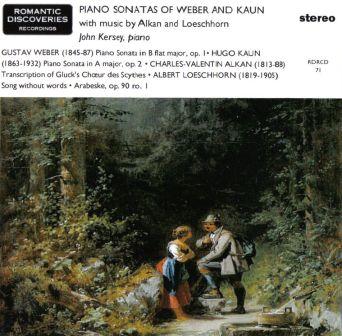
 Piano Sonatas by Gustav Weber and Hugo Kaun
John Kersey, piano
RDR CD71
Total time: 66 mins 48 secs
Gustav Weber (1845-87)
Piano Sonata in B flat major, op. 1
1. Allegro (12’16”)
2. Scherzo: Presto (6’55”)
3. Andante espressivo (7’16”)
4. Allegro vivace (6’53”)
Hugo Kaun (1863-1932)
Piano Sonata in A major, op. 2
5. Allegro moderato (8’31”)
6. Andante espressivo (6’12”)
7. Intermezzo: Presto (2’34”)
8. Rondo: Allegretto grazioso (6’04”)
Charles-Valentin Alkan (1813-88)
9. Transcription of the Chœur des Scythes from Gluck’s “Iphigenia in Tauris” (5’38”)
Albert Loeschhorn (1819-1905)
10. Song without words (2’48”)
11. Arabeske, op. 90 no. 1 (1’26”)
We are grateful to Peter Cook for supplying copies of scores for use in this recording.
Notes on the music
We know little of Gustav Weber’s life other than that his lack of posthumous recognition is likely the result of his premature death aged forty-one. Born in Switzerland, he studied at the Leipzig Conservatoire and became a professional organist and conductor as well as a composer. Much of his career was spent as a teacher of singing in the Zurich public schools, and towards the end of his life he became editor of the Zurich journal Schweizerische Musikzeitung. Of his piano trio, op 5, Liszt, who was the dedicatee, wrote in 1882 that “I consider [it] an eminent work, worthy of recommendation and performance.”
The Piano Sonata op. 1 is in the grandest of styles, and occupies a similar coming-of-age role in Weber’s output to the early sonatas of Brahms. It is clear that Weber had absorbed elements of the “orchestral” piano style, with many passages featuring massive chords and double octave figurations. His melodic material recalls previous B flat Sonata monuments such as the opp. 106 by both Beethoven, and more particularly, Mendelssohn. Throughout the four movements a high level of invention and creativity is sustained, with the return of the opening motif at the end of the finale marking a satisfying cyclical aspect to the work. This sonata could well be revived in concert to good effect.
The work of Weber and Kaun is linked by a now-forgotten fellow student at the Leipzig Conservatoire and later pupil of Tausig and Liszt, Robert Freund (1852-1936), who was to become the first piano professor of the Zurich Musikschule and championed both Weber and Kaun in recital. Perhaps his extensive capabilities were an influence on their virtuosic piano writing.
By the side of Weber’s monumental work, the early Sonata by Hugo Kaun is more obviously lyrical and inward in intent. Kaun was born in Berlin and studied piano there with Oscar Raif. Around 1886, he left Germany for the United States, where he settled in Milwaukee. Here he taught at the conservatory and conducted local choirs, but was prevented from following a career as a pianist by a hand injury. Perhaps feeling the pull of his homeland, he returned to Germany at the turn of the twentieth-century and remained there for the rest of his life. He was appointed to the Prussian Academy of Arts in 1912 and in 1922 joined the staff of the Berlin Conservatoire.
Kaun’s works span all the major genres, and generally occupy a neo-Wagnerian niche that opposed the modernism of the post-First World War years. His piano concerto was dedicated to his friend Godowsky. Some of his works, particularly those for male choir, have a nationalist quality. The Piano Sonata op. 2 is a reflective, expansive work that epitomises the confident late Romantic style with a notable debt to Beethoven in its formal structure and sensitive use of texture.
Alkan’s works are generally well represented on disc today, but his transcriptions remain neglected. This is the first recording of an unusual choice of his – the Chorus of the Scythians from Act 1 of “Iphigenia in Tauris” by Gluck. The Scythians tell of having found two young Greeks shipwrecked; they demand their blood. Alkan renders the music in his customary fashion, interpolating considerable pianistic difficulties that are not immediately obvious to the listener but are all-too apparent to the performer.
Carl Albert Loeschhorn taught at Berlin from 1851 and was appointed Royal Professor of Piano in 1858. Best-known as a teacher, he also appeared often in chamber music and composed in both longer and shorter forms for piano and chamber groups. The two works here show him at his best in two lyrical encore pieces.

 Romantic Discoveries Recordings
You must be logged in to post a comment.