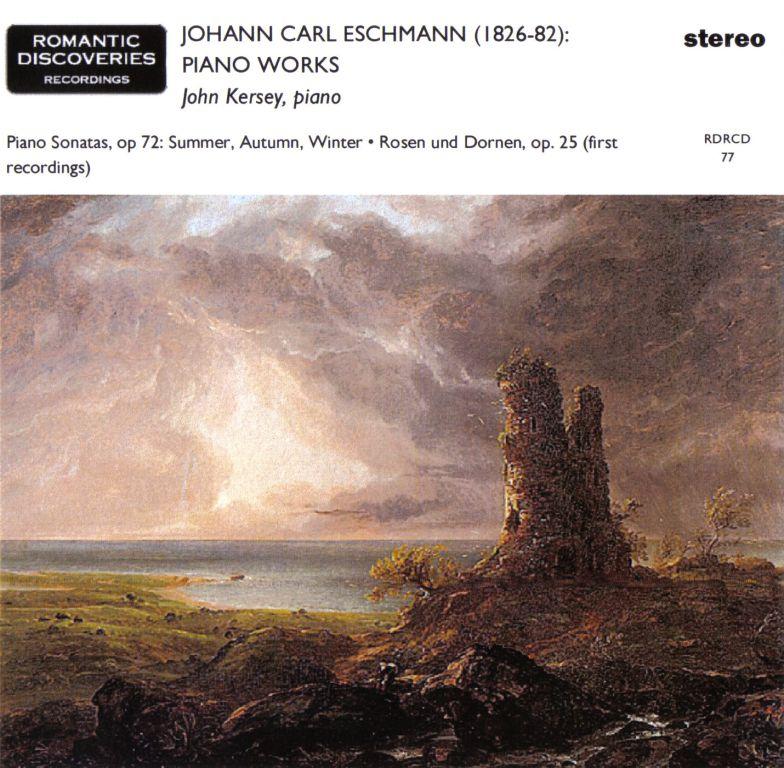
 Johann Carl Eschmann (1826-82): Piano Works
John Kersey, piano
RDR CD77
Total time: 64 minutes 5 seconds
Piano Sonata op 72 no 3 “Summer”
1. Allegro moderato, giocoso (6’37”) 2. Andante sostenuto – Scherzo, non troppo presto, leggiero – Tempo di Andante sostenuto (5’35”) 3. Allegro non troppo (6’28”)
Rosen und Dornen (Roses and thorns), op 25
4. Sanft träumerisch, nicht schnell (2’08”) 5. Presto (00’56”) 6. Allegretto, grazioso (2’48”) 7. Sehr rasch, feurig (1’00”) 8. Polonaisen-Tempo: Fröhlich (1’37”) 9. Sehr rasch, unruhig (1’52”) 10. Ziemlich langsam, ausdrucksvoll (2’55”) 11. Rasch, flüchtig (1’11”) 12. Allegretto grazioso (1’46”)
Piano Sonata op 72 no 4 “Autumn (The Hunt)”
13. Allegro vivace, non troppo presto (3’51”) 14. Abseits: Andante con moto (5’34”) 15. Abends in der Herberge (Allegro vivace) (6’27”)
Piano Sonata op 72 no 1 “Winter”
16. Allegro moderato, risoluto (6’59”) 17. Allegretto scherzando e grazioso (1’50”) 18. Allegretto risoluto (4’17”)
Our thanks to Dr Klaus Tischendorf and Peter Cook for supplying scores of these rare works.
Notes on the music:
The Swiss composer Johann Carl Eschmann was born to a family of musicians in Zurich. He studied at the Leipzig Conservatoire between 1847 and 1849 with Mendelssohn, Moscheles and Gade, and thereafter pursued a career as composer and teacher initially in Kassel. From 1850-59 he taught in Winterthur but found competition with his friend Theodor Kirchner difficult, and between 1859-66 based himself in Schaffhausen. The latter year saw him return to Zurich where he spent the remainder of his days.
In 1871, Eschmann published his “Wegweiser durch die Klavierliteratur”, a graded survey of the piano repertoire suitable for teachers. This was republished in several editions, but by the tenth edition in 1925, Eschmann’s name as compiler and reference to all except his most basic didactic works had been entirely removed.
Eschmann was a reasonably prolific composer of piano and chamber music. His style is firmly in the mould of Mendelssohn and Schumann, and is concerned primarily with the expression of character and mood within well-defined structures. At the same time, some of his earlier works are more experimental and more technically varied that this would suggest, with some exploration of cyclical forms. The conjoined Andante and Scherzo in the Summer Sonata on this disc is one example of this tendency.
Eschmann knew Richard Wagner, and indeed Wagner referred to him on one occasion as a friend. There is a suggestion that Eschmann may have been involved in the first performance of the “Wesendonk-Lieder” and a copy of one of these songs exists with a dedication from Wagner to him. In his work “Richard Wagner’s Zurich: the muse of place”, Chris Walton suggests that Eschmann’s song “Mittags” may have provided Wagner with one of the themes from “Das Rheingold” (pp 141-148). Walton also provides much further information on Eschmann’s work. In July 1853, Liszt invited Eschmann and Kirchner to meet him at Wagner’s apartment and presumably to bring their latest compositions; unfortunately no details of the meeting have been recorded.
Later on, however, Eschmann developed an affinity with Brahms and became sharply critical of Wagner in his “100 Aphorisms” (1878). His output tended to become more conservative after his earlier works, and by and large he was content to compose within established boundaries rather than seeking to innovate, with many of his later piano pieces intended for pupils.
The cycle of four sonatas inspired by the seasons seems to have been written with able women pianists in mind, for although they contain some demanding passages, they carefully avoid the use of passages in octaves. Such music was a requirement of the period, since many women attained a high standard of piano playing while being unable to pursue a public concert career. Rather like Czerny before him, Eschmann writes in such a way as to make technical points while maintaining musical interest; the sonatas are attractive and confident in their compositional approach, with plenty of melodic inspiration and a lively spirit throughout.
The set of “Rosen und Dornen” is a cycle of miniature studies of the kind that Kirchner would make his own. Here, in works that are at times aphoristic, one might at times be listening to Schumann. The cycle is attractively varied and the beautiful cantabile melody of the seventh piece is particularly notable.

 Romantic Discoveries Recordings
You must be logged in to post a comment.