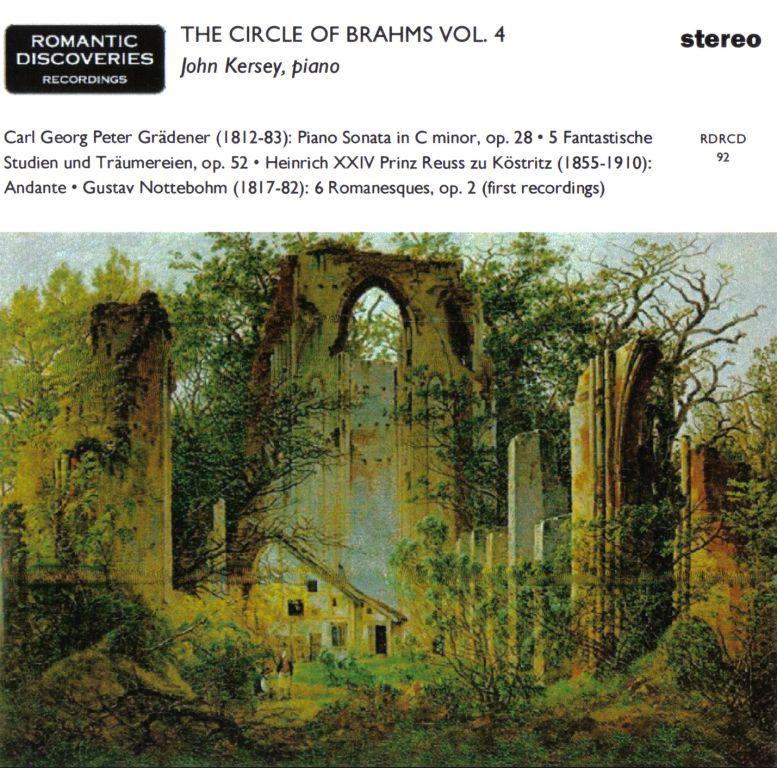
 The Circle of Brahms, vol. 4
John Kersey, piano
RDR CD92
Total time: 70 minutes 35 seconds
Carl Georg Peter Grädener (1812-83): Piano Sonata in C minor, op. 28
1. Allegro molto e con brio (8’15”) 2. Grave assai lento (8’24”) 3. Scherzo finale molto vivace (7’21”)
Heinrich XXIV Prinz Reuss zu Köstritz (1855-1910)
4. Andante (5’01”)
Grädener: Fantastische Studien und Träumereien, op. 52, vol. 1
5. „Immer zu immer zu/Ohne Rast noch Ruh!” (3’52”) 6. Beschaulichkeit (2’58”) 7. Jüngling und Mädchen (3’35”) 8. Kampf, Entsagung, Kampf (4’06”) 9. Resignation (9’21”)
Gustav Nottebohm (1817-82): Six Romanesques, op. 2
10. Andantino (2’41”) 11. Allegro poco agitato (1’08”) 12. Andante cantabile (5’34”) 13. Allegro grazioso (2’00”) 14. Allegro (2’30”) 15. Allegro brioso (3’38”)
Our thanks to Dr Klaus Tischendorf and Peter Cook for supplying scores of these rare works.
Carl Grädener was born in Rostock and spent ten years as a cellist in Helsinki. He was then director of music at the Kiel Conservatoire for ten years, later teaching at the Vienna and Hamburg Conservatoires. His compositions include operas, symphonies and other large-scale works, as well as miniatures for piano and songs. His son Hermann also became a composer. His piano sonata op. 28 is a large-scale and ambitious work that has stylistic parallels with Brahms’ own early essays in the genre. Like Brahms, Grädener’s writing is tightly worked-out and highly pianistic, with a good deal of writing in double octaves and other virtuoso figurations. By contrast, the central slow movement is introverted and, while continuing the overall seriousness of the work, introduces a lyrical element that is otherwise absent. Grädener’s combination of scherzo and finale is an interesting innovation whose stormy character is fully in keeping with the Romanticism of his age without neglect of the essential backbone of Classical form.
Grädener’s first book of Fantastische Studien und Träumereien shows him to have been an effective scene-painter tending particularly towards the intense and dramatic, as in the first and fourth pieces. However, there is contrast here and the second piece, Beschaulichkeit (or Tranquillity) is full of bluff good humour of a slightly boisterous kind. The last of these studies, headed Resignation, is the most extended, with an agitated middle section leading to a long passage of repeated figuration for the left hand.
Martin Gustav Nottebohm is probably best known for his studies of Beethoven’s sketchbooks, but was also well regarded as a composer. After studies in Leipzig, where he met Mendelssohn and Schumann, he settled in Vienna in 1846. His first meeting with Brahms was in 1862 and the two men became close friends, with Brahms caring for Nottebohm in his last illness and making the arrangements for his funeral.
Nottebohm composed on a domestic scale, with most of his works for piano or chamber ensembles. His Variations on a Sarabande of J.S. Bach for piano duet was performed with Brahms as his duo partner. Brahms wrote in a letter to Heinrich von Herzogenberg (see earlier volumes of this series) that Nottebohm was among the modern practitioners of variation form.
Prince Heinrich XXIV Reuss zu Köstritz was born into the younger line of the Princely House of Reuss; his father was an amateur composer. He studied music at Dresden and then entered the Universities of Bonn and Leipzig where he studied with Wilhelm Rust. From 1881 he studied with Herzogenberg and through his good relations with Herzogenberg came to meet Brahms, who offered him some helpful advice on compositional matters. As well as six symphonies, he wrote a quantity of chamber music, influenced in style by Herzogenberg and Mendelssohn. His works were admired by Reger and other contemporaries, but he fell from favour in the post-war years.

 Romantic Discoveries Recordings
You must be logged in to post a comment.