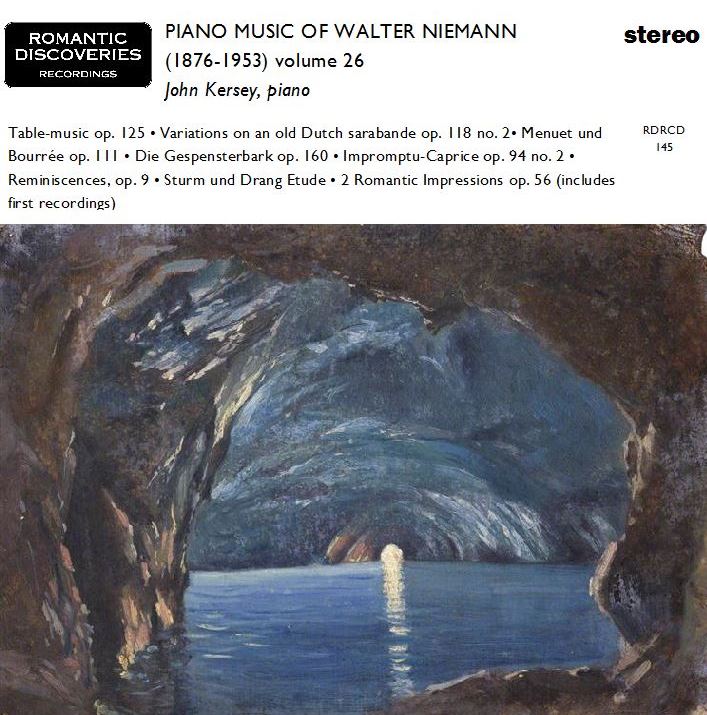
 Piano Music of Walter Niemann volume 26
(includes first recordings)
John Kersey, piano
RDR CD145
Total time: 77 minutes 25 seconds
1. Tafelmusik, op. 125
i. Intrada
ii. Pavane
iii. Inventione fugata
iv. Allemanda
v. Courante
vi. Sarabande
vii. Rigaudon
viii. Menuett
ix. Gigue
2. Variationen über eine altholländische Sarabande, op. 118 no. 2 (Theme and Variations 1-7 by Gisbert Steenwick (c. 1670))
Tema (Tempo di Sarabande)
Var. 1: Un poco allegro
Var. 2: L’istesso tempo
Var. 3: Più allegro
Var 4: Più tranquillo
Var. 5: Un poco Andantino
Var. 6: Molto allegro e scherzando
Var. 7: Tempo del tema
Var. 8: Allegro leggiero
Var. 9: Moderato, ma energico marcato
Var. 10: Vivo (molto allegro)
Var. 11: Moderato, ma energico marcato
Var. 12: Andante mosso
Var. 13: Giga (molto allegro e chiaro)
Var. 14: Canarie (l’istesso tempo, giocoso)
Var. 15: Almand (molto moderato)
Var. 16: Pavana (Sostenuto con grazia)
Var. 17: Gagliardo (Con moto e giocoso)
Var. 18: Courante (Allegro molto e con grazia)
Var. 19: Minuetto (Moderato)
Var. 20: Siciliana (Tempo di Siciliano)
Var. 21: Rigaudon (animato e marcato)
Var. 22: Molto allegro marcato e appassionato
Var. 23: Moderato pesante
Var. 24: L’istesso tempo
Var. 25: Tempo del tema, ma più largamente e pesante
3. Menuett und Bourrée, op. 111
4. Die Gespensterbark, Traumballade, op. 160
5. Impromptu-Caprice, op. 94 no. 2
6. Erinnerungen, Stimmungen und Bilder, op. 9
i. On the Fjord (Norwegian Idyll)
ii. Hermitage (A little Gavotte)
iii. When our grandfather met our grandmother
iv. A sad hour (In memory of my dear cousin Carl Warnke (obit. Kiel, May 1908))
v. A little dance on the green
7. Sturm und Drang Etude
8. Zwei Romantische Impressionen, op. 56
i. The blue grotto
ii. Der Goldsoot*
Er stand und sah ins Wasser, das mit stillem, traurigem Auge ihn ansah, als hielte es wehmütig sein Geheimnis fest. – Gustav Freussen
He stood and looked into the water, which looked at him with quiet, sad eyes, as if it were wistfully holding on to its secret.
*According to a Schleswig-Holstein folk legend, the Goldsoot (Soot = spring), located in the deepest heathland solitude, keeps immeasurable treasures at its bottom.
John Kersey, piano
Our thanks go to Nicolo Figowy and Steffen Herrmann for their generous loan of scores.
Walter Niemann was regarded in 1927 as “the most important living piano composer who knows how to make music from the piano in a subtle and colorful way, although he often enters the field of salon music” (H. Abert, Illustrated Music Lexicon). This most sensitive and introverted master of the piano devoted his life to composition and musical scholarship, also performing his music in concerts and radio broadcasts. Niemann’s vast output for the piano is only now starting to become more widely known. Although his style is generally unashamedly conservative, he was one of the very few German composers to explore Impressionism in music, and this also reflected a fascination with the Far East. Elsewhere, Niemann’s imagination takes us from much Baroque recreation to large-scale epic sonatas, Schumannesque miniatures and even the exploration of early jazz styles. His understanding of the capabilities of the piano was complete, and his works include both collections for young pianists and mature works that exploit the full range of pianistic effect and make significant demands on the performer.

 Romantic Discoveries Recordings
You must be logged in to post a comment.