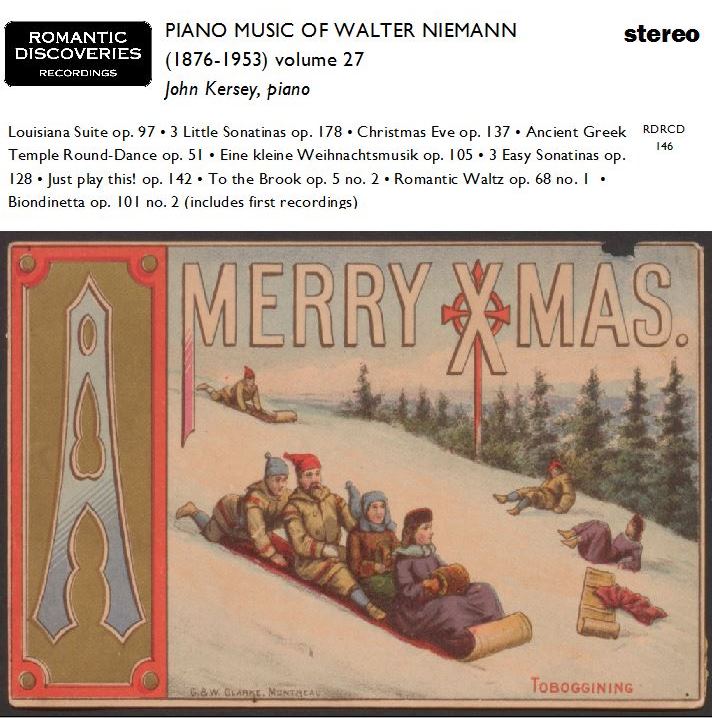
 Piano Music of Walter Niemann volume 27
(includes first recordings)
John Kersey, piano
RDR CD146
Total time: 67 minutes 39 seconds
1. Louisiana Suite, op. 97
i. The Mississippi Steam-Boat’s in Sight
(“The Glendy Burke” – Stephen C. Foster)
ii. My Old Kentucky Home (Stephen C. Foster)
iii. The Interrupted Serenade
(“Old Black Joe” – Stephen C. Foster; “Massa’s in the Cold Ground” – Stephen C. Foster; “Oh! boys carry me ‘long” – Stephen C. Foster; “Gentle Nettie Moore” – Pike)
iv. Longing for Home
(“Old Folks at Home” (Way down upon the Swanee River) – Stephen C. Foster)
v. Mardi Gras in New Orleans
(“Dixie’s Land” – Dan Emmet)
Foreword by Walter Niemann (1924)
The following Suite contains eight of the finest and best-known popular Negro-Songs, such as were chiefly sung on the vast Cotton- and Sugar-plantations in the Southern States of North America, and arranged by the composer.
By far the finest songs, born of and permeated with the national spirit, both as regards the words and the music, are those written by America’s most popular and earliest song-composer, Stephen C. Foster (1826 to 1864). His chief aim throughout was to counter-balance the predominating number of sad or religious songs with merry, cheerful tunes. Both kinds breathe the very soul of these great big grown-up black children, whose spirit feels, pulsates and responds just as vividly and deeply, as cheerfully and tenderly to the joys and sorrows of life, as our own.
The grief and sorrow for the old abandoned country is mostly done full justice to and pulsates in most of these songs; thus, for instance, in the heart-touching tune “My old Kentucky Home” or in the early “Song of Home”; The “Old Folks at Home”, the rendering of which is so beautifully described by the German poet Paul Keller, when he says “She sang this most pathetic of all Songs of Home with deep heart-born emotion, and Mr. Brown hummed the accompaniment with a nasal tone, as the negroes do, when, far from home, one of them, leaning against the wall, allows his inmost, heart-felt sorrow and the grief of his enslaved soul to flow forth in song. Then all, with motionless body, like rigid statues, join in the humming-part, their large eyes fed with burning tears gazing, staring at the yellow light of the dim lamps.”
The tunes or melodies upon which “The Interrupted Serenade” is based, belong to the series or class of songs expressive of: the heart, forlorn and longing for death (“Old black Joe”), -lamenting the dead (“Massa’s in the cold ground”), –farewell to life (“Oh boys, carry me ‘long!”) They all impressed the minstrel accompanying himself on the banjo, the national instrument of the negroes, as being too sad, hence his ever-increasing desire, his demand for something merry and cheerful, resulting in his winding up with a little serenade to his sweetheart: “Nettie Moore”. This leads to the class of cheerful songs, as delightful in their simple, childlike purity and mirth, as they are fascinating in their charm of melody and rhythm.
Such a one is “Dixie Land” – that beautiful, tropical Florida in the South, where the minstrel’s cradle stood, and finally that delicious melody in praise of the famous old Mississippi Express-boat “Glendy Burke”
2. Drei kleine Sonatinen, op. 178
no. 1 in F major:
i. Morgentlich frisch und munter
ii. Rondino (Pastorale)
no. 2 in D major
i. Munter und frisch
ii. Im alten Menuett-Tempo
iii. Lebhaft und heiter
no. 3 in C major
i. Mässig bewegt
ii. Kinderliedchen (aus Alt-Hamburg)
3. Der Weihnachtsabend, op. 137
i. Christmas is ringing in
ii. Shepherds’ music
iii. The boys play soldiers
iv. Dolls’ waltz for the girls
v. To bed
4. Altgriechischer Tempelreigen, op. 51
5. A little Christmas music on old Christmas melodies, op. 105
i. O Holy Night
ii. Under the Christmas tree – little variations on the German Christmas carol “O Tannenbaum”
iii. At the Christmas market
iv. The Christmas Mass
v. Farmhand Rupert
vi. The Christmas Bells
6 Drei leichte Sonatinen, op. 128
no. 1 in C major
i. Moderato ma energico
ii. Minuetto
iii. Giga alla caccia (A little Hunting Air). Presto.
no. 2 in G major
i. Amabile con moto
ii. Siciliano per la notte de natale. Un poco lento.
iii. Giocoso ed animato alla burla
no. 3 in F major
i. Allegro non troppo, ma giocoso
ii. Pastorale “Die Schalmei”. Moderato ed amabile con moto.
iii. Finale. Molto animato e giocoso
7. To the brook from Pastellbilder, op. 5 no. 2
8. Romantic Waltz from Three Modern Pieces, op. 68 no. 1
9. Biondinetta – Graceful Waltz from Zwei kleine Waltzer, op 101 no. 2
John Kersey, piano
Our thanks go to Nicolo Figowy and Steffen Herrmann for their generous loan of scores.
Walter Niemann was regarded in 1927 as “the most important living piano composer who knows how to make music from the piano in a subtle and colorful way, although he often enters the field of salon music” (H. Abert, Illustrated Music Lexicon). This most sensitive and introverted master of the piano devoted his life to composition and musical scholarship, also performing his music in concerts and radio broadcasts. Niemann’s vast output for the piano is only now starting to become more widely known. Although his style is generally unashamedly conservative, he was one of the very few German composers to explore Impressionism in music, and this also reflected a fascination with the Far East. Elsewhere, Niemann’s imagination takes us from much Baroque recreation to large-scale epic sonatas, Schumannesque miniatures and even the exploration of early jazz styles. His understanding of the capabilities of the piano was complete, and his works include both collections for young pianists and mature works that exploit the full range of pianistic effect and make significant demands on the performer.

 Romantic Discoveries Recordings
You must be logged in to post a comment.