Archive for the ‘Catalogue’ Category

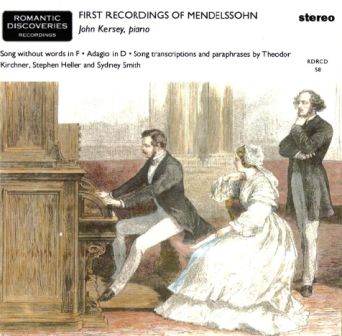
First recordings of Felix Mendelssohn

First recordings of Felix Mendelssohn
Original works and transcriptions by his contemporaries

John Kersey, piano
RDR CD58

Total time: 76 mins 46 secs

1. Felix Mendelssohn (1809-47): Song without words in F (1’56”)
2. Stephen Heller (1813-88): Caprice caracteristique on two themes by Mendelssohn, op 76 (7’11”)
3. Mendelssohn transc. Dietrich Krug (1821-80): Auf Flügeln des Gesanges (On Wings of Song) (6’31”)
4. Sydney Smith (1839-89): Mendelssohn’s Two Part Songs – reminiscence, op 141b (5’43”)

Mendelssohn transcribed Theodor Kirchner (1823-1903): Songs
5. Bei der Wiege (By the Cradle) (2’09”)
6. Frühlingslied (Spring Song) (1’16”)
7. An die Entfernte (To the Distant Beloved) (2’13”)
8. Reiselied (Journeying Song) (1’20”)
9. Reiselied (2’45”)
10. Suleika I (4’18”)
11. Suleika II (4’10”)
12. Schilflied (Reed Song) (3’51”)
13. Venetianisches Gondellied (Venetian Gondola Song) (2’43”)
14. Volkslied (Folk Song) (4’19”)

15. Stephen Heller: 3 Melodies of Mendelssohn, op 72: no 2 – Chant du Troubadour (Song of the Troubadour) (4’25”)
16. Mendelssohn: Adagio in D (ca. 1820) (6’56”)
17. Stephen Heller: Saltarello on Mendelssohn’s Finale from the “Italian” Symphony, op 77 (4’55”)
18. Sydney Smith: Transcription of Mendelssohn’s “O for the Wings of a Dove”, op 244 (9’07”)

We are grateful to Dr. Klaus Tischendorf and the Sydney Smith Archive for supplying copies of scores for use in this recording.

Notes on the music
Mendelssohn’s bicentennial in 2009 provides a long-awaited opportunity to celebrate this most extraordinary of nineteenth-century composers. To some extent, he continues to suffer from Wagner’s anti-Semitic attacks on him, but his relative neglect today has deeper roots. Mendelssohn is a composer for whom the balance of form and emotion are crucial, and where drama is frequently intimate rather than large-scale. He only rarely offers us the excess of temperament that is Schumann’s stock-in-trade, and often achieves his effects with great subtlety. Such was Mendelssohn’s influence during and beyond his lifetime that many features apt to be dismissed today as nineteenth-century clichés actually began fresh and new in Mendelssohn’s own work, to be taken up with varying degrees of success by his followers.

Posterity has distrusted Mendelssohn’s prolific output, his multiple talents (he was a watercolourist of professional standard in addition to his accomplishments as teacher and executant musician) and in particular his adherence to a religious style that has come to be seen as the epitome of comfortable mid-century Anglicanism. In reality, Mendelssohn’s spiritual life was much more complex, his father’s wholesale conversion of his family to Christianity in 1816 (he and his wife followed in 1822) causing Felix to be balanced on the cusp of the two faiths rather than wholly contained within one or the other. His musical style, often labelled as conservative, is in fact more introspective than genuinely unprogressive, and also has a rhetorical aspect which is strongly of its time but which has fallen from fashion since. Like Mozart before him, Mendelssohn’s outward heart-on-sleeve style masks deeper undercurrents and calls for more insight in interpretation than is sometimes afforded by overly boisterous readings. And Mendelssohn is, even when at his most light-hearted, a sincere composer of deep integrity and poetic feeling. He offers sentiment, not sentimentality, and that we should mistake those two is more of an indictment on the standards of our own age than on those of Mendelssohn.

There is still a good deal of Mendelssohn’s music that is unpublished and unrecorded, and little of the unpublished music is available to performers either in facsimile or in modern editions. Here are two pieces on this disc: firstly an Adagio written aged eleven or so in the white heat of Mendelssohn’s early creativity, and which already shows his style to be well-developed, and secondly a Song without Words that has somehow escaped from the published sets.

The heart of Mendelssohn’s emotional expression is in the songs, but it is rare that performances expose the intensity and even the psychodrama of these short works. The transcriptions by Mendelssohn’s pupil Theodor Kirchner are works of tremendous craft and pianistic invention, not designed like those of Liszt to transcend the originals, but rather to illuminate them from a different angle. Playing the Volkslied, one senses that Wagner’s jealousy of Mendelssohn may well have stemmed from the latter’s highly accurate pre-empting of his harmonic and melodic style. When one puts these transcriptions by the side of the more conventional if no less enjoyable work of the pedagogue Dietrich Krug one can see Kirchner’s achievement starkly delineated.

This Volkslied formed the basis for the extended Fantasy-Sonata op 69 by Stephen Heller, who was during his lifetime considered one of Mendelssohn’s most significant peers. Heller’s extreme Romantic sensibility and similar stylistic adherences to Mendelssohn again caused him to be eclipsed by the Wagner school. His writing for the piano is ingenious, virtuosic and shows considerable understanding of his sources. His transcriptions are not literal and often recast the melodic material into an interesting etude or exercise making use of pianistic effect – but, like Henselt’s writing, this feature is often obvious only to the performer, the audience remaining unaware of considerable difficulties that are written to sound easy. Heller’s Caprice on 2 themes is perhaps his most distinctive interpretation of the Mendelssohn style; recalling the G minor concerto, his writing exploits the full range of the instrument.

Sydney Smith was during the first part of his lifetime tremendously celebrated as an English touring virtuoso, having studied at the Leipzig Conservatoire under Moscheles and Plaidy from 1855. His many transcriptions of Mendelssohn show a respect for that composer which is reflected in their relative restraint and reliance on their original material for their effect. Like Heller, Smith found himself out of fashion in the later years of his life, and died stricken by illness and largely forgotten by the musical establishment.

Read Full Post »

Piano music of Carl Reinecke (1824-1910)

Piano music of Carl Reinecke (1824-1910)
John Kersey, piano
RDR CD57

Total time: 72 mins 18 secs

1. Novelette, op 226 (5’34” )

Lieder der Nacht (Songs of the Night), op 31:
2. Mit innigem Ausdrucke (3’46”) 3. Lento, ma non troppo (2’31”) 4. Presto – Rasch und wild (2’06”) 5. Spanische Serenade (3’43”)

6. Funeral March on the death of Kaiser Wilhelm I, op 200 (6’04”)

Old and new dances, op 57
7. Gigue (2’35”) 8. Courante (2’14”) 9. Ländler (Tyrolienne) (1’45”) 10. Polka (2’20”)

11. Rhapsodie in B minor (unpublished) (1844) (1’54”)

Märchengestalten (Fairy tale forms), op 147
12. Prolog (1’25”) 13. Aschenbrödel (Cinderella) (1’09”) 14. Heinzelmännchen (Gnomes) (1’46”) 15. Gute Fee (The Good Fairy) (2’09”) 16. Rübezahl (The Mountain Spirit) (1’05”) 17. Schneewittchen (Snow White) (1’18”) 18. Die Roggenmuhme (The Rye-Wolf) (00’58”) 19. Der Königssohn (The King’s Son) (00’46”) 20. Dornröschen (Sleeping Beauty) (1’04”) 21. Rothkäppchen (Red Riding-Hood) (1’12”) 22. Die sieben Zwerge (The seven dwarves) (1’19”) 23. Böse Fee (Bad Fairy) (00’40”) 24. Melusine (1’10”) 25. Undine (1’15”) 26. Die Regentrude (The Rain Maiden) (1’59”) 27. Epilog (1’28”)

28. Nocturne (3’27”)
29. Variations on a theme by J.S. Bach, op 52 (11’57”)

We are grateful to Dr. Klaus Tischendorf for supplying copies of scores for use in this recording.

Notes on the music
Carl Heinrich Carsten Reinecke was born in Altona, then part of Denmark, and studied music with his father, a teacher. A child prodigy, he was composing at age seven and performing as a concert pianist aged twelve. In 1843 he was appointed court pianist to King Christian VIII and was consequently based in Copenhagen until 1848. This was a fruitful period as a composer and he produced works in both larger and smaller forms. Moving to Germany, he was in 1851 appointed professor at the Cologne Conservatoire and in 1860 became director of the Leipzig Gewandhaus concerts and professor at the Leipzig Conservatoire. His students included Grieg, Sinding, Bruch, Albeniz and Janacek. He remained director of the orchestra until 1895 and finally retired as a professor in 1902. His retirement allowed him more time for composition, and eventually he had completed over three hundred works in all formats.

Reinecke was the oldest pianist to record his playing. He made piano rolls for Welte and Hupfeld/Triphonola, and the Welte rolls show his style undiminished at the age of over eighty. Reinecke’s performances of his own works have been consulted in the preparation of this recording.

In style, Reinecke was a consummate craftsman and at his best a considerable artist in the mainstream of the Romantic movement. He is given more to considered utterance than many of his more spontaneous contemporaries, so that his piano works are the outcome of deep thought and culture rather than displaying the more visceral emotions. His writing throughout reveals a profound understanding of musical and pianistic effect, as well as an active and often playful imagination. Like many of his era, he was easily drawn to landscapes of fantasy and could evoke them with only a few metaphorical strokes of the pen.

Reinecke was intellectually curious, and his engagement with the music of the past can be seen at its most interesting in two near-contemporary works, the Variations on a theme by J.S. Bach op 52, and the Old and New Dances, op 57. The Variations show an approach to Bach’s style that points the way forward to Reger and incorporates at the conclusion aspects of the improvisatory approach of the fantasia. The Dances, by contrast, are neo-baroque long before the age of Pulcinella, Reinecke re-casting the Gigue and Courante into Romantic harmonic and textural settings so that the works are not so much pastiched as renewed in a different context. Then come two new dances, closer to their populist roots, but again re-conceived for listening rather than for dancing.

The fairy-pictures that occupy op. 147 were written for Reinecke’s daughter, and were surely approached in a spirit of challenge – the creation of a sketch-portrait with the greatest possible economy of effect and language. That they transcend their simple intentions and fall gratefully upon the ear is testament to Reinecke’s art.

The set Lieder der Nacht op 31 is more ambitious, outward-looking piano music in contrast to the domesticity of op. 147. Its emotions are at once more complex and more fully-realised. The spirit of Mendelssohn hovers not far away from the first piece, while the second features eloquent polyphony. In the third, marked “rasch und wild”, we are in a Schumannesque ride by night, assailed by creeping terrors and the exterior – or is it interior? – landscape of cataclysm. Only a complete contrast could follow this, and so it proves with the light, seemingly inconsequential Spanish Serenade, which however reveals strong poetic undercurrents in the central section.

The shorter works show Reinecke in more experimental mode. The early Rhapsodie, unpublished and here prepared from a copy of the autograph, was written in Leipzig in 1844 and dedicated to Miss Louise Lallemand “with friendly reminiscence”. The work is omitted from catalogues of Reinecke’s compositions and clearly he himself forgot it in later years, for it was never published. Here, a hunting motif leads to contrasting and intermeshing episodes, so that a good deal happens in a very short space of time.

The sophistication of the Novelette op 226 showed how far Reinecke had come in his approach to this sort of piece in the course of exactly forty years. This work above all reflects Reinecke’s approach to the keyboard as reviewed by the evidence of his recordings. The Funeral March op 200 is another striking work, with its muffled drumbeats and brass choruses; a grand memorial of public grief.

Read Full Post »

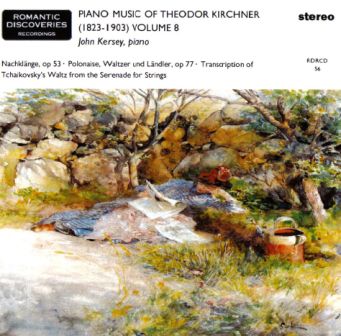
Piano music of Theodor Kirchner (1823-1903), volume 8
John Kersey, piano
RDR CD56

Total time: 70 mins 53 secs

Nachklänge, op 53:
1. Non troppo vivace (3’27”) 2. Poco lento (3’15”) 3. Animato (4’37”) 4. Andante (poco lento) (2’42”) 5. Kräftig, nicht zu schnell (5’46”) 6. Dolce animato (4’32”)

Polonaise, Walzer und Ländler, op 77
7. Im Polonaisen-Tempo (3’53”) 8. Comodo (2’27”) 9. Animato (3’22”) 10. Comodo (2’22”) 11. Comodo (2’07”) 12. Comodo (1’51”) 13. Animato (2’05”) 14. Allegretto (2’31”) 15. Comodo (1’21”) 16. Comodo (1’01”) 17. Allegretto (00’41”) 18. Comodo (1’16”) 19. Poco vivace (1’33”) 20. Comodo (00’51”) 21. Comodo (2’06”) 22. Poco Allegro (1’08”) 23. Poco lento (2’15”) 24. Poco vivace (2’15”) 25. Comodo (2’39”) 26. Allegro (2’46”)

27. Transcription of Tchaikovsky’s Waltz from the Serenade for Strings (4’32”)

We are grateful to Dr. Klaus Tischendorf for supplying copies of scores for use in this recording.

Notes on the music
Fürchtegott Theodor Kirchner, a pupil of Mendelssohn at the newly-founded Leipzig Conservatoire, composed over 1,000 original works for piano, most of which are sets of miniatures. Kirchner expert Dr. Klaus Tischendorf, who has kindly provided the scores for these recordings, has described Kirchner as “the piano miniaturist of the Romantic era”.

Kirchner was recommended by Mendelssohn for the post of organist of Winterthur in Switzerland in 1843, and remained there for the next twenty years. The position gave him the opportunity to travel throughout Germany, and there he came into contact with Brahms and the Schumanns (he had first met Robert Schumann aged fourteen), who recognised in him an arch-Romantic and kindred spirit. He appears to have had a brief affair with Clara Schumann in the 1860s.

In 1862, Kirchner became director of the subscription concerts in Zurich, but remained there for only three years before returning to freelance life. He was appointed court pianist at Meiningen in 1872 and became director of the conservatoire in Würzburg the following year. Again, he did not stay long, and in 1876 moved to Leipzig for seven years, before going on to Dresden, where he taught score-reading. The year 1890 was a climactic one for him, for he abandoned his wife and family and went to live in Hamburg, where he was looked after by a former pupil. Four years later he suffered the first of two strokes that left himparalysed, and began to go blind.

“In his character there is no stability” wrote Clara Schumann. Kirchner’s career suffered because of his addiction to gambling and an extravagant lifestyle that was beyond his means, and his musical friends had periodically to bail him out from financial ruin. In 1884 a group including Brahms, Grieg, Gade and von Bülow raised thirty thousand marks to help him pay off his gambling debts.

The art of Kirchner has been almost completely overlooked because his talent was expressed in miniature form, yet the age which determined Wagnerian bombast preferable to Mendelssohnian intimacy has passed by and enabled us to re-evaluate the miniaturist on something approaching his own terms rather than those of his artistic opponents. Viewed from any angle, Kirchner’s achievement is remarkable. One might expect his works to be commonplace and unexceptional because of his prolific nature, yet the opposite is the case. Kirchner is the master of intimate expression; of scale above all, because he knows how to manipulate the interior monologue to evoke fantasies that can turn from charm to poignancy to anguish in a mere moment.

To listen to Kirchner is to be drawn into a world whose parameters may at first seem strange. Sometimes we have less than a minute to get our bearings, and a casual listener may miss the nuance that becomes second nature to the Kirchner initiate. Kirchner’s language is rich and diverse; it is full both of self-references and echoes of others; here of Schumann, or of Mendelssohn, or (particularly in op 77) of Schubert. Like his successor Webern, the music is distilled and represents concentration as well as economy: Kirchner does not waste notes or strive for effect at the expense of substance. What he offers is a continual engagement with one of the greatest problems for a creative artist; the capture of the elusive moment – of an overheard voice, a perfume, a half-glimpsed scene – rather as would be addressed in very different ways by Fauré and Debussy in due course. Kirchner’s world is not public and external – rather it is like browsing through a confessional and intimate diary (indeed diaries and sketchbooks were to feature in several of his compositions). In an age that fears intimacy, Kirchner is a challenge indeed.

Often with Kirchner it is the most outwardly ordinary and unassuming of titles that hide the most interesting music. Kirchner hardly whets the appetite with the drily descriptive “Polonaise, Walzer und Ländler”, but within is an intriguing set that continues a form that fascinated Schubert – the set of contrasting, not-quite-interlinking but nevertheless emotionally and sometimes motivically connected waltzes or ländler – which would eventually produce such grand offerings as Jensen’s Ländler aus Berchtesgaden (available on RDR CD 48) and Ravel’s knowing homage Valses Nobles et Sentimentales. Kirchner’s waltzes are stylised even beyond the examples of Schubert and Chopin, with any strain of rustic populism viewed (as so often in his music) as if at a remove of some distance. Some, indeed, are the perfect personification of introversion in music, seeming as if to listen too closely would result in their wholesale disappearance into the ether. Others are more boisterous, playing with their intertwined material as if caught up in the compositional equivalent of a crossword solution.

Kirchner’s Echoes, op 53, are somewhat more extended tone-pictures, and if Schumann is called to mind in the obsessive dotted rhythm of the first piece and the steadfast Davids-band procession of the fifth, this is probably entirely intentional. So often with Kirchner it is the central sections of pieces that are used for the opening of the emotional heart of the work, and so it is with these works. The sixth, however, is pure Kirchner, an exquisite piece based on a motif that is disarming in its simplicity but stays in the mind long after its last notes have died away.

Read Full Post »

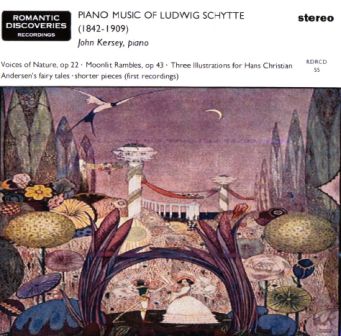
Piano music of Ludvig Schytte (1848-1909)

Piano music of Ludvig Schytte (1848-1909)
John Kersey, piano
RDR CD55

Total time: 78 mins 66 secs

Three Illustrations for Hans Christian Anderson’s fairy tales:
1. Elves on a Hill (2’19”) 2. The Nightingale (5’34”) 3. The Steadfast Tin Soldier (3’19”)

4. Poème lyrique, op 80 no 2 (5’36”)

Moonlit Rambles, op 43:
5. Moderato (2’55”) 6. Andantino (3’21”) 7. Allegro moderato (1’33”) 8. Moderato (2’28”) 9. Allegretto (2’57”) 10. Allegro molto (2’35”)

11. Valse-caprice, op 13 (5’16”)
12. Nocturne (3’03”)

Voices of Nature, op 22:
13. In the Woods (2’54”) 14. At the Gulf (2’28”) 15. To the Mountains (1’47”) 16. At the Lake (3’17”) 17. Down the River (2’59”) 18. On the Sea (2’21”) 19. Over the Steppe (2’16”)

20. Impromptu (2’41”)

Two Waltzes, op 102
21. Valse capriccietto (2’16”) 22. Valse noble (4’05”)

23. Barcarole from “Piazza del Popolo” – Little Italian Suite, op 110 no 3 (3’50”)
24. Polonaise from Ambroise Thomas’ “Mignon” (5’34”)

We are grateful to Dr. Klaus Tischendorf for supplying copies of scores for use in this recording.
Cover picture: Illustration for Hans Christian Andersen’s “Thumbelina” by Harry Clarke (1889-1931)

Notes on the music
Let us deal with the name first. In his native Danish it is Skütte, pronounced rather like the English “scooter”. In transliteration this became the German Schytte, with the hard “k” somehow mistakenly replaced with the soft “ch” and the final “e” pronounced, rather than elided as in English. “Scooter” may then be an unusual name for the English speaker, but it is devoid of the scatological connotations which denigrators of Schytte have not been slow to apply over the years – “aptly named” says one commentator seeking to do him down. As this disc will show, there is more to Schytte than this, and his neglect is unjustified.

Born in Aarhus, Schytte was a pupil of Gade and Neupert, before studying with Liszt in Germany in 1884. The intervening years had seen him qualify as a pharmacist to insure against the uncertainties of a musical career, but from 1886 he established himself as a teacher in Vienna, moving to Berlin for his final two years.

Schytte’s musical style shows a clear influence of Gade but also a wider European outlook in such works as the Piazza del Popolo suite and his isolated Nocturne. His writing for piano is notable for its command of texture and technique (a number of his works are didactic in nature) and it generally avoids the commonplace in favour of a subtle distinction of feeling and nuance.

Early works, such as the Valse-caprice, op 13, show Schytte the youthful virtuoso desirous of making an impression. As Schytte matured as a composer, a focus on melody and a lyrical, long-breathed style came to overtake effect for its own sake, and the set Voices of Nature, op 22, is notable for its concentration on the creation of character and for a number of well-thought-out melodic ideas presented attractively. The finale, Over the Steppe, achieved some popularity as an encore piece (included in the repertoire of Sophie Menter, in particular) and has a more pronounced etude-like character.

Schytte’s pieces inspired by the fairytales of Hans Christian Andersen show him at his imaginative best. Here he writes with delicacy and charm and preserves a formality that distinguishes his style from the more rhapsodic of his contemporaries, such as Grieg. For Schytte, clear structure is of importance, and ensures that his ideas do not outstay their welcome or become over-complex in their development.

As well as original music, Schytte also contributed to the literature of the virtuoso transcription. The comic opera “Mignon” by Ambroise Thomas enjoyed great popularity, with the thousandth performance taking place in 1894. Schytte sets the opera’s most famous moment – the Polonaise – in a style that shows that he had absorbed much from Liszt’s paraphrases. The themes are treated with considerable elaboration in the grand virtuoso style to produce an effective homage to the work.

Read Full Post »

Piano music of Emil Hartmann (1836-98)

Piano music of Emil Hartmann (1836-98)
John Kersey, piano
RDR CD54

Total time: 77 mins 6 secs

Four Pieces, op 31
1. Elegi (3’55”) 2. Impromptu (3’14”) 3. Canzonetta (3’25”) 4. Etude (3’23”)

Arabesque and Caprice, op 16
5. Arabesque (Theme varié) (5’33”) 6. Caprice (5’47”)

Fra Høilandene – Nordic Tone Pictures for Piano, op 11
7. Moderato (4’15”) 8. Gamle Minder (Old Memories) (1’44”) 9. En Leg (A Game) (2’28”) 10. Paa Fjorden (On the Fjord) (3’06”) 11. Folkedands (2’40”)

Ballscenen – Dances and Arabesques for Piano, op 23
12. Introduction et Valse Gracieuse (3’52”) 13. Polka (3’54”) 14. Menuet (4’58”) 15. Intermezzo I – La Coquette (2’21”) 16. Contredanse (2’22”) 17. Valse (2’52”) 18. Galop Furioso (2’04”) 19. Intermezzo II – Scene d’amour (2’04”) 20. Tyrolienne (2’27”) 21. Valse-Finale (6’37”)

22. Albumleaf (1’44”)

We are grateful to Dr. Denis Waelbroeck for supplying copies of scores for use in this recording.
Cover picture: Johan Laurentz Jensen: Still Life (1827)

Notes on the music
For biographical information, see http://da.wikipedia.org/wiki/Emil_Hartmann (in Danish).

Emil Hartmann’s work was eclipsed in his lifetime by the fame of his father, J.P.E. Hartmann, and his brothers-in-law Niels Gade and August Winding. He composed music before he could talk, and developed into a confident master of the Danish expressive style of the mid-nineteenth-century.

Hartmann worked as a church musician, but this forms only one aspect of his musical output, which is extremely varied. The piano music explores a number of styles ranging from nationalistic folksongs and dances to virtuoso display-pieces such as the Caprice op 16 no 2, and balances an extrovert sensibility with a fine command of melody and expressive shading.

The Ballscenen op 23 suggest some similarities with Schumann’s Carnaval and offer an unified set of strong contrasts and considerable charm. The piano writing is at times demanding and offers a number of exciting effects.

The Nordic Tone Pictures “from Høilandene”, op 11 inevitably draw comparison with Grieg’s nationalistic works. Hartmann handles his original material with some mastery, effectively evoking each scene with economy and avoiding the commonplace.

Read Full Post »

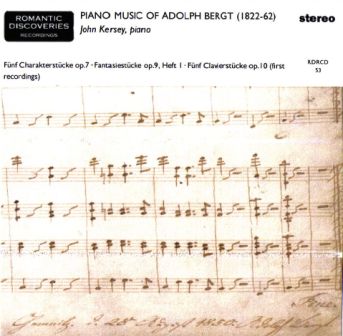
Piano music of Adolph Bergt (1822-62)

Piano music of Adolph Bergt (1822-62)
John Kersey, piano
RDR CD53

Total time: 79 mins 57 secs

Fünf Charakterstücke op.7 (Leipzig, Peters, April 1849)
1. Un poco Moderato (4’29”) 2.  Allegro giocoso (3’23”) 3. Andantino (6’41”) 4. Molto vivace (4’28”) 5. Andante molto moderato (9’24”)

Fünf Clavierstücke op.10 (Leipzig, Breitkopf & Härtel, Oktober 1855)
6. Allegretto vivace (4’34”) 7. Presto (3’39”) 8. Andante con moto (6’47”) 9. Agitato (4’36”) 10. Allegro assai (8’02”)

Fantasiestücke op.9, Heft 1 (Leipzig, Whistling, März 1850)
11. Marcia (12’08”) 12. Maskentanz-Scene (7’12”) 13. Andantino (3’52”)

We are grateful to Dr. Klaus Tischendorf for supplying copies of scores for use in this recording.
Cover picture: Excerpt from the autograph score of Bergt’s “Concert Overture” (1850) (collection Klaus Tischendorf)

Notes on the music by Dr. Tischendorf
Wie im Falle von Heinrich von Sahr (RDR CD 41 und 44), stieß ich auf den Namen des Komponisten Adolph Bergt im Handbuch der Klavier-Literatur von Adolf Prosniz (Bd. 2, Wien 1907). Dort wird er als Hochbegabter Klavierkomponist von großer Innerlichkeit bezeichnet. Prosniz lässt noch eine Liste der gedruckten Werke op. 1-10 folgen, die neben einer Sonate für 2 Klaviere (op.1) und drei Opera zu vier Händen (op.3, 6 und 8), auch sechs Werke für Soloklavier enthält. Sucht man im Internet nach Adolf Bergt, so geistert ein offenkundig mehrfach aufgelegtes Trio für 3 Fagotte durch die Seiten, das noch heute bei Hofmeister greifbar ist. Sonst keine weiteren Informationen. In einigen grösseren Bibliotheken sind vereinzelt Drucke vorhanden, allerdings nicht alle der von Prosniz genannten. Bislang nicht nachweisbar sind die Ballade op.5 und die vierhändigen Capriccios op. 6 und 8; ferner das zweite Heft der Phantasiestücke op.9.

In der deutschsprachigen Musiklexikographie taucht Adolph Bergt letztmals 1929 in der 11. Auflage von Hugo Riemanns Musiklexikon, mit folgenden dürren Worten auf:
Bergt, Adolf, *1822 zu Altenburg, †29. August 1862 zu Chemnitz (durch Selbstmord), war ein hochbegabter Musiker, besonders auf dem Gebiete der Komposition für Klavier (Sonaten, Charakterstücke).

Neben dem falsch geschriebenen Vornamen und der irreführenden, offenbar falsch abgeschriebenen Formulierung Sonaten, bietet Altmann als Bearbeiter des Riemann, so gut wie keine Information. Man muss ein halbes Jahrhundert weiter in die Vergangenheit vordringen, um ein wenig mehr zu erfahren. Das Musikalische Conversations-Lexikon von Mendel-Reissmann (Bd. 1, 1880, S.557) liefert Folgendes:
Bergt, Adolph, geboren im J. 1822 zu Altenburg, war der Sohn des dortigen Musikdirectors Benjamin Fürchtegott B., durch den er, noch Gymnasiast, gründlich musikalisch ausgebildet wurde. Er spielte bereits mehrere Instrumente und zeigte hervorragendes Compositionstalent, als er 1838 nach Chemnitz ging und behufs weiterer praktischer Ausbildung daselbst in das städtische Orchester des Musikdirectors [Wilhelm August] Mejo trat. Von 1847 bis 1849 that er sich in Leipzig als Künstler vortheilhaft hervor, kehrte jedoch nach Chemnitz zurück, wo er als Orchestermitglied und Musiklehrer wirkte. Dort machte er, in einem Anfalle von Schwermuth, seinem Leben am 29. August 1862 ein Ende. Mit ihm ging ein hochbegabter Tonkünstler vor der Zeit zu Grabe, wie seine sehr beachtenswerthen Klaviercompositionen (eine Sonate für zwei Pianofortes, Charakterstücke, Capricen u.s.w.) unzweideutig beweisen.

Nun haben wir einige Anhaltspunkte zu Herkunft und Werdegang von Adolph Bergt, aber die wenigen Zeilen werfen mehr Fragen auf, als sie beantworten. Sein Geburtsdatum scheint nicht bekannt und es liess sich auch kein Porträt nachweisen. Ich selbst besitze die autographe Partitur einer 1850 in Chemnitz komponierten Ouvertüre für Orchester, von deren letzter Seite die Cover-Abbildung dieser CD stammt. So können wir wenigstens eine Probe der Handschrift Adolph Bergts vorweisen. Aber: was war der Grund für seinen Freitod, warum konnte er in Leipzig scheinbar nicht Fuss fassen und welches mögen weitere, ungedruckte Kompositionen gewesen sein?

Ein wenig über den künstlerischen Umkreis Adolph Bergts, verraten zwei der Widmungen: die Fantasiestücke op.9 sind dem Musikkritiker und Komponisten Richard Pohl (1826-1896) gewidmet, der vor seiner musikalischen Laufbahn Mathematik in Chemnitz und Karlsruhe studierte. Mit der Feder war er später ein glühender Vorkämpfer der Neudeutschen Richtung um Liszt und Wagner. Bergts letztes publiziertes Werk, die Clavierstücke op.10, eignete er dem Schumann-Freund und Klavierpädagogen Ernst Ferdinand Wenzel (1808-1880) zu, der lange Jahre Leiter einer Klavierklasse am Leipziger Konservatorium war. Dort zählte u. a. Grieg zu seinen Schülern, und Brahms widmete Wenzel sein Scherzo op.4. Es ist wahrscheinlich, dass auch Bergt, wie so viele andere, in seiner Leipziger Zeit bei Wenzel Unterricht nahm; ob jedoch als offizieller Schüler des Konservatoriums, bleibt unklar. Er wäre damit Enkelschüler von Friedrich Wieck.

Wer die Klavierstücke von Adolph Bergt erstmalig hört, wird von deren Originalität und Unabhängigkeit überrascht sein. Es finden sich so gut wie keine Anklänge an Mendelssohn, Chopin oder Liszt. Athmosphärisch sind einige Werke allenfalls Schumann oder Kirchner verwandt, und op.10 Nr.4 ähnelt dem frühen Brahms. Es handelt sich bei Bergt um meist breit ausgeführte, vollgewichtige Charakterstücke, die eine Fülle von Stimmungen ausbreiten und durchführen. Der Klaviersatz ähnelt in seinen Anforderungen demjenigen Schumanns. Er zeichnet sich jedoch zuweilen durch grössere Weitgriffigkeit und, wo nötig (z.B. op.7 Nr.5), auch durch Virtuosität und Brillanz aus. Die Ausgestaltung und Machart verraten Bergt als sehr fähigen, reifen Pianisten, von dem wir nicht einmal wissen, ob er öffentlich spielte. Zu bewundern ist, wie Bergt die Spannungsbögen auch über längere Strukturen aufrecht erhält. Neben kraftvollen Nummern stehen introspektive und grüblerische Stücke, die zum Teil erlesene melodische und harmonische Raffinessen enthalten. Es ist John Kersey zu verdanken, die ganz eigene Klangwelt des Adolph Bergt erstmals dem Publikum zugänglich zu machen.

Seit der Veröffentlichung dieser ersten CD mit Werken von Adolph Bergt, fand ich eine weitere Quelle zu seiner Biographie, die neue und aufschlussreiche Informationen bietet (Walter Rau: Hundert Jahre Städtische Kapelle Chemnitz. Chemnitz 1933). Darin findet sich zu Adolph Bergt auf Seite 66:
Ein sehr begabter Musiker war Adolph Bergt, der Fagott, Klarinette, Violine und Klavier erlernt hatte und mit kurzer Unterbrechung von 1838 bis 1860 dem Chemnitzer Orchester angehörte. 1847 erteilte ihm Mendelssohn-Bartholdy unentgeltlichen Unterricht in der Komposition. Er muss ein ausgezeichneter Pianist gewesen sein, den er übernahm in den Chemnitzer Konzerten nicht nur die vorkommenden Klavierbegleitungen, sondern spielte auch 1844 als Solist Mendelssohns Klavierkonzert. Darüber hinaus schuf er sich einen Namen mit einer Anzahl beachtlicher Klavierkompositionen […] Er war einer jener stillen, zartbesaiteten Poeten, die durch das Leben gehen wie Träumende. In einem Steinbruch im Zeisigwalde schied dieser Künstler in einem Anfall von Schwermut 1862 freiwillig aus dem Leben.

Read Full Post »

Piano music of Hans Huber (1852-1921), vol. 3
John Kersey, piano
RDR CD52

Total time: 62 mins 54 secs

Sechs Impressionen
1. Am See – Barcarola (3’08’) 2. Impromptu-Valse (5’02”) 3. Intermezzo – Rêverie (2’06”) 4. Scherzo – Regennacht (4’07”) 5. Romanze (4’47”) 6. Humoreske (3’18”)

Jugendalbum
7. Gebet (1’24”) 8. Rondoletto (1’00”) 9. Romanze (1’16”) 10. Menuett (2’09”) 11. Perpetuum mobile (00’44”) 12. Wiegenlied (1’10”) 13. Gavotte (1’13”) 14. Kleiner Marsch (1’41”) 15. Waltzer (1’16”) 16. Variationen (2’03”) 17. Träumerei (1’38”) 18. Bourrée (1’33”) 19. Elegie (1’39”) 20. Novellette (00’59”) 21. Nachtstück (00’53”) 22. Marsch (1’25”)

Drei Stücke im alten Styl, op 14
23. Gavotte (5’16”) 24. Menuett (5’45”) 25. Bourrée (5’30”)

We are grateful to Dr. Klaus Tischendorf for supplying copies of scores for use in this recording.

Notes on the music by Dr. Tischendorf
Der Schweizer Komponist Hans Huber wurde am 28. Juni 1852 in Eppenberg bei Aarau im Kanton Solothurn geboren. Der 10jährige kam als Schüler des Solothurner Choraulen- und Partisten-Instituts unter die Fittiche des Oltener Musikdirektors Carl Munzinger, und zeigte früh auch seine kompositorische Begabung. 1870 ging er ans Leipziger Konservatorium, wo vor allem Carl Reinecke und Ernst Ferdinand Wenzel seine nachhaltigen Lehrer waren. In einer autobiographischen Notiz erinnerte sich Huber an die Leipziger Jahre: Wir alle wurden in diesem Circulum Wien, Bayreuth, Weimar und Leipzig tüchtig herumgeworfen. Huber bezieht sich auf den zu jener Zeit voll entbrannten Parteienstreit zwischen der Neudeutschen Richtung (Liszt, Wagner) und den scheinbar konservativen Meistern um Brahms. Nach seinen Leipziger Studien lebte Huber für einige Zeit als Musiklehrer in Wesserling im Elsass, ehe er sich 1877 in Basel niederliess und hier seinen eigentlichen Wirkungskreis fand. Als Pianist, Dirigent und Pädagoge hatte er entscheidenden Einfluss auf das Musikleben der alten Universitätsstadt. Er etablierte sich auch bald als Komponist, der um 1900 unbestritten die führende Persönlichkeit des Schweizer Musiklebens war, und seine Heimat aus der durch den Chorgesang geprägten Enge herausführte. Er war ab 1889 Klavierlehrer an der Allgemeinen Musikschule in Basel, der er ab 1896 als Leiter vorstand. Huber war massgeblich an der Gründung des Basler Konservatoriums beteiligt, stand dem 1900 gegründeten Schweizerischen Tonkünstlerverein vor und war ein auch international angesehener Komponist. Von 1905 bis 1918 war er Direktor des Basler Konservatoriums, musste dann aber aus gesundheitlichen Gründen das Amt niederlegen. Seine schwere diabetische Erkrankung führte auch zu seinem Tod am 25. Dezember 1921 in Locarno, wo er, neben seiner angestammten Sommerfrische Vitznau am Luzernersee, seine letzten Lebensjahre verbrachte.

Sucht man heute nach den Spuren dieses bemerkenswerten Mannes, der in seinen Werken (u. a. 8 Symphonien, vier Opern, Messen und Oratorien, neben einer Vielzahl von Liedern, Klavierwerken und Kammermusik), als wesentliches Merkmal eine unerhörte, natürliche Frische und Kraft ausstrahlt, so wird man weder in Basel noch Eppenberg fündig. Das winzige, auf einem Hochplateau oberhalb Schönenwerd gelegene Dorf, hat seinen prominentesten Bürger offenkundig vergessen. Es gibt keine Gedenktafel, und bei der Gemeindeverwaltung weiss niemand zu sagen, wo das Geburtshaus von Hans Huber zu finden ist. Immerhin haben seine Werke auf CD eine gewisse Renaissance erlebt. Alle Symphonien und weitere Orchesterwerke sind greifbar, allerdings erstarren diese gelegentlich in spätromantischer Rhetorik. Seine wohl bedeutenderen und persönlicheren Werke der Kammer-, Vokal- und Klaviermusik, sind jedoch unterrepräsentiert. John Kersey bietet nun erstmals einen nur Hans Huber gewidmeten Querschnitt aus dessen Klavierwerken.

In eine andere Welt führen die 1908 bei Simrock in Berlin und Leipzig gedruckten  Impressionen. Sechs Klavierstücke von Hans Huber. Das Werk blieb ohne Opuszahl. Es mag erstaunen, hier, gemäss dem Titel, deutliche Anklänge an den französischen Impressionismus zu entdecken. Einige Nummern stehen Fauré und Debussy sehr nahe, und legen einen überzeugenden Beweis für die Bandbreite des Huberschen Klavierschaffens ab. Wie viele andere Werke, schrieb Huber diese Stücke auch für seine eigenen Konzerte – er muss demnach ein eindrucksvoller Pianist mit bemerkenswerter Technik gewesen sein.

Das weniger anspruchsvolle Jugendalbum WoO erschien 1919 bei Hug & Co in Leipzig und Zürich. 16 Stücke meist kleineren Umfangs, folgen den massgeblich von Schumann, Reinecke oder Gurlitt geprägten Mustern. Huber bringt aber auch hier des öfteren eine persönliche Note ins Spiel, die dieses bescheidenere Opus als persönliche Schöpfung erscheinen lässt.

Read Full Post »

Piano music of Hans Huber (1852-1921), vol. 2
John Kersey, piano
RDR CD51

Total time: 60 mins 55 secs

Sechs kleine Konzertstücke, op 131
1. Präludium – Im breiten Lapidarstile (4’35”) 2. Gavotte (3’54”) 3. Wiegenlied (4’31”) 4. Arabeske (4’18”) 5. Intermezzo (3’39”) 6. Impromptu (Menuett) (4’39”)

Drei Stücke, op 48
7. Gavotte (4’25”) 8. Etude (Schneeflocken) (4’58”) 9. Valse-Caprice (7’05”)

10. Studien über ein Originalthema, op 7 (18’09”)
Thema – Ziemlich langsam; Mässig bewegt; Im Tempo des Themas. Sehr kräftig; Etwas düster gehalten; So rasch wie möglich; Sehr langsam; Im deutschen Walzertempo; Im Tempo vom Thema; Sehr schnell; Durchgehend sehr zart, aber nicht zu langsam; Finale – Sehr kräftig und schwungvoll – Ziemlich viel schneller – Tempo I.

We are grateful to Dr. Klaus Tischendorf for supplying copies of scores for use in this recording.

Notes on the music by Dr. Tischendorf
Der Schweizer Komponist Hans Huber wurde am 28. Juni 1852 in Eppenberg bei Aarau im Kanton Solothurn geboren. Der 10jährige kam als Schüler des Solothurner Choraulen- und Partisten-Instituts unter die Fittiche des Oltener Musikdirektors Carl Munzinger, und zeigte früh auch seine kompositorische Begabung. 1870 ging er ans Leipziger Konservatorium, wo vor allem Carl Reinecke und Ernst Ferdinand Wenzel seine nachhaltigen Lehrer waren. In einer autobiographischen Notiz erinnerte sich Huber an die Leipziger Jahre: Wir alle wurden in diesem Circulum Wien, Bayreuth, Weimar und Leipzig tüchtig herumgeworfen. Huber bezieht sich auf den zu jener Zeit voll entbrannten Parteienstreit zwischen der Neudeutschen Richtung (Liszt, Wagner) und den scheinbar konservativen Meistern um Brahms. Nach seinen Leipziger Studien lebte Huber für einige Zeit als Musiklehrer in Wesserling im Elsass, ehe er sich 1877 in Basel niederliess und hier seinen eigentlichen Wirkungskreis fand. Als Pianist, Dirigent und Pädagoge hatte er entscheidenden Einfluss auf das Musikleben der alten Universitätsstadt. Er etablierte sich auch bald als Komponist, der um 1900 unbestritten die führende Persönlichkeit des Schweizer Musiklebens war, und seine Heimat aus der durch den Chorgesang geprägten Enge herausführte. Er war ab 1889 Klavierlehrer an der Allgemeinen Musikschule in Basel, der er ab 1896 als Leiter vorstand. Huber war massgeblich an der Gründung des Basler Konservatoriums beteiligt, stand dem 1900 gegründeten Schweizerischen Tonkünstlerverein vor und war ein auch international angesehener Komponist. Von 1905 bis 1918 war er Direktor des Basler Konservatoriums, musste dann aber aus gesundheitlichen Gründen das Amt niederlegen. Seine schwere diabetische Erkrankung führte auch zu seinem Tod am 25. Dezember 1921 in Locarno, wo er, neben seiner angestammten Sommerfrische Vitznau am Luzernersee, seine letzten Lebensjahre verbrachte.

Sucht man heute nach den Spuren dieses bemerkenswerten Mannes, der in seinen Werken (u. a. 8 Symphonien, vier Opern, Messen und Oratorien, neben einer Vielzahl von Liedern, Klavierwerken und Kammermusik), als wesentliches Merkmal eine unerhörte, natürliche Frische und Kraft ausstrahlt, so wird man weder in Basel noch Eppenberg fündig. Das winzige, auf einem Hochplateau oberhalb Schönenwerd gelegene Dorf, hat seinen prominentesten Bürger offenkundig vergessen. Es gibt keine Gedenktafel, und bei der Gemeindeverwaltung weiss niemand zu sagen, wo das Geburtshaus von Hans Huber zu finden ist. Immerhin haben seine Werke auf CD eine gewisse Renaissance erlebt. Alle Symphonien und weitere Orchesterwerke sind greifbar, allerdings erstarren diese gelegentlich in spätromantischer Rhetorik. Seine wohl bedeutenderen und persönlicheren Werke der Kammer-, Vokal- und Klaviermusik, sind jedoch unterrepräsentiert. John Kersey bietet nun erstmals einen nur Hans Huber gewidmeten Querschnitt aus dessen Klavierwerken.

Noch persönlicher geprägt erscheinen vielleicht die 6 Kleinen Konzertstücke op.131, die 1911 bei Steingräber in Leipzig herauskamen. Sie sind durchweg jungen Damen der Basler Gesellschaft gewidmet, die möglicherweise seine Klavierschülerinnen waren. Diese müssen jedoch sehr avancierte Pianistinnen gewesen sein, denn die sehr effektvollen Werke verdienen alles andere, als den Titel Klein. Es handelt sich um persönliche, reife und anspruchsvolle Stücke, die einen Zyklus von mehr als 25 Minuten Dauer bilden.

Hans Hubers op.48, die schlicht benannten Drei Stücke für das Pianoforte componirt und Fräulein Anna Mehlig in grösster Verehrung zugeeignet von Hans Huber, wurde im Juli 1879 bei Lichtenbergs Verlag in Stuttgart gedruckt. Die Widmungsträgerin Anna Mehlig (1847-1928) war in jenen Tagen eine sehr bekannte Virtuosin, die auch bei Liszt Unterricht genossen hatte. In ihrem weitgespannten Repertoire finden sich, neben dem Standardrepertoire, auch Konzerte von Hiller und Henselt. Hans Huber widmete ihr drei hochvirtuose Studien, die seinem Erfindungsreichtum und brillantem Klaviersatz, nochmals ein glänzendes Zeugnis ausstellen.

Die Studien über ein Originalthema op.7 kamen im Januar 1875 bei Breitkopf & Härtel in Leipzig heraus. Sie bedienen sich eines Motivs aus op.2, betitelt Spielereien. Das schlichte Thema wird in teilweise virtuosen, vor allem weitgriffigen Variationen abgehandelt, die bereits die meisterhafte Faktur des jungen Hans Huber zeigen. Wenn auch der Schumann der Symphonischen Etüden gelegentlich im Hintergrund sichtbar wird, so drängt hier bereits die persönliche Kraft Hubers in den Vordergrund. Wir entdecken einen ganz zu Unrecht in Vergessenheit geratenen Variationszyklus im Umkreis des mittleren Brahms.

Read Full Post »

Piano music of Theodor Kullak (1818-82)

Theodor Kullak (1818-82)
Symphonie for solo piano, op 27
Grande Sonate in F sharp minor, op 7

John Kersey, piano
RDR CD50

Total time: 63 mins 24 secs

Symphonie de piano: Grande Sonate en quatre parties in E flat major, op 27:
1. Allegro (10’01”) 2. Andante con moto (10’41”) 3. Scherzo – Allegro vivace (4’23”) 4. Finale – Allegro con fuoco (10’42”)

Grande Sonate in F sharp minor, op 7:
1. Allegro (14’21”) 2. Adagio (5’26”) 3. Finale – Allegro (7’23”)

Notes on the music
If the name of Theodor Kullak is known at all today, it is as a noted pedagogue, the teacher of Moszkowski and Scharwenka and the author of the formidable School of Octave Playing (1848). Those who open the pages of the latter will gain some idea of the massive technique that Kullak had at his command and sought to impart to others.

Born in Poznan (Posen), now part of Poland but then annexed by Prussia, Kullak’s life was spent in close proximity to the German aristocracy of the day, attracting both royal patronage as a performer and as a teacher to the sons and daughters of the court. He was appointed pianist to the court of Prussia in 1846.

This professional success together with Kullak’s activities as a teacher and founder of two conservatoires (what was to become the Stern Conservatoire with Stern and Marx, and then the Neue Akademie der Tonkunst, eventually the largest private music school in Germany) made for a long and well-rewarded career. What material is available to the public on Kullak today tends to emphasise these aspects of his life and pay less attention to his music, and indeed to his important role in the development of the “orchestral school” of piano virtuosi.

The Grande Sonate op 7 dates from around 1842-3 when Kullak was studying with Czerny in Vienna. It is an important precursor of Chopin’s sonata op 58 as well as Thalberg’s op 56. Cast in a massive mould, its first movement is of symphonic dimensions and close, at times feverish argument. These elements are balanced with a formal rhetoric that owes a certain amount to Beethoven, and in the bold harmonic clashes some influence of later composers such as Berlioz can perhaps be felt.

Kullak’s forceful piano writing would probably have made mincemeat of the pianos of just ten years earlier. Where a composer such as Mendelssohn, himself a formidable technician, would write single or double notes, Kullak’s preference is invariably for octaves and massive chords. This is not merely effect for its own sake, but a conscious attempt to expand the capabilities of the piano as a substitute for the orchestra. The emphasis on strength is also not at the expense of more subtle moods, as is shown in the fine slow movement, embellished over a chordal structure that recalls Henselt’s writing.

The finale is an innovative study in the expansion of the classic Chopinesque “ride in hell” idea to take in all manner of technical obstacles at rapid tempo. Kullak’s short-breathed main motif is the germ from which the movement takes shape, but unlike Chopin’s episodic rondo in op. 58, Kullak’s movement is subject to strict development, thereby displaying an intellect as rigorous as its challenges are cruel. Resisting the temptation for a fireworks-based ending, Kullak instead sends the movement furiously disappearing into the distance.

Was Kullak’s op. 27 the first symphony for solo piano? Apparently, Schuberth hesitated to publish a work with such a designation, and may indeed have compelled the addition of the “Sonata” subtitle. Initially it was published in parts, with the first movement headed “Allegro symphonique” and so on, and was complete before the public by 1848. Alkan’s Symphonie from op 39 was not published until 1859, but this of course says nothing about the time when it was actually composed.

Kullak must have known Liszt’s 1833 transcription of Berlioz’s Symphonie fantastique in which the orchestral capacities of the piano were stretched to new dimensions, as well of course as his transcriptions of the Beethoven symphonies. His own symphony is rather different in design, and has a good deal in common with the terse neo-Classicism of Alkan’s creation, as well as sharing its four-movement structure.

The opening movement is an expansive Allegro that calls on Beethoven and Haydn as models, adding a strong element of chromatic interest. Kullak’s ideas are always clear but rarely commonplace, and he shares with Alkan a certain element of obsessiveness when it comes to the development of motifs that gives his work backbone and a sense of propulsive drive. The piano writing is on the grandest scale, again concentrating on octaves and emphatic chords, and making great demands on the pianist’s stamina in long sections that have the hand at full stretch.

The slow movement is again indebted to Classical models and features some novel balancing of the melody with accompaniments that, although difficult, sound easy (a common feature of Henselt’s writing). It is succeeded by a tough, demonic Scherzo written largely in octaves and taking as its theme a memorable rhythmic device. The simulation of timpani in the Scherzo is carried through to the muffled drumbeat of its trio, where imitative figures exchange against this sombre backdrop.

Kullak’s finale begins arrestingly and takes some time to get into its stride. Once it does, it can be seen as having almost all the pianistic features we have come to know from Alkan’s style, including melodies in the most unexpected of tessituras, elaborate crossing of hands, striking tremolandi and double-note trills and widely-spaced effects. However, Kullak’s material is perhaps the most Classical of all the four movements, belonging to the world of Haydn’s quartets, and taking time to build up the contrapuntal head of steam necessary to form a fitting conclusion to a work of such magnitude.

Read Full Post »

Piano music of Hans Huber (1852-1921), vol. 1
John Kersey, piano
RDR CD49

Total time: 68 mins 34 secs

Zu Maler Nolten (Ed. Mörike): Sonate, op. 47
1. Andante – Allegro con fuoco (11’33”) 2. Adagio ma non troppo (3’52”) 3. Presto (6’06”) 4. Allegro con fuoco (8’26”)

Drei Melodien, op 21
5. Anfangs sehr ruhig, fast wehmüthig gehalten (6’12”) 6. Zart leidenschaftlich (6’47”) 7. Mit Anmuth und feinem Vortrag (4’10”)

Blätter und Blüthen – Neun Clavierstücke, op 2
8. Maestoso (1’56”) 9. Herbstgefühle (Autumn Feelings) (1’26”) 10. Viel Humor! (Much Humour) (3’31”) 11. Aus alter Zeit (From times past) (1’06”) 12. Eine Frage (A Question) (1’46”) 13. Die Antwort (The Answer) (1’23”) 14. Bauerntanz (Farmers’ Dance) (1’23”) 15. Spielereien (Playthings) (3’28”) 16. Ungeduld (Impatience) (1’17”) 17. Tändelei (Toying) (3’00”)

We are grateful to Dr. Klaus Tischendorf for supplying copies of scores for use in this recording.

Notes on the music by Dr. Tischendorf
Der Schweizer Komponist Hans Huber wurde am 28. Juni 1852 in Eppenberg bei Aarau im Kanton Solothurn geboren. Der 10jährige kam als Schüler des Solothurner Choraulen- und Partisten-Instituts unter die Fittiche des Oltener Musikdirektors Carl Munzinger, und zeigte früh auch seine kompositorische Begabung. 1870 ging er ans Leipziger Konservatorium, wo vor allem Carl Reinecke und Ernst Ferdinand Wenzel seine nachhaltigen Lehrer waren. In einer autobiographischen Notiz erinnerte sich Huber an die Leipziger Jahre: Wir alle wurden in diesem Circulum Wien, Bayreuth, Weimar und Leipzig tüchtig herumgeworfen. Huber bezieht sich auf den zu jener Zeit voll entbrannten Parteienstreit zwischen der Neudeutschen Richtung (Liszt, Wagner) und den scheinbar konservativen Meistern um Brahms. Nach seinen Leipziger Studien lebte Huber für einige Zeit als Musiklehrer in Wesserling im Elsass, ehe er sich 1877 in Basel niederliess und hier seinen eigentlichen Wirkungskreis fand. Als Pianist, Dirigent und Pädagoge hatte er entscheidenden Einfluss auf das Musikleben der alten Universitätsstadt. Er etablierte sich auch bald als Komponist, der um 1900 unbestritten die führende Persönlichkeit des Schweizer Musiklebens war, und seine Heimat aus der durch den Chorgesang geprägten Enge herausführte. Er war ab 1889 Klavierlehrer an der Allgemeinen Musikschule in Basel, der er ab 1896 als Leiter vorstand. Huber war massgeblich an der Gründung des Basler Konservatoriums beteiligt, stand dem 1900 gegründeten Schweizerischen Tonkünstlerverein vor und war ein auch international angesehener Komponist. Von 1905 bis 1918 war er Direktor des Basler Konservatoriums, musste dann aber aus gesundheitlichen Gründen das Amt niederlegen. Seine schwere diabetische Erkrankung führte auch zu seinem Tod am 25. Dezember 1921 in Locarno, wo er, neben seiner angestammten Sommerfrische Vitznau am Luzernersee, seine letzten Lebensjahre verbrachte.

Sucht man heute nach den Spuren dieses bemerkenswerten Mannes, der in seinen Werken (u. a. 8 Symphonien, vier Opern, Messen und Oratorien, neben einer Vielzahl von Liedern, Klavierwerken und Kammermusik), als wesentliches Merkmal eine unerhörte, natürliche Frische und Kraft ausstrahlt, so wird man weder in Basel noch Eppenberg fündig. Das winzige, auf einem Hochplateau oberhalb Schönenwerd gelegene Dorf, hat seinen prominentesten Bürger offenkundig vergessen. Es gibt keine Gedenktafel, und bei der Gemeindeverwaltung weiss niemand zu sagen, wo das Geburtshaus von Hans Huber zu finden ist. Immerhin haben seine Werke auf CD eine gewisse Renaissance erlebt. Alle Symphonien und weitere Orchesterwerke sind greifbar, allerdings erstarren diese gelegentlich in spätromantischer Rhetorik. Seine wohl bedeutenderen und persönlicheren Werke der Kammer-, Vokal- und Klaviermusik, sind jedoch unterrepräsentiert. John Kersey bietet nun erstmals einen nur Hans Huber gewidmeten Querschnitt aus dessen Klavierwerken.

Im März 1879 publizierte Hans Huber bei dem in Leipzig und Winterthur ansässigen Verlag Rieter-Biedermann sein vermutlich bedeutendstes Klavierwerk: Zu Maler Nolten. (Ed. Mörike). Sonate für das Pianoforte componirt und Herrn Prof. Dr. L. Stark in grösster Verehrung gewidmet von Hans Huber. Op.47. Mit dieser Sonate entdecken wir nicht nur einen halbstündigen Klangrausch an energiegeladener und vollgriffiger, hinreissender Musik, sondern auch eine der bedeutendsten Sonaten der ausgehenden Romantik. Huber scheint eine besondere Geistes- verwandschaft mit dem schwäbischen Dichter Eduard Mörike verbunden zu haben. Schon in seinen ein Jahr zuvor veröffentlichten Peregrina-Liedern op.32, ist eine meisterhafte Beschwörung dieser höchst persönlichen und autobiographischen Verse zu bewundern, die bereits, wie kaum ein anderes Werk jener Zeit, auf Hugo Wolf vorausweist. Die grosszügige, epische und ebenso tragische Sonate, vertieft nur noch das Eindringen in die Welt des allzu lange als biedermeierlich unterschätzten Dichters. Hans Huber hat offensichtlich bereits damals, ingeniös, die dunkelschwarze Abgründigkeit dieses romantischen Künstlerromans erspürt, und eine Partitur geschaffen, die eine höchst reale und, durch Suizid erlösende, Todessehnsucht und – wie Hermann Hesse es nannte – eine permanente Schicksalsschwüle, artikuliert. Lassen Sie sich gefangen nehmen von dieser in jeder Hinsicht grossen Sonate, die auch Mahler antizipiert, und vielleicht die Sonate ist, die Hugo Wolf, unter anderen Umständen und wenn er es gewollt hätte, vielleicht zu komponieren im Stande gewesen wäre.

Die Hans Huber oftmals im Schrifttum angedichtete, übertriebene Nähe zu Schumann und Brahms, erweist sich auch im Falle seiner kleineren Klavierwerke als Fehlurteil. Sie beruht, wie die unter Musikwissenschaftlern weit verbreitete Unsitte des ignoranten und ungeprüften Voneinander-Abschreibens, schlicht auf – aus Faulheit – resultierender Repertoire-Unkenntnis: speziell in Bezug auf das 19. Jahrhundert. So bilden die im November 1876 bei Kistner in Leipzig gedruckten Drei Melodien für Pianoforte componirt von Hans Huber op.21 ein höchst persönliches Trifolium von differenzierten Charakterstücken, die sich, ungeachtet des schlichten Titels, als technisch anspruchsvolle und eigenständige, vollwichtige Werke erweisen, die kaum (als solche vermutete) Vorbilder durchschimmern lassen. Selbst das pianistische Erstlingswerk, die im März 1875 bei Breitkopf & Härtel in Leipzig veröffentlichten Blätter und Blüthen. Neun Clavierstücke componirt von Hans Huber op.2, zeigen nicht nur die dem Komponisten eigene, natürliche Kraft und Frische, sondern bestechen durch viele Feinheiten und ungewöhnliche Wendungen. Die, entgegen dem Titel, 10 meist knapper geformten Stücke, tragen schlichte Überschriften und sind pianistisch weniger anspruchsvoll. Dennoch stellen auch sie eine wertvolle Bereicherung des Repertoires dar, und zeigen Hans Huber auch als Meister im Bereich musikalischer Kleinigkeiten.

Read Full Post »

« Newer Posts - Older Posts »