Archive for the ‘Catalogue’ Category

Piano music of Adolf Jensen (1837-79), volume 2
John Kersey, piano
RDR CD48

Total time: 71 mins 25 secs

Romantic Studies, op 8
1. Gelübte (The Vow) (4’34”) 2. Neues Leben (New Life) (4’01”) 3. Unerwartetes Glück (Unexpected Luck) (1’57”) 4. Nach vollbrachtem Tage (At the Close of Day) (3’20”) 5. Sehnsucht (Longing) (2’57”) 6. Frohe Botschaft (Joyful News) (1’52”) 7. Träumerei (Reverie) (2’23”) 8. Lose (Fate) (1’53”) 9. Arme Gefangene (The poor Captive) (2’46”) 10. Weiße Rose (White Rose) (2’41”) 11. Am Meeresstrand (On the Sea-Shore) (3’04”) 12. Ein Nachklang (An Echo) (3’42”) 13. Liebeszeichen (Love-token) (4’44”) 14. Meine Ruh’ ist hin (My Peace shattered) (2’14”) 15. Deingedenken (Thinking of you) (3’01”) 16. Liebesfrühling (Love’s Spring) (2’04”) 17. Epilog (3’33”)

18. Ländler aus Berchtesgaden, op 46 (19’24”)
1. Praeludium – Vivace con Allegrezza 2. Allegretto comodo 3. L’istesso tempo 4. Poco animato 5. Poco meno mosso 6. Più animato 7. Poco più vivace 8. Con vivacità 9. Allegro energico 10. Poco Allegretto 11. Con espressione 12. L’istesso tempo 13. Poco più mosso 14. Tempo risoluto – Più mosso – Con brio

We are grateful to Dr. Klaus Tischendorf for supplying copies of scores for use in this recording.

See also http://www.burgmueller.com/tondichterjensen.html

Notes on the music by Dr. Tischendorf
Adolf Jensen zählt zu den bedeutendsten Komponisten von Liedern und Klavierwerken im dritten Viertel des 19. Jahrhunderts. Seine Werke blieben bis zum ersten Weltkrieg in Konzert und Salon präsent, büssten dann jedoch sowohl Forum als auch Publikum ein und fielen, wie mach andere wertvolle Werke aus jener Epoche, dem Vergessen anheim. Nachdem bislang lediglich eine CD mit Klavierwerken von Jensen vorliegt und die Lieder sich stiefmütterlich verstreut nur hie und da finden, bietet John Kersey nun erstmalig einen repräsentativen Querschnitt aus Jensens Klavierschaffen.

Adolf Jensen kam am 12. Januar 1837 als Sohn einer Musikerfamilie in Königsberg zur Welt, ebenfalls der Geburtsort seiner Kollegen E.T.A. Hoffmann, Otto Nicolai und Hermann Goetz. Seine wenig geregelte musikalische Ausbildung, hatte Jensen vor allem Louis Ehlert, Louis Köhler und Friedrich Wilhelm Marpurg zu verdanken, war aber teilweise Autodidakt. Als Musiklehrer und Theaterkapellmeister schlug er sich von 1856 bis 1860 in Grodno, Posen, Bromberg und bei Niels Gade in Kopenhagen durch. 1860 kehrte er nach Königsberg zurück, wo er sich durch Heirat und eine sehr glückliche Ehe, ab 1863, für einige Jahre materielle Unabhängigkeit sichern konnte. In Königsberg etablierte er sich als angesehener Komponist und Lehrer. Nach einem Intermezzo als Professor für Klavierspiel in Berlin an Carl Tausigs Lehrinstitut (ab 1866), nahm er 1868 seinen Wohnsitz in Dresden. Die schon seit Jugend sich bemerkbar machende Lungentuberkulose, zwang ihn zum Rückzug ins Privatleben und zum Aufenthalt in milderem Klima. 1870 lebte er bereits schwer leidend in Meran, 1871-1875 in Graz und dann bis zu seinem Tode am 23. Januar 1879 in Baden-Baden. Jensen war mit den Musikerkollegen Hans von Bülow, Johannes Brahms und Peter Cornelius, sowie den Dichtern Paul Heyse und Robert Hamerling befreundet. Johannes Brahms setzte sich für ein würdiges Begräbnis des inzwischen verarmten Komponisten ein.

Wer mit den Klavierwerken von Adolf Jensen nicht vertraut ist, wird von dem blühenden, weitgriffigen und klangesättigten Wohllaut seiner Werke überrascht sein, die sämtlich auf einen ausgezeichneten Pianisten als Autor schliessen lassen. In der Tat ist Jensen, so lange er gesundheitlich dazu in der Lage war, allein oder an der Seite renommierter Künstler, vor allem in Königsberg und Berlin als Pianist aufgetreten. Auch einige der Werke der vorliegenden Auswahl, stellen durchaus virtuose Anforderungen und verdienen das Prädikat der Konzertfähigkeit. Stilistisch von Chopin und vor allem Schumann ausgehend (als dessen Erbe Jensen vor allem als Liederkomponist angesehen wurde), zeigte sich Jensen später auch als Bewunderer von Wagner. Diese Muster hat Jensen weiter entwickelt und seinem persönlichen Stil eingeschmolzen. Ein wesentliches Merkmal, neben Ebenmass und meisterhafter Faktur, ist Jensens Fähigkeit, in Melodik und Gestaltung seinen Stücken häufig eine geheime Erregung beizumischen, die vielen Partien einen schwärmerischen und leidenschaftlichen Ausdruck verleiht. Anklänge an die Musik des hochgeschätzten Freundes Brahms finden sich eher selten.

Schon der im Oktober 1870 bei Schuberth in Hamburg erschienene Zyklus Romantische Studien op.8, besticht durch den ausgereiften Klavierstil. Die Stücke entstanden bereits 1863 in Königsberg in der Brautzeit mit seiner künftigen Ehefrau Friederike Bornträger und sind deren Mutter gewidmet. Die Sammlung ist ein Liebesfrühling im wahren Sinne des Wortes: 17 Stücke mittlerer Ausdehnung, gespickt mit Feinheiten und zahlreichen Nuancen, die vom Pianisten viel Beweglichkeit und Anschlagsdelikatesse verlangen. Die Stücke tragen poetische Überschriften und in einigen Fällen auch vorangestellte Zeilen aus Gedichten von Goethe, Uhland und anderen.

Die unter dem harmlosen Titel Ländler aus Berchtesgaden op.46 im März 1874 bei Hainauer in Breslau publizierte Sammlung, schrieb Jensen im Sommer des Vorjahres während eines Kuraufenthaltes am Königsee. Die pausenlos zu spielenden 13 Walzer, denen ein Präludium voran geht, erweisen sich als höchst anspruchsvoller, gro?er Konzertwalzer, der (vor Ravels berühmtem La Valse) in der Klavierliteratur seinesgleichen sucht. Die technischen Anforderungen sind wiederum erheblich: so sind Dezimengriffe an der Tagesordnung. Gewisse Passagen nehmen überdies die hochkomplizierten Walzerparaphrasen von Godowsky voraus.

Read Full Post »

Piano music of Adolf Jensen (1837-79), volume 1
John Kersey, piano
RDR CD47

Total time: 65 mins 31 secs

1. Impromptu, op 37 (3’48”)

Erinnerungen (Memories), op 48: 2. Allegro appassionato (3’06”) 3. Con espressione (4’09”) 4. Allegro vivace (4’00”) 5. Allegretto scherzando (4’24”) 6. Andantino trasognato (4’44”)

Lieder und Tänze (Songs and Dances), op 33: 7. Widmung (Dedication) (1’55”) 8. Trompeterstücklein (Trumpeter’s Little Piece) (1’09”) 9. Intermezzo (00’51”) 10. Ländler (1’54”) 11. Reigen (Round Dance) (1’59”) 12. Romanze (2’36”) 13. Erster Walzer (1’06”) 14. Zweiter Walzer (00’43”) 15. Intermezzo (2’33”) 16. Lied (2’25”) 17. Menuett (3’31”) 18. Kindermarsch (March of the Children) (3’29”) 19. Ungarisch (Hungarian) (2’34”) 20. Reiterlied (Song of the Rider) (2’06”) 21. Walzer (1’14”) 22. Barkarole (2’28”) 23. Ländler (00’46”) 24. An der Wiege (To the Cradle) (1’57”) 25. Polonaise (2’49”) 26. Abendlied (Evening Song) (1’24”)

We are grateful to Dr. Klaus Tischendorf for supplying copies of scores for use in this recording.

See also http://www.burgmueller.com/tondichterjensen.html

Notes on the music by Dr. Tischendorf
Adolf Jensen zählt zu den bedeutendsten Komponisten von Liedern und Klavierwerken im dritten Viertel des 19. Jahrhunderts. Seine Werke blieben bis zum ersten Weltkrieg in Konzert und Salon präsent, büssten dann jedoch sowohl Forum als auch Publikum ein und fielen, wie mach andere wertvolle Werke aus jener Epoche, dem Vergessen anheim. Nachdem bislang lediglich eine CD mit Klavierwerken von Jensen vorliegt und die Lieder sich stiefmütterlich verstreut nur hie und da finden, bietet John Kersey nun erstmalig einen repräsentativen Querschnitt aus Jensens Klavierschaffen.

Adolf Jensen kam am 12. Januar 1837 als Sohn einer Musikerfamilie in Königsberg zur Welt, ebenfalls der Geburtsort seiner Kollegen E.T.A. Hoffmann, Otto Nicolai und Hermann Goetz. Seine wenig geregelte musikalische Ausbildung, hatte Jensen vor allem Louis Ehlert, Louis Köhler und Friedrich Wilhelm Marpurg zu verdanken, war aber teilweise Autodidakt. Als Musiklehrer und Theaterkapellmeister schlug er sich von 1856 bis 1860 in Grodno, Posen, Bromberg und bei Niels Gade in Kopenhagen durch. 1860 kehrte er nach Königsberg zurück, wo er sich durch Heirat und eine sehr glückliche Ehe, ab 1863, für einige Jahre materielle Unabhängigkeit sichern konnte. In Königsberg etablierte er sich als angesehener Komponist und Lehrer. Nach einem Intermezzo als Professor für Klavierspiel in Berlin an Carl Tausigs Lehrinstitut (ab 1866), nahm er 1868 seinen Wohnsitz in Dresden. Die schon seit Jugend sich bemerkbar machende Lungentuberkulose, zwang ihn zum Rückzug ins Privatleben und zum Aufenthalt in milderem Klima. 1870 lebte er bereits schwer leidend in Meran, 1871-1875 in Graz und dann bis zu seinem Tode am 23. Januar 1879 in Baden-Baden. Jensen war mit den Musikerkollegen Hans von Bülow, Johannes Brahms und Peter Cornelius, sowie den Dichtern Paul Heyse und Robert Hamerling befreundet. Johannes Brahms setzte sich für ein würdiges Begräbnis des inzwischen verarmten Komponisten ein.

Wer mit den Klavierwerken von Adolf Jensen nicht vertraut ist, wird von dem blühenden, weitgriffigen und klangesättigten Wohllaut seiner Werke überrascht sein, die sämtlich auf einen ausgezeichneten Pianisten als Autor schliessen lassen. In der Tat ist Jensen, so lange er gesundheitlich dazu in der Lage war, allein oder an der Seite renommierter Künstler, vor allem in Königsberg und Berlin als Pianist aufgetreten. Auch einige der Werke der vorliegenden Auswahl, stellen durchaus virtuose Anforderungen und verdienen das Prädikat der Konzertfähigkeit. Stilistisch von Chopin und vor allem Schumann ausgehend (als dessen Erbe Jensen vor allem als Liederkomponist angesehen wurde), zeigte sich Jensen später auch als Bewunderer von Wagner. Diese Muster hat Jensen weiter entwickelt und seinem persönlichen Stil eingeschmolzen. Ein wesentliches Merkmal, neben Ebenmass und meisterhafter Faktur, ist Jensens Fähigkeit, in Melodik und Gestaltung seinen Stücken häufig eine geheime Erregung beizumischen, die vielen Partien einen schwärmerischen und leidenschaftlichen Ausdruck verleiht. Anklänge an die Musik des hochgeschätzten Freundes Brahms finden sich eher selten.

Die Lieder und Tänze. 20 kleine Clavierstücke op.33, erschienen 1872 bei Kistner in Leipzig und sind seiner damals 8jährigen Tochter Elsbeth gewidmet. Wer nun einen Zyklus von simplen, der kindlichen Hand angemessenen Stückchen erwartet, sieht sich getäuscht. Es handelt sich vielmehr um die Rückbesinnung eines älteren auf die Sphäre der Kindheit, wie wir sie auch bei Schumann oder Kirchner zuweilen finden. Von Schumann nimmt denn die überaus reizvolle Sammlung auch hauptsächlich ihren Ausgang, und mischt unter die Lieder und Tänze, ganz in dessen Sinne, auch Märsche und nachdenkliche Betrachtungen.

Nachdem sich Jensen in den Berliner Jahren mit der Brahms gewidmeten, prachtvollen Sonate op.25 und der Deutschen Suite op.36 den grösseren Formen zugewandt hatte, beginnt mit dem im August 1869 bei Forberg in Leipzig gedruckten Impromptu op.37 die Reihe der reifen und harmonisch avancierten Klavierwerke Jensens. Das prächtige Stück entstand in Dresden und ist dem befreundeten Berliner Bankier und Musiker Paul Kuzcynski (1846-1892) gewidmet. Für Kunczynski und dessen Braut schrieb Jensen später noch die populäre Hochzeitsmusik op.45 (zu vier Händen), und Kuzcynski edierte nach Jensens Tod Teile ihres Briefwechsels.  Das leidenschaftliche und hochvirtuose Impromptu erscheint wie ein Brückenschlag zwischen Chopin und dem frühen Skrjabin.

Die den Abschluss bildenden Erinnerungen. Fünf Clavierstücke op.48 entstanden 1872 in Graz und wurden 1874 bei Peters in Leipzig veröffentlicht. Nach Jensens Biograph Arnold Niggli (1900), zählt das op.48 zu den am meisten subjectiv zugespitzten und auch technisch schwierigsten, daher weniger zugänglichen Compositionen des Meisters. Heute besticht unsere Ohren jedoch die rhapsodische Freiheit der klanglich rauschenden  Musik. Höhepunkte bilden das dramatische Feuer von Nr.1 und die verhangene Harmonik der Nr.5.

Read Full Post »

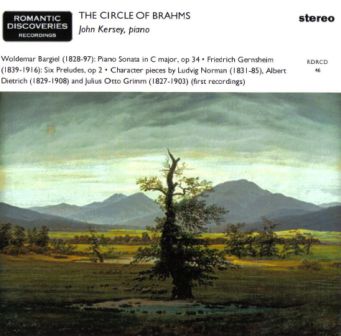
The Circle of Brahms

The Circle of Brahms
John Kersey, piano
RDR CD46

Total time: 71 mins 51 secs

Woldemar Bargiel (1828-97): Piano Sonata in C major, op 34
1. Allegro moderato, ma con passione (10’30”) 2. Andante, un poco con moto (8’08”) 3. Adagio maestoso – Allegro molto – Prestissimo – Presto possibile (7’27”)

Ludvig Norman (1831-85): Two Character Pieces, op 1
4. no. 1: Allegro commodo (5’29”) 5. no. 2: Der Sonntagsritt (The Sunday Ride) (7’11”)
6. Reality (3’17”)

Albert Dietrich (1829-1908): from Four Piano Pieces, op 2
7. no. 2: Canon (4’25”) 8. no. 4: Sehr ruhig, ausdrucksvoll (5’33”)

Julius Otto Grimm (1827-1903): from Abendbilder (Evening Scenes), op 2
9. no. 1: Abendlandschaft (Evening landscape) (2’13”) 10. no. 4: Elfenchor (Elves’ Chorus) (1’20”)

Friedrich Gernsheim (1839-1916)
Six Preludes, op 2
11. no. 1: Un poco lento e sostenuto (2’18”) 12. no. 2: Andante espressivo (2’29”) 13. no. 3: Allegro energico (2’11”) 14. no. 4: Andantino (3’47”) 15. no. 5: Allegretto vivace e leggiero (2’06”) 16. no. 6: Allegro molto agitato (2’20”)

We are grateful to Dr. Klaus Tischendorf for supplying copies of scores for use in this recording.

Woldemar Bargiel was not a prolific composer, but his works deserve greater attention than the almost complete neglect they fell into in the years immediately following his death. Similarly, if he is known at all these days, it is as the half-brother of Clara Schumann (as a result of her mother’s second marriage to music teacher Adolf Bargiel), with the implication that not only was the success of his career due to this connexion (which was undoubtedly the case) but also that such reputation that he enjoyed was merely the result of this nepotism (which was certainly not so).

Bargiel studied under Moscheles, Hauptmann, Rietz and Gade at the Leipzig Conservatoire (being noted among the younger generation in Schumann’s Neue Bahnen in 1853) and from 1859 took up a teaching position as a theorist at the conservatoire in Köln. 1866 saw him move to Rotterdam where he concentrated on conducting and musical direction, and 1874 (at the invitation of Joachim) back to Berlin (where he had taught privately throughout the 1850s) as professor of composition at the Royal Hochschule. He attained the peak of professional recognition as a senator of the Akademie der Künste, teaching up until his death at the age of sixty-nine.

Bargiel’s well-crafted and distinctive music enjoyed wide popularity during his lifetime. As well as piano music, he wrote a number of chamber works, songs, and orchestral pieces. His Piano Sonata is a large-scale, heroic work cast firmly in the Brahmsian mould but possessing a confidence and distinction that Brahms himself might well have admired. It begins with a suitably “symphonic” movement introduced by a broad theme that is contrasted with more agitated triplet material and developed with some distinct Beethovenian touches (note the chordal near-quote from the “Eroica”) The central slow movement, which acts to some extent as relief from this intense drama, was a favourite of Bargiel’s to the extent that he orchestrated it as the Intermezzo, op 46. His tarantella finale ends with a brilliant coda calling to mind the example of Beethoven’s “Waldstein” sonata as well as Brahms’ own F minor example in that genre.

The Swede Ludvig Norman studied at the Leipzig Conservatoire between 1848 and 1852 (and was mentioned by Schumann as a rising star of the younger generation in his 1853 Neue Bahnen). He returned to Sweden to teach (appointed to the Stockholm Conservatoire in 1858) and then in 1861 to become Hofkapellmeister of the Royal Theatre there. He was among the most important Swedish musicians of his time and represents the continuation of the school of Schumann, Gade and Mendelssohn with strong elements of Brahmsian breadth and character (particularly apparent in his short piece “Reality”). His wife was the violinist Wilma Neruda, who left him after only a few years, and after his death married the conductor Sir Charles Hallé.

Albert Dietrich was not merely influenced by Brahms, but was one of the composer’s closest friends. Like Norman, he was of the school of Schumann, studying with the composer from 1851 and then, in 1853, meeting Brahms and collaborating on the “F-A-E Sonata” for Joachim. Thereafter, Dietrich was music director at the court of Oldenburg (1861-90) and did much to promote Brahms’ music. His mastery of counterpoint is well-illustrated by the Canon from his op 2 set.

The Latvian Julius Otto Grimm, like Dietrich, belonged to Brahms’ inner circle, having first met the younger composer in 1853. He spent some of 1854 in Hanover, and while visiting Brahms and Joachim in February met Robert and Clara Schumann. Only a few weeks later Robert Schumann threw himself into the Rhine.

In 1855, Grimm was appointed as professor and chorus conductor in Göttingen, and in 1860 became conductor of the Musikverein in Münster. His compositions were highly regarded during his lifetime and he was the recipient of many honours. His works include a symphony and a number of chamber and piano works, of which his early Abendbilder show a confident grasp of the smaller forms.

Friedrich Gernsheim met Brahms later in his career, in 1868, and from that point onwards showed a notable Brahmsian influence in his works, which include four symphonies, concertos and much chamber music. However, he was not without an individual voice, as his early virtuosic Preludes show, and had clearly learned much of piano technique from his teacher Moscheles.

Read Full Post »

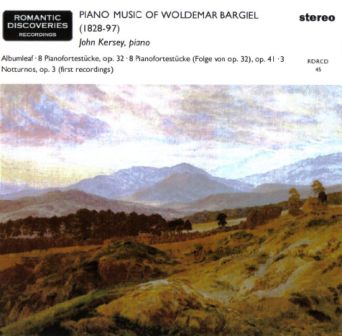
Piano music of Woldemar Bargiel (1828-97)

Piano music of Woldemar Bargiel (1828-97)
John Kersey, piano
RDR CD45

Total time: 75 mins 58 secs

Albumleaf in B flat major (1’23”)

Acht Pianofortestücke, op 32
1. Allegro con grazia (1’47”) 2. Andante con moto (5’43”) 3. Presto (2’37”) 4. Lento (6’15”) 5. Allegretto, un poco Allegro (1’49”) 6. Allegro commodo (1’53”) 7. Andante sostenuto (5’53”) 8. Con moto grazioso (2’25”)

Drei Notturnos, op 3
1. Allegretto (8’38”) 2. Andante (2’39”) 3. Andante (7’40”)

Acht Pianofortestücke (Folge von op. 32), op 41
1. Tempo di Menuetto (2’03”) 2. Allegro, non troppo (2’11”) 3. Andante, molto cantabile (3’11”) 4. Con grazia (1’40”) 5. Con moto (5’12”) 6. Presto e leggierissimo (1’46”) 7. Andante (5’59”) 8. Allegro molto (3’46”)

We are grateful to Dr. Klaus Tischendorf for supplying copies of scores for use in this recording.

Woldemar Bargiel was not a prolific composer, but his works deserve greater attention than the almost complete neglect they fell into in the years immediately following his death. Similarly, if he is known at all these days, it is as the half-brother of Clara Schumann (as a result of her mother’s second marriage to music teacher Adolf Bargiel), with the implication that not only was the success of his career due to this connexion (which was undoubtedly the case) but also that such reputation that he enjoyed was merely the result of this nepotism (which was certainly not so).

Bargiel studied under Moscheles, Hauptmann, Rietz and Gade at the Leipzig Conservatoire (being noted among the younger generation in Schumann’s Neue Bahnen in 1853) and from 1859 took up a teaching position as a theorist at the conservatoire in Köln. 1866 saw him move to Rotterdam where he concentrated on conducting and musical direction, and 1874 (at the invitation of Joachim) back to Berlin (where he had taught privately throughout the 1850s) as professor of composition at the Royal Hochschule. He attained the peak of professional recognition as a senator of the Akademie der Künste, teaching up until his death at the age of sixty-nine.

Bargiel’s well-crafted and distinctive music enjoyed wide popularity during his lifetime. As well as piano music, he wrote a number of chamber works, songs, and orchestral pieces. His Notturnos date from 1853 and show a command of the Gothic style he had inherited from Schumann, but in the first, particularly, adding a rhetorical element that creates an individual impression. This, however, was not to be a major feature of his later works, and in the major piano sets opp. 32 and 41 he looks to Brahms and Mendelssohn for inspiration.

The set op 32, dating from November 1865, is ambitious in its uniting of diverse moods and textures. Beginning with the Mendelssohnian no. 1 (Allegro con grazia), the second piece (Andante con moto) recalls the funeral marches of both Beethoven and Schumann (in the Piano Quintet). Bargiel’s economy of texture in the initial section is notable. This is followed by an energetic Presto perpetuum mobile that keeps the hands desynchronised throughout. Such activity is followed by the Schubertian D minor Lento (no. 4) which surely has the slow movement of the B flat major sonata (D.960) in mind for its initial rhythmic idea. The central material expands in texture in a more Schumannesque style. The piece that follows might have been termed by Brahms Intermezzo; it treats a scalic idea strongly reminiscent of him. This is succeeded by the brief and flowing Allegro commodo (no. 6), republished on its own as “Pensee fugitive”. The penultimate piece of the set, an Andante sostenuto marked molto espressivo e cantabile is typical of Bargiel’s musical language, moving from the declamatory opening melody into a more ardent E minor central section. The cycle ends with a landler-like movement in D minor that plays to some extent with interior voice effects.

Following in August 1877, the cycle op. 41 was designated a successor to op. 32 and expands those pieces with a number that explore more extrovert textures. Beginning with a grand minuet with plentiful octave scoring, the second piece (Allegro, non troppo) is full of fire and determination, packing a good deal of development into its compact form, and demonstrating an able command of Brahmsian virtuoso effect. Its octaves and chords are replaced by the calm Andante, molto cantabile (no. 3) which has the effect of quartet writing. Although folk music is not a major influence on Bargiel’s style, the fourth piece has a rustic feel to it and foreshadows Dvorak’s Slavonic Dances. Bargiel then gives us an extended scena in the following Con moto, whose passionate central section alternates octave and chordal writing with a Schubertian chromatic tremolo in double-notes. Such seriousness needs pause, and this is provided by the Mendelssohnian Presto e leggierissimo, demanding staccato effects achieved through a haze of pedal and occasionally emerging in clarity. The seventh piece is a C minor Andante that would be worthy of any sonata slow movement; its triplet central section is fused with the opening melody on its return. The finale, although not developed to any great extent, is a bright and fast-moving rondo with plenty of personality and an emphatic conclusion.

The short and charming Albumleaf dates from November 1871 and provides an effective summation of Bargiel’s best qualities of melodic invention and textural command.

Read Full Post »

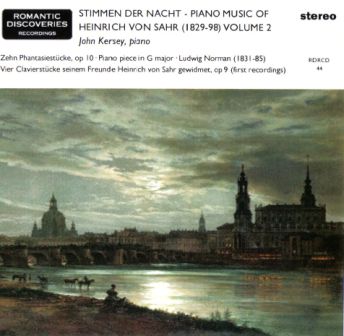
Stimmen der Nacht
Piano music of Heinrich von Sahr (1829-98) vol 2

John Kersey, piano
RDR CD44

Total time: 63 mins 42 secs

Zehn Phantasiestücke, op 10
1. Widmung – Andante con moto – Zum Abschied (7’37”) 2. Moderato (7’24”) 3. Allegretto (5’44”) 4. Zum 4 November (2’06”) 5. Andante (2’52”) 6. Dolce far niente (7’23”) 7. Vivace (1’30”) 8. Scherzo (4’37”) 9. Venetianisches Gondellied (4’43”) 10. Abendlied (3’16”)

Piano piece in G major (unpublished) (1’08”)

Ludwig Norman (1831-85): Vier Clavierstücke seinem Freunde Heinrich von Sahr gewidmet, op 9
1. Allegro non tanto e grazioso (3’59”) 2. Allegro moderato (4’07”) 3. Molto vivace (3’00”) 4. Andante sostenuto (3’13”)

We are grateful to Dr. Klaus Tischendorf for supplying copies of scores for use in this recording. The CD includes programme notes in German by Dr. Tischendorf.

The composer Heinrich von Sahr (actually Heinrich Ernst Sahrer of Sahr) was the son of a wealthy aristocratic family born on 2 November 1829 in Dresden. After graduating high school (as a colleague of Hans von Bülow), Sahr in 1848 went to the Leipzig Conservatory and was soon initiated into the circles of musicians influenced by Mendelssohn and Schumann. He was friendly with Woldemar Bargiel, Julius Otto Grimm and Albert Dietrich. The latter took him to Dusseldorf in 1852 to Robert Schumann, who already had noted Sahr in Dresden in 1847 in his Projektenbuch under Younger Composers of my choice. In 1854 the circle of friends expanded to Johannes Brahms, whom Sahr introduced to Leipzig’s artistic circles. The friendship with Brahms existed until the early 1880s: 1878 saw Sahr, Brahms, Billroth and Goldmark make a trip to Italy. After deputising for his sick friend Albert Dietrich as Hofkapellmeister in Oldenburg in 1863, he went in 1868, probably courtesy of his friend Bülow, to become teacher of harmony at the Royal School of Music in Munich. Yet in 1870, however, he had already retired from the faculty. He took up no other position, but withdrew more and more into private life. His last published works were printed in 1886. On 6 December 1898, Heinrich von Sahr died in Munich. His small worklist (16 opus numbers) includes, in addition to the piano pieces, 3 orchestral works, and 11 collections of songs.

Sahr was at once severely depressive and a visionary creator, keen to share his gifts and inspiring love in his friends. He is one of those composers from the radius of Johannes Brahms (such as Joseph Joachim, Gustav Nottebohm or Eusebius Mandyczewski), whose remarkable work disappeared in the towering shadow of their famous friend. The personal tragedy of this gifted musician resonates today. Hedwig von Holstein, the widow of the composer Franz von Holstein, with both of whom Sahr was very friendly, wrote in 1892 to Heinrich von Herzogenberg (whom Sahr wanted to visit in Munich): “But the poor Sahr shrank from the reputation of the giant [Brahms] and, in a fit of desperation, burned all of his manuscripts – those which were already printed, he could not destroy. Finally, he continued with his piano because he considered his playing was not good enough and made him unhappy.”

Read Full Post »

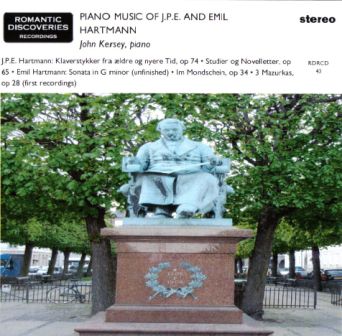
Piano music of J.P.E. (1805-1900) and Emil Hartmann (1836-98)
John Kersey, piano
RDR CD43

Total time: 74 mins 11 secs

Emil Hartmann (1836-98)
3 Mazurkas, op 28
1. Moderato (2’20”) 2. Vivo (2’19”) 3. Allegretto (2’21”)

Johann Peter Emilius Hartmann (1805-1900)
Studier og Novelletter (Studies and Novellettes), op 65:
4. Moderato con espressione (2’50”) 5. Allegro appassionato (1’21”) 6. Moderato (2’14”) 7. Allegro agitato, con passione (00’54”) 8. Moderato pastorale (1’41”) 9. Allegro (1’47”) 10. Allegro vivo scherzando (2’07”) 11. Moderato (1’53”) 12. Allegretto grazioso (1’43”)

Emil Hartmann (edition: Denis Waelbroeck)
Sonata in G minor (unfinished):
13. Allegro (7’53”) 14. Andante (3’19”) 15. Finale (2’55”)

Johann Peter Emilius Hartmann
Klaverstykker fra ældre og nyere Tid (Piano pieces from older and newer times), op 74:
16. Allegro moderato, con passione (4’39”) 17. Allegro energico, non vivace (6’20”) 18. Andantino sostenuto (3’23”) 19. Allegretto moderato (3’47”) 20. Allegro moderato e cantabile (4’32”)

Emil Hartmann
21. Im Mondschein – Introduction und Waltzer, op 34 (9’34”)
22. Jean de France – Sarabande (2’44”)

We are grateful to Dr. Denis Waelbroeck for supplying copies of scores and his editions for use in this recording.

This disc presents two generations – father and son – of the gifted Danish Hartmann dynasty, a family of musicians and creative artists that included, as well as those featured on this disc, such names as Niels Gade and August Winding (sons-in-law of J.P.E.), and in time Niels Viggo Bentzon (great-grandson of J.P.E.)

Johann Peter Emilius Hartmann succeeded his father at the Garnisons Kirke in 1824, and thereafter was successively professor at Copenhagen University and the founding director of the Conservatoire there from 1867. His studies in Europe in 1836 brought him into contact with Chopin, Rossini, Cherubini and Spohr. In musical style he successfully fused elements of Nordic nationalism with a post-Mendelssohnian style that at its most progressive (such as in op 74) clearly looks forward to Brahms. The quality of Hartmann’s inspiration and mastery of compositional and pianistic technique was considerable, and marks him out as the leading Danish composer for the piano of his generation.

Emil Hartmann received his early training from his father and developed a successful career in his homeland and Germany, despite being somewhat eclipsed by his father’s fame. His unpublished Sonata shows a forward-looking grasp of the mid-Romantic idiom, with a powerful opening movement followed by two that were both left unfinished, interestingly when each had reached similar melodic ideas. His shorter works are gratefully written for the instrument, showing an apt grasp of the salon style of the turn of the century.

Read Full Post »

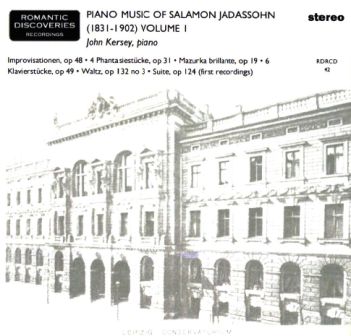
Piano music of Salomon Jadassohn (1831-1902)
John Kersey, piano
RDR CD42

Total time: 68 mins 1 sec

Vier Phantasiestücke, op 31
1. Andantino grazioso (1’48”) 2. Quasi Allegretto (3’09”) 3. Mouvement de Valse très-animé (2’29”) 4. Marcato e vigoroso, non troppo Allegro (3’44”)

5. Mazurka brillante, op 19 (3’00”)

Improvisationen, op 48
6. Andante, non troppo lento (2’28”) 7. Lento (3’35”) 8. Non troppo agitato (2’07”) 9. Allegro vigoroso (3’50”)

Sechs Klavierstücke, op 49
10. Lento (2’16”) 11. Allegretto scherzando (2’08”) 12. Allegretto (4’30”) 13. In tempo moderato (3’04”) 14. Lento espressivo (2’43”) 15. Allegretto, non troppo vivo (4’30”)

16. Valse, op 132 no 3 (2’31”)

Suite, op 124
17. Einleitung – Mesto e patetico (5’02”) 18. Scherzo – Allegretto vivo (2’09”) 19. Andante tranquillo (4’03”) 20. Menuett – Andantino, un poco lento (2’15”) 21. Finale – Allegro di marcia (5’11”)

According to Jadassohn scholar Klaus-Peter Koch, there are two major reasons why the music of Salomon Jadassohn is not better known today. One is that, as a Jew, he was a victim of the anti-Semitism of Wilhelmine Germany, in which critics labelled his music as academic and dry, and the other is that he was overshadowed by his colleague at the Leipzig Conservatoire, Carl Reinecke.

As this recording – only the second ever to be devoted to Jadassohn, and the first to include any of his piano music – hopefully shows, Jadassohn was far from dry, instead being a composer of melodic felicity and great harmonic imagination, with his unexpected use of chords at times drawing parallels with Alkan and Jadassohn’s own pupil Busoni. There are around 140 works in total, written for every medium from symphonic works to lieder and characteristic pieces for the piano.

Jadassohn studied with Moritz Hauptmann and Moscheles at the Leipzig Conservatoire and also for three years (1849-51) with Liszt in Weimar. He admired the music of Liszt and Wagner greatly. In 1893 he was awarded a professorship at the Leipzig Conservatoire, a post which he held until his death. His pupils included Grieg (some of whose Lyric Pieces were surely influenced by the Jadassohn works on this disc), Busoni, Delius and Karg-Elert. He was considered a master of counterpoint.

Jadassohn’s music is not merely well-crafted, it is highly original. Whether in the grand conception of the Suite, op 124, or the sets of piano pieces, there is a subtlety and depth of feeling that mark these works out as worthy of greater attention. This is music that rarely behaves as one might expect.

Read Full Post »

Stimmen der Nacht
Piano music of Heinrich von Sahr (1829-98)

John Kersey, piano
RDR CD41

Total time: 69 mins 17 secs

Acht Clavierstücke, op 1
1. In Nordischer Weise (In Nordic Style) (2’08”) 2. Allegretto (2’31”) 3. Andante (5’53”) 4. Allegro (2’19”) 5.Andante (1’42”) 6.Jagdlied (Hunting Song) (3’07”) 7. Allegretto (3’08”) 8. Andante con moto (2’04”)

Stimmen der Nacht (Voices of the Night), op 3
1. Allegro vivace e appassionato (5’25”) 2. Larghetto, ma non troppo (3’33) 3. Allegro molto vivace e appassionato (3’53”) 4. Andante tranquillo (3’10”) 5. Andante sostenuto (4’03”)

Variationen über ein eigenes Thema (Variations on an original theme), op 10 (25’24”)

We are grateful to Dr. Klaus Tischendorf for supplying copies of scores for use in this recording. The CD includes programme notes in German by Dr. Tischendorf.

The composer Heinrich von Sahr (actually Heinrich Ernst Sahrer of Sahr) was the son of a wealthy aristocratic family born on 2 November 1829 in Dresden. After graduating high school (as a colleague of Hans von Bülow), Sahr in 1848 went to the Leipzig Conservatory and was soon initiated into the circles of musicians influenced by Mendelssohn and Schumann. He was friendly with Woldemar Bargiel, Julius Otto Grimm and Albert Dietrich. The latter took him to Dusseldorf in 1852 to Robert Schumann, who already had noted Sahr in Dresden in 1847 in his Projektenbuch under Younger Composers of my choice. In 1854 the circle of friends expanded to Johannes Brahms, whom Sahr introduced to Leipzig’s artistic circles. The friendship with Brahms existed until the early 1880s: 1878 saw Sahr, Brahms, Billroth and Goldmark make a trip to Italy. After deputising for his sick friend Albert Dietrich as Hofkapellmeister in Oldenburg in 1863, he went in 1868, probably courtesy of his friend Bülow, to become teacher of harmony at the Royal School of Music in Munich. Yet in 1870, however, he had already retired from the faculty. He took up no other position, but withdrew more and more into private life. His last published works were printed in 1886. On 6 December 1898, Heinrich von Sahr died in Munich. His small worklist (16 opus numbers) includes, in addition to the piano pieces, 3 orchestral works, and 11 collections of songs.

Sahr was at once severely depressive and a visionary creator, keen to share his gifts and inspiring love in his friends. He is one of those composers from the radius of Johannes Brahms (such as Joseph Joachim, Gustav Nottebohm or Eusebius Mandyczewski), whose remarkable work disappeared in the towering shadow of their famous friend. The personal tragedy of this gifted musician resonates today. Hedwig von Holstein, the widow of the composer Franz von Holstein, with both of whom Sahr was very friendly, wrote in 1892 to Heinrich von Herzogenberg (whom Sahr wanted to visit in Munich): “But the poor Sahr shrank from the reputation of the giant [Brahms] and, in a fit of desperation, burned all of his manuscripts – those which were already printed, he could not destroy. Finally, he continued with his piano because he considered his playing was not good enough and made him unhappy.”

Read Full Post »

Theodor Kirchner (1823-1903)
Romantic Poems

John Kersey, piano
RDR CD39

Total time: 65 mins 12 secs

Romantische Geschichten, op 73:
Volume 1:
1) Eintritt (Entrance) (5’01”) 2) Frühlingsgruss (Spring Greeting) (3’26”) 3) Ein Davidsbündlertanz (A Dance of the David’s-League) (2’02”) 4) Damals (Days gone by) (4’18”) 5) Ländler (1’04”)

Volume 2:
6) Romanze (2’20”) 7) Humoreske (4’28”) 8) Legende (3’15”) 9) Im Circus (At the Circus) (2’00”) 10) Menuett (1’37”)

Volume 3:
11) Novellette (2’16”) 12) Nachtstuck (Nocturne) (5’18”) 13) A la Hongroise (In Hungarian style) (3’52”) 14) Impromptu (3’18”) 15) In’s Album (Albumleaf) (2’21”)

Volume 4:
16) Elegie (5’16”) 17) Daheim (At home) (4’17”) 18) Klage (Complaint) (2’02”) 19) Balladenmässig (In the style of a Ballade) (3’22”) 20) Abschiedslied (Song of Parting) (2’14”)

Fürchtegott Theodor Kirchner, a pupil of Mendelssohn at the newly-founded Leipzig Conservatoire, composed over 1,000 original works for piano, most of which are sets of miniatures. Kirchner expert Dr. Klaus Tischendorf, who has kindly provided the scores and cover photograph for these recordings, has described Kirchner as “the piano miniaturist of the Romantic era”.

Kirchner was recommended by Mendelssohn for the post of organist of Winterthur in Switzerland in 1843, and remained there for the next twenty years. The position gave him the opportunity to travel throughout Germany, and there he came into contact with Brahms and the Schumanns (he had first met Robert Schumann aged fourteen), who recognised in him an arch-Romantic and kindred spirit. He appears to have had a brief affair with Clara Schumann in the 1860s.

In 1862, Kirchner became director of the subscription concerts in Zurich, but remained there for only three years before returning to freelance life. He was appointed court pianist at Meiningen in 1872 and became director of the conservatoire in Würzburg the following year. Again, he did not stay long, and in 1876 moved to Leipzig for seven years, before going on to Dresden, where he taught score-reading. The year 1890 was a climactic one for him, for he abandoned his wife and family and went to live in Hamburg, where he was looked after by a former pupil. Four years later he suffered the first of two strokes that left himparalysed, and began to go blind.

“In his character there is no stability” wrote Clara Schumann. Kirchner’s career suffered because of his addiction to gambling and an extravagant lifestyle that was beyond his means, and his musical friends had periodically to bail him out from financial ruin. In 1884 a group including Brahms, Grieg, Gade and von Bülow raised thirty thousand marks to help him pay off his gambling debts.

Kirchner’s op 73 originated in the productive year 1883 and is among his most ambitious sets of pieces. The movements are both more extended and more virtuosic than in his contemporaneous works, but share with those the predominant themes of fantasy and nostalgia, and a certain harmonic exploration that takes its cue from both Schumann and Brahms. The inclusion of a Davidsbündlertanz is a reference to more than Schumann’s op 6; it also reflects Kirchner’s identification with Schumannesque principles in music at a time when these were under serious challenge from Wagner and his school. Those principles involve the imbuing of what in other hands might appear conventional forms with an inner life that comes from the distillation of emotion: as Kirchner was to write some time before 1886, his compositions are really felt and not merely churned out.

Read Full Post »

Theodor Kirchner (1823-1903)
Old Memories

John Kersey, piano
RDR CD38

Total time: 69 mins 53 secs

Alte Erinnerungen (Old Memories), op 74:
1) Poco lento, espressivo (2’20”) 2) Allegretto (3’03”) 3) Andantino espressivo (poco lento) (1’46”) 4) Moderato (3’21”) 5) Andantino (2’43”) 6) Con espressione (1’46”) 7) Cantabile (3’07”) 8) Allegretto (1’20”) 9) Andantino (2’30”) 10) Vivace scherzando (00’38”) 11) Comodo (2’21”) 12) Poco lento (2’30”).

13) Scherzo no. 2, op 54 (5’27”).

“Aus der Jugendzeit” (From Childhood), op 88:
14) Allegro moderato (00’53”) 15) Poco Allegro (1’24”) 16) Moderato (1’41”) 17) Risoluto (1’18”) 18) Vivace scherzando (00’59”) 19) Poco Allegro (1’02”) 20) Lento (1’17”) 21) Vivace (1’06”) 22) Poco lento (1’14”) 23) Allegretto (1’12”).

Federzeichnungen (Pen and Ink Sketches), op 47:
24) Moderato (2’45”) 25) Allegro ma non troppo (3’00”) 26) Moderato (3’04”) 27) Poco lento (2’14”) 28) Allegro vivace (1’58”) 29) Andantino (3’06”) 30) Moderato, cantabile (1’39”) 31) Poco lento (2’06”) 32) Intermezzo (Allegretto con moto) (1’03”) 33) Zum Schluss (Poco lento) (1’36”)

Fürchtegott Theodor Kirchner, a pupil of Mendelssohn at the newly-founded Leipzig Conservatoire, composed over 1,000 original works for piano, most of which are sets of miniatures. Kirchner expert Dr. Klaus Tischendorf, who has kindly provided the scores and 1890 cover photograph for these recordings, has described Kirchner as “the piano miniaturist of the Romantic era”.

Kirchner was recommended by Mendelssohn for the post of organist of Winterthur in Switzerland in 1843, and remained there for the next twenty years. The position gave him the opportunity to travel throughout Germany, and there he came into contact with Brahms and the Schumanns (he had first met Robert Schumann aged fourteen), who recognised in him an arch-Romantic and kindred spirit. He appears to have had a brief affair with Clara Schumann in the 1860s.

In 1862, Kirchner became director of the subscription concerts in Zurich, but remained there for only three years before returning to freelance life. He was appointed court pianist at Meiningen in 1872 and became director of the conservatoire in Würzburg the following year. Again, he did not stay long, and in 1876 moved to Leipzig for seven years, before going on to Dresden, where he taught score-reading. The year 1890 was a climactic one for him, for he abandoned his wife and family and went to live in Hamburg, where he was looked after by a former pupil. Four years later he suffered the first of two strokes that left himparalysed, and began to go blind.

“In his character there is no stability” wrote Clara Schumann. Kirchner’s career suffered because of his addiction to gambling and an extravagant lifestyle that was beyond his means, and his musical friends had periodically to bail him out from financial ruin. In 1884 a group including Brahms, Grieg, Gade and von Bülow raised thirty thousand marks to help him pay off his gambling debts.

Kirchner’s op 74, dating from 1885, is one of his finest mature sets of pieces, and inhabits his favourite mood of reminiscent Innigkeit. Most of the pieces are quiet, reflective and concentrate on the expression of subtle and restrained emotion. By contrast, Kirchner the virtuoso appears in the Second Scherzo (1881), whose trio was described in a contemporary review as “one of the most beautiful movements that have ever come from Kirchner’s pen. The beauty of sound of this simple cantilena, which at times flowers with a finely Chopin-like arabesque, cannot be put into words.” Kirchner’s op 88 (1889) follows Schumann’s op 15 example in that it is a set of pieces describing childhood in retrospect, rather than intended for children to perform. The Federzeichnungen (1880) are more ambitious, calling upon a richly expressive palette to create interior landscapes of lasting melodic and harmonic quality.

Read Full Post »

« Newer Posts - Older Posts »