Archive for the ‘Catalogue’ Category

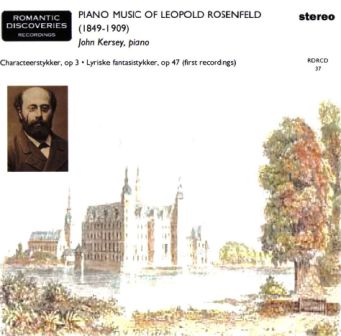
Leopold Rosenfeld (1849-1909)
Lyric Fantasy Pieces

John Kersey, piano
RDR CD37

Total time: 71 mins 54 secs

Characteerstykker (Character Pieces), op 3:
1) Allegro moderato e agitato (4’18”) 2) Fra Gammel Tid (3’43”) 3) Slot I Skoven (4’32”) 4) Allegro agitato (2’24”) 5) Latter (3’26”)

Lyriske fantasistykker (Lyric Fantasy Pieces), op 47:
Book 1:
6) Humoreske (1’53”) 7) Legende (3’36”) 8) Cracovienne (1’14”) 9) Bondedans (1’58”) 10) Sylfelet (2’29”) 11) Valse érotique (3’12”) 12) Scherzino (1’07”)

Book 2:
13) Hilsen (1’22”) 14) Stille Tider (1’53”) 15) Alene (2’22”) 16) Foraarsmorgen (1’02”) 17) Af et Digt (2’29”) 18) Vekselsang (2’53”)  19) I Dag (2’24”) 20) Hilsen (1’37”) 21) Til Afsked (1’12”) 22) Hvorfor? (3’27”) 23) Forsilde (2’03”) 24) Øde (2’00”) 25) Farvel (2’40”) 26) Langfredag (1’24”) 27) Et Gravmæle (4’43”) 28) Epilog (1’43”)

We are grateful to Robert Commagere for the supply of scores for use in this project.

Danish composer Leopold Rosenfeld was born in Copenhagen on 21 July 1849, and at first was compelled by his father to enter commercial employment. However, his love of music caused a change of heart, and he then spent the years 1872-75 studying composition at the Copenhagen Conservatoire of Music. He won a travelling scholarship in 1881 and the title of professor was conferred on him in 1889. He was mainly active as a teacher of singing at the Royal Conservatoire and an author of a noted pedagogical work on voice-training, and also as critic of the newspaper Dannebrog among other periodicals.

Rosenfeld’s output is principally in the areas of piano music and song, but significant orchestral works include the once-popular Henrik og Else (1885). The early set of Characteerstykker show a clear influence of Schumann and his fellow Scandinavians Grieg and Ludvig Schytte within a particular strain of Nordic pessimism that was to make itself felt constantly within Rosenfeld’s work. The set of Lyriske fantasistykker op 47 takes us further into this world, in particular through Book 2 whose dark, reflective nature at times foreshadows Sibelius. The piano writing is sometimes orchestral in character, but throughout the emphasis is on melodic invention, creating a memorable impression. The theme of the final Epilog somehow manages to anticipate Bart Howard’s popular song Fly Me To The Moon by half a century.

Each of the Lyriske fantasistykker is preceded by a romantic vignette or short verse by Baroness Gudrun Reedz-Thott (1873-1917), who also provided the text for one of Rosenfeld’s op 46 songs. The subject matter is often melancholy, dealing with parting and death, so that the whole set forms a unified cycle travelling from the more energetic opening to the elegiac music of its conclusion.
Read Full Post »

Theodor Kirchner (1823-1903)
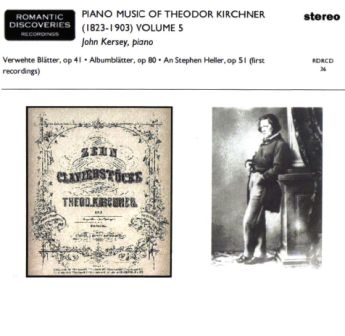
Fallen Leaves

John Kersey, piano
RDR CD36

Total time: 62 mins 5 secs

Verwehte Blätter (Fallen Leaves), op 41:
1) Moderato (3’00”) 2) Allegretto (2’17”) 3) Poco Allegretto (2’27”) 4) Allegro (1’36”) 5) Ziemlich langsam, zart (4’01”) 6) Andante (2’01”)

Albumblätter (Albumleaves), op 80:
7) Lento espressivo (2’25”) 8) Allegro (0’57”) 9) Moderato assai (3’33”) 10) Allegretto (3’23”) 11) Poco lento (1’10”) 12) Poco animato (1’15”) 13) Comodo (1’20”) 14) Vivace (1’06”) 15) Lento (2’20”)

An Stephen Heller (To Stephen Heller), op 51:
16) Andantino (4’06”) 17) Moderato (1’15”) 18) Allegro moderato (2’02”) 19) Etwas langsam und still (1’52”) 20) Poco Allegretto (1’57”) 21) Ruhig (2’05”) 22) Allegretto (1’22”) 23) Moderato (2’07”) 24) Sanft bewegt. Nicht schnell. (2’18”) 25) Sehr zart, nicht schnell (2’49”) 26) Con comodo (3’03”) 27) Langsam, ausdrucksvoll (2’22”)

Fürchtegott Theodor Kirchner, a pupil of Mendelssohn at the newly-founded Leipzig Conservatoire, composed over 1000 original works for piano, most of which are sets of miniatures. Kirchner expert Dr. Klaus Tischendorf, who has kindly provided the scores and 1861 cover photograph for these recordings, has described Kirchner as “the piano miniaturist of the Romantic era”.

Kirchner was recommended by Mendelssohn for the post of organist of Winterthur in Switzerland in 1843, and remained there for the next twenty years. The position gave him the opportunity to travel throughout Germany, and there he came into contact with Brahms and the Schumanns (he had first met Robert Schumann aged fourteen), who recognised in him an arch-Romantic and kindred spirit. He appears to have had a brief affair with Clara Schumann in the 1860s.

In 1862, Kirchner became director of the subscription concerts in Zurich, but remained there for only three years before returning to freelance life. He was appointed court pianist at Meiningen in 1872 and became director of the conservatoire in Würzburg the following year. Again, he did not stay long, and in 1876 moved to Leipzig for seven years, before going on to Dresden, where he taught score-reading. The year 1890 was a climactic one for him, for he abandoned his wife and family and went to live in Hamburg, where he was looked after by a former pupil. Four years later he suffered the first of two strokes that left him paralysed, and began to go blind.

“In his character there is no stability” wrote Clara Schumann. Kirchner’s career suffered because of his addiction to gambling and an extravagant lifestyle that was beyond his means, and his musical friends had periodically to bail him out from financial ruin. In 1884 a group including Brahms, Grieg, Gade and von Bülow raised thirty thousand marks to help him pay off his gambling debts.

The music on this disc dates from 1879 (op 41), 1880 (op 51) and 1887 (op 80), a time when Kirchner was reliant almost entirely on new compositions to provide his living expenses. The Fallen Leaves were reviewed at the time of their publication by Arnold Niggli in the Schweizerische Musikzeitung und Sängerblatt, who wrote “We must thus reckon the Fallen Leaves to be amongst the most delicately subtle of this master’s creations.” The high standard of this music is easily maintained in Kirchner’s tribute to the great pianist Stephen Heller, then very much in his twilight years, who responded “[Kirchner’s] works are my uncommon love. They give me true rest.” The op 80 set belongs to the same spirit of Innigkeit, and at its end quotes Kirchner’s first set of Albumleaves, op 7, which had been written some thirty years earlier.

Read Full Post »

Theodor Kirchner (1823-1903)
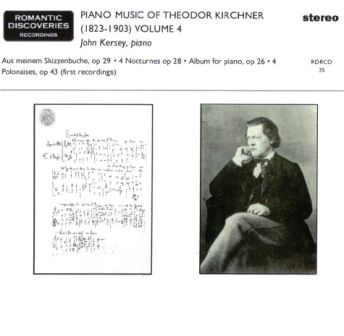
From my Sketchbook

John Kersey, piano
RDR CD35

Total time: 66 mins 3 secs

Four Nocturnes, op 28:
1) Ruhig, singend (5’25”) 2) Con sentimento (3’18”) 3) Moderato (3’07”) 4) Molto moderato (4’13”)

Aus meinem Skizzenbuche, op 29:
5) Ungarisch (1’56”) 6) Deutscher Walzer (3’00”) 7) Humoreske (3’26”) 8) Frühlingsgesang (2’21”) 9) Ständchen (3’25”) 10) Jagdstückchen (0’53”)

Album for piano, op 26 (19’29”):
11) Moderato (1’30”) 12) Allegretto scherzando (1’32”) 13) Ruhig (1’23”) 14) Allegretto (1’18”) 15) Moderato (2’17”) 16) Allegretto semplice (1’21”) 17) Vivace (00’59”) 18) Comodo (1’15”) 19) Ziemlich bewegt (1’45”) 20) Nicht zu schnell (1’24”) 21) Allegretto comodo(2’29”) 22) Ziemlich schnell (1’14”)

Four Polonaises, op 43:
12) Maestoso (2’25”) 13) Allegro ma non troppo (3’58”) 14) Lebhaft (4’59”) 15) Moderato (3’07”)

Fürchtegott Theodor Kirchner, a pupil of Mendelssohn at the newly-founded Leipzig Conservatoire, composed over 1000 original works for piano, most of which are sets of miniatures. Kirchner was recommended by Mendelssohn for the post of organist of Winterthur in Switzerland in 1843, and remained there for the next twenty years. The position gave him the opportunity to travel throughout Germany, and there he came into contact with Brahms and the Schumanns (he had first met Robert Schumann aged fourteen), who recognised in him an arch-Romantic and kindred spirit. He appears to have had a brief affair with Clara Schumann in the 1860s.

In 1862, Kirchner became director of the subscription concerts in Zurich, but remained there for only three years before returning to freelance life. He was appointed court pianist at Meiningen in 1872 and became director of the conservatoire in Würzburg the following year. Again, he did not stay long, and in 1876 moved to Leipzig for seven years, before going on to Dresden, where he taught score-reading. The year 1890 was a climactic one for him, for he abandoned his wife and family and went to live in Hamburg, where he was looked after by a former pupil. Four years later he suffered the first of two strokes that left him paralysed, and began to go blind.

“In his character there is no stability” wrote Clara Schumann. Kirchner’s career suffered because of his addiction to gambling and an extravagant lifestyle that was beyond his means, and his musical friends had periodically to bail him out from financial ruin. In 1884 a group including Brahms, Grieg, Gade and von Bülow raised thirty thousand marks to help him pay off his gambling debts.

Many of Kirchner’s original works were written for accomplished women pianists. They demand not merely a sound and sometimes virtuosic technique, but also a poetic imagination befitting the intimate setting of the nineteenth-century salon. His Sketchbook and Album showcase the creation of drama within the miniature in a way that foreshadows Grieg, and also develop the miniature into a larger-scale connected cycle. The Nocturnes and Polonaises (the latter of which also exist in versions for four hands) owe little to Chopin’s models, but rather offer an insight into the way the Germanic school made those forms their own at the height of their popularity. The Nocturnes in particular provide the ground for some novel harmonic effects in their agitated central sections.

Read Full Post »

« Newer Posts