Archive for the ‘Catalogue’ Category

Brahms Piano Works volume 1

Brahms Piano Works volume 1
Seven Fantasias, op. 116 • Six Piano Pieces, op. 118 • Four Piano Pieces, op. 119
John Kersey, piano
RDR CD139

Total time: 71 minutes 17 seconds

1. Seven Fantasias, op. 116 (27:02)
i. Capriccio in D Minor (Presto energico)
ii. Intermezzo in A Minor (Andante)
iii. Capriccio in G Minor (Allegro passionato)
iv. Intermezzo in E Major (Adagio)
v. Intermezzo in E Minor (Andante con grazia ed intimissimo sentimento)
vi. Intermezzo in E Major (Andante teneramente)
vii. Capriccio in D Minor (Allegro agitato)

2. Sechs Klavierstücke, op 118 (26:57)
i: Intermezzo in A minor
ii: Intermezzo in A major
iii: Ballade in G minor
iv: Intermezzo in F minor
v: Romanze in F major
vi: Intermezzo in E-flat minor

3. Vier Klavierstücke, op. 119 (17:13)
i. Intermezzo in B Minor
ii. Intermezzo in E Minor
iii. Intermezzo in C Major
iv. Rhapsodie in E Flat Major

Read Full Post »

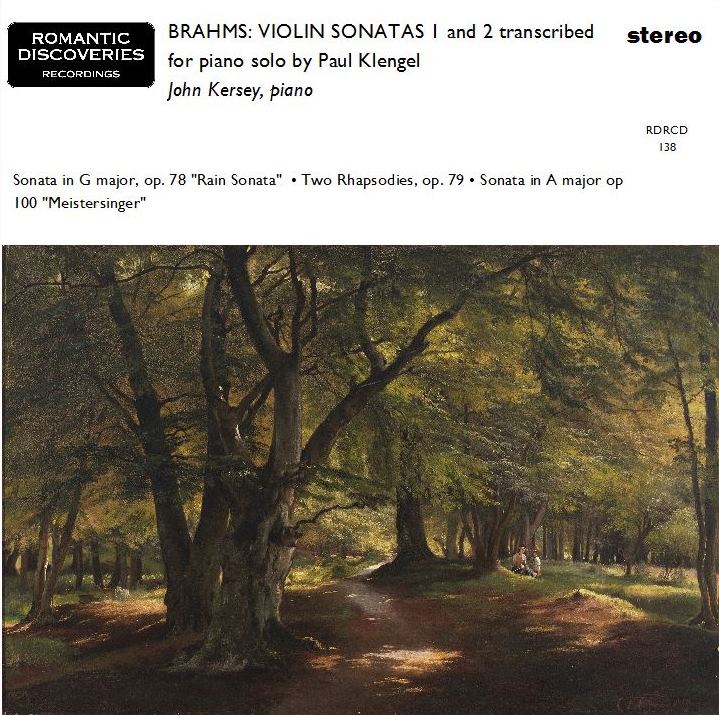
Brahms Violin Sonatas 1 and 2 transcribed for piano solo by Paul Klengel
Sonata in G major, op. 78 “Rain Sonata” • Two Rhapsodies, op. 79 • Sonata in A major op 100 “Meistersinger” (includes first recordings)
John Kersey, piano
RDR CD138

Total time: 72 minutes 3 seconds

1. Johannes Brahms (1833-97) Sonata for violin and piano no. 1 in G major, op. 78 “Rain Sonata”, transcribed for solo piano by Paul Klengel (1854-1935) (31:54)
i. Vivace ma non troppo
ii. Adagio
iii. Allegro molto moderato

2. Johannes Brahms (1833-97): Two Rhapsodies, op 79 (15:49)
i. Agitato in B minor
ii. Molto passionato, ma non troppo Allegro in G minor

3. Johannes Brahms (1833-97) Sonata for piano and violin no. 2 in A major, op. 100 “Meistersinger” (1886), transcribed for solo piano by Paul Klengel (1854-1935) (24:14)
i. Allegro amabile
ii. Andante tranquillo – Vivace
iii. Allegretto grazioso, quasi Andante

Read Full Post »

Piano Music of Frédéric Chopin (1810-49) volume 2
Polonaise-fantaisie, op. 61 • Scherzos nos. 2 and 4 • Barcarolle, op. 60 • Polonaise op. 44 • Two Nocturnes, op. 62
John Kersey, piano
RDR CD137

Total time: 76 minutes 15 seconds

1. Polonaise-fantaisie in A flat major, op 61 (16:04)

2. Scherzo in B flat minor, op. 31 (11:00)

3. Barcarolle in F sharp major, op. 60 (10:03)

4. Polonaise in F sharp minor, op. 44 (12:08)

5. Two Nocturnes, op 62 (14:16)
i. Andante in B major
ii. Lento in E major

6. Scherzo no. 4 in E major, op. 54 (12:32)

Read Full Post »

Piano Music of Frédéric Chopin (1810-49) volume 1
Piano Sonata no. 3 in B minor, op. 58 • Two Nocturnes, op. 32 • Two Polonaises, op. 26
John Kersey, piano
RDR CD136

Total time: 70 minutes 14 seconds

1. Piano Sonata no. 3 in B minor, op. 58 (38:04)
i. Allegro maestoso
ii. Scherzo: Molto vivace
iii. Largo
iv. Finale: Presto non tanto
The variant passages in the first movement exposition are taken from the 1845 first edition published by J. Meissonier in Paris.

2. Two Nocturnes, op 32 (11:17)
i. Andante sostenuto in B major
ii. Lento in A flat major

3. Two Polonaises, op 26 (20:49)
i. Allegro appassionato in C sharp minor
ii. Maestoso in E flat minor

Read Full Post »

Piano Music by Nikolai Medtner

Piano Music of Nikolai Medtner (1880-1951)
Canzona matinata and Sonata tragica from op 39 • Sonate-elegie (Sonata no. 3) op 11 no 2 • Sonata reminiscenza, op 38 no 1 • Sonata no. 4 in C major, op. 11 no. 3 • Sonata no. 9 in A minor “War Sonata”, op. 30
John Kersey, piano
RDR CD135

Total time: 70 minutes 35 seconds

1. from Forgotten Melodies book 2, op. 39 nos. 4 and 5 (1920) (17:25)
i. Canzona matinata ii. Sonata tragica (Sonata no. 11)

2. Sonate-elegie (Sonata no. 3), op. 11 no. 2 (7:09)

3. from Forgotten Melodies book 1, op. 38 no. 1 (1920) (17:38)
i. Sonata reminiscenza (Sonata no. 10)

4. Sonata no. 4 in C major, op. 11 no. 3 (11:38)
“Und so das Herz erleichtert merkt behende,
Daß es noch lebt und schlägt und möchte schlagen,
Zum reinsten Dank der überreichen Spende
Sich selbst erwidernd willig darzutragen.
Da fühlte sich – o daß es ewig bliebe! –
Das Doppelglück der Töne wie der Liebe.”
Johann Wolfgang von Goethe

5. Piano Sonata no. 9 in A minor “War Sonata”, op. 30 (16:35)

“I want to speak of music….as a country, our native country which determines our musicians’ nationality, our musicality, a country in relation to which all our ‘ideologies’, schools, individualities, are merely sides.” – Nikolai Medtner, The Muse and the Fashion.

Read Full Post »

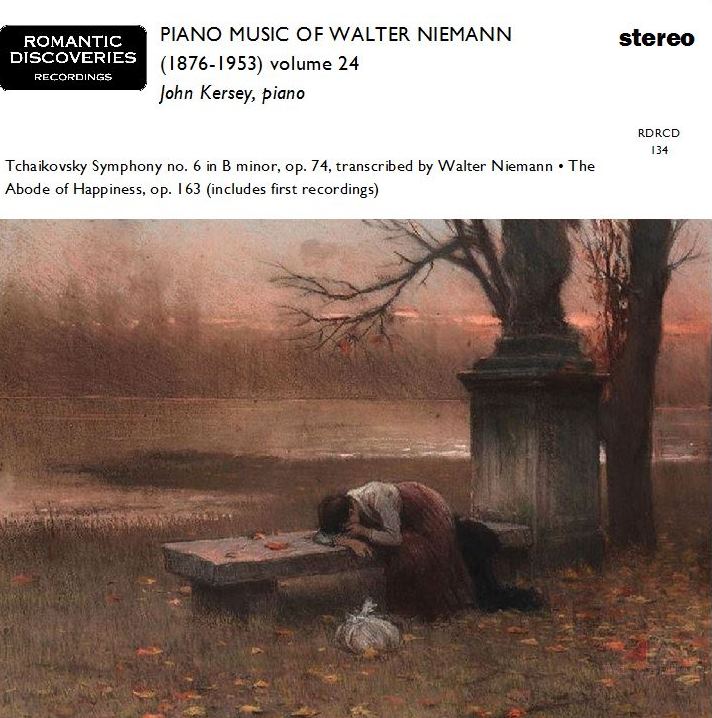
Piano Music of Walter Niemann volume 24
Tchaikovsky Symphony no. 6 in B minor, op. 74, transcribed by Walter Niemann • The Abode of Happiness, op. 163 (includes first recordings)
John Kersey, piano
RDR CD134

Total time: 78 minutes 35 seconds

1. Peter Ilyich Tchaikovsky (1840-93): Symphony no. 6 in B minor, op. 74 “Pathetique”, transcribed for solo piano by Walter Niemann (49:10)
I. Adagio – Allegro non troppo
2. Allegro con grazia
3. Allegro molto vivace
4. Finale. Adagio lamentoso – Andante

2. Die Wohnung des Glücks, op. 163 (13:06)
In grateful memory of his sister Elisabeth (1866-1942), with whom he had lived all his life.
i. Home
ii. Summerland
iii. A Birthday
iv Grief and Consolation
v. Epilogue

Our thanks go to Nicolo Figowy and Steffen Herrmann for their generous loan of scores.

Walter Niemann was regarded in 1927 as “the most important living piano composer who knows how to make music from the piano in a subtle and colorful way, although he often enters the field of salon music” (H. Abert, Illustrated Music Lexicon). This most sensitive and introverted master of the piano devoted his life to composition and musical scholarship, also performing his music in concerts and radio broadcasts. Niemann’s vast output for the piano is only now starting to become more widely known. Although his style is generally unashamedly conservative, he was one of the very few German composers to explore Impressionism in music, and this also reflected a fascination with the Far East. Elsewhere, Niemann’s imagination takes us from much Baroque recreation to large-scale epic sonatas, Schumannesque miniatures and even the exploration of early jazz styles. His understanding of the capabilities of the piano was complete, and his works include both collections for young pianists and mature works that exploit the full range of pianistic effect and make significant demands on the performer.

Read Full Post »

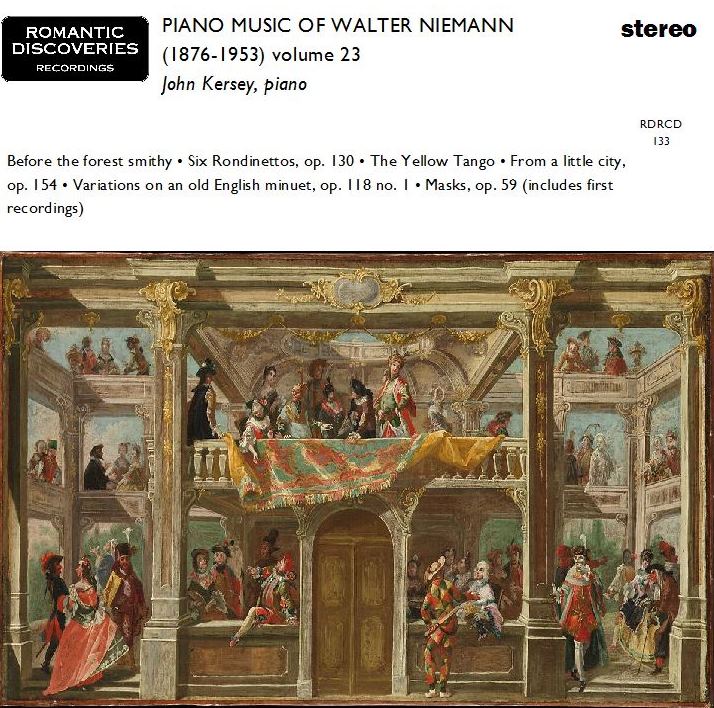
Piano Music of Walter Niemann volume 23
Before the forest smithy • Six Rondinettos, op. 130 • The Yellow Tango • From a little city, op. 154 • Variations on an old English minuet, op. 118 no. 1 • Masks, op. 59 (includes first recordings)
John Kersey, piano
RDR CD133

Total time: 60 minutes 48 seconds

1. Vor der Waldschmiede (published 1907) (3:50)

2. Six Rondinettos, op. 130 (8:47)
i. Amabile con moto, in modo pastorale ii. Allegro alla caccia ii. Moderato con moto e un poco malinconico iv. Amabile con moto v. Giocoso con moto vi. Allegro liquido

3, Der gelbe Tango (1933) (3:55)

4. Aus einer kleinen Stadt, op. 154 (after Wilhelm Raabe’s “Das Horn von Wanza”) (10:34)
i. The little city ii. The old gate iii. The peasant jug iv. Dance in the old patrician house (17th century) v. The worthies in the “Great Bear” vi. The little river in front of the city vii. Night and watchman’s call

5. Variations on an old English minuet (Theme (Minuet) from Sonata VIII by Thomas Augustine Arne (1710-78)), op. 118 no. 1 (7:07)

6. Masken, a cycle of twenty little character pieces, op. 59 (26:21)
i. Praeludium in Schumann’s style ii. Chinese Mandarin iii. Coquette iv. The Spanish Woman v. Johann Strauss vi. Louis XIV vii. Russian Folk Dances viii. The Timid One ix. German Girls x. Winter xi. Tarantella dance xii. Debussy xiii. The Jolly Dutch Gentleman xiv. The Black Larva xv. Grieg xvi. Biedermeier xvii. The Irascible One xviii. The Swiss Milkmaid xix. Italian Pipers xx. To End

Our thanks go to Nicolo Figowy and Steffen Herrmann for their generous loan of scores.

Walter Niemann was regarded in 1927 as “the most important living piano composer who knows how to make music from the piano in a subtle and colorful way, although he often enters the field of salon music” (H. Abert, Illustrated Music Lexicon). This most sensitive and introverted master of the piano devoted his life to composition and musical scholarship, also performing his music in concerts and radio broadcasts. Niemann’s vast output for the piano is only now starting to become more widely known. Although his style is generally unashamedly conservative, he was one of the very few German composers to explore Impressionism in music, and this also reflected a fascination with the Far East. Elsewhere, Niemann’s imagination takes us from much Baroque recreation to large-scale epic sonatas, Schumannesque miniatures and even the exploration of early jazz styles. His understanding of the capabilities of the piano was complete, and his works include both collections for young pianists and mature works that exploit the full range of pianistic effect and make significant demands on the performer.

Read Full Post »

Piano Music of Walter Niemann volume 22
Pickwick, op. 93 • Pictures from Chiemsee, op. 131 • Der Artushof, op. 158 • Tales from the Mountains, op. 41 • Scarlattiana, op. 126 (includes first recordings)
John Kersey, piano
RDR CD132

Total time: 78 minutes 35 seconds

1. Pickwick, a cycle after Charles Dickens, op. 93 (21:03)
i. Mr Pickwick ii. Mr Tupman Waltzes iii. The poetic Mr Snodgrass iv. Mr Winkle, the friend of the woods and hunts v. Sam and Mary (Duettino) vi. A morning in the country (Manor Farm) vii. The fat Joe viii. How Mr Weller drives his stagecoach ix. The Ball at Bath x It is over (A backwards glance)

2. Bilder vom Chiemsee, op. 131 (11:39)
i. Summer morning ii. In the monastery church (Fraueninsel) iii. Highland – Dirndl iv. Castle Herrenchiemsee (Herreninsel) v. On the lake vi. Highland – Bua vii. Mending the fishing nets (Fraueninsel) viii. Market day in Prien

3. Der Artushof – suite from old Danzig, op. 158 (11:36)
i. Praeludium (Moderato con moto) ii. Sarabande (Tempo di Sarabanda, largamente e solenne) iii. Menuett (Tempo di Minuetto, Allegretto amabile) iv. Alla Giga (Giocoso animato)
“Now a magical chiaroscuro crept through the murky windows, all the strange pictures and carvings with which the walls are richly decorated, became active and alive.” – E.T.A. Hoffmann, Der Artushof

4. Geschichten aus den Bergen, little Ländler and dances, op. 41 (14:14)
i. Sehr gemütlich und gemächlich ii. Anmutig, in mässigem Zeitmass iii. Ein wenig gehalten und trübe erregt iv. Mit Wärme, night zu schnell v. Ein wenig gehalten, mit sanft verhaltener Melancholie vi. Mit feurigem Aufschwung vii. Ein wenig gehalten, in stiller Wehmut viii. Anmutig und leicht bewegt ix. Mit sanfter Melancholie, ein wenig gehalten x. Den Manen Edvard Griegs – Sehr mässig, mit grösster Wärme xi. Schmerzlich gehalten xii. Mit derb-übermütiger Lustigkeit in Holzschuhen
“On the Wiesenanger, which, walking gently downhill, came up against the wood, and partly also on the harvested fields, there were stalls, tables with people feasting, there were bowling alleys, target shooting, swings, music stages, dance floors and I don’t know what else , towered over by poles with waving flags and swarming with colourful people.” – – Adalbert Stifter

Scarlattiana, three little Sonatas in the style of Domenico Scarlatti, op. 126
5. Sonata no. 1 in D major (4:23)
6. Sonata no. 2 in A minor – i. Allegro marcato, ma leggiero ii. Pastorale – Molto moderato ed amabile iii. Presto leggiero (8:29)
7. Sonata no. 3 in G major – i. Pastorale – Molto moderato e malinconico ii. Allegro capriccioso (6:57)

Our thanks go to Nicolo Figowy and Steffen Herrmann for their generous loan of scores.

Walter Niemann was regarded in 1927 as “the most important living piano composer who knows how to make music from the piano in a subtle and colorful way, although he often enters the field of salon music” (H. Abert, Illustrated Music Lexicon). This most sensitive and introverted master of the piano devoted his life to composition and musical scholarship, also performing his music in concerts and radio broadcasts. Niemann’s vast output for the piano is only now starting to become more widely known. Although his style is generally unashamedly conservative, he was one of the very few German composers to explore Impressionism in music, and this also reflected a fascination with the Far East. Elsewhere, Niemann’s imagination takes us from much Baroque recreation to large-scale epic sonatas, Schumannesque miniatures and even the exploration of early jazz styles. His understanding of the capabilities of the piano was complete, and his works include both collections for young pianists and mature works that exploit the full range of pianistic effect and make significant demands on the performer.

Read Full Post »

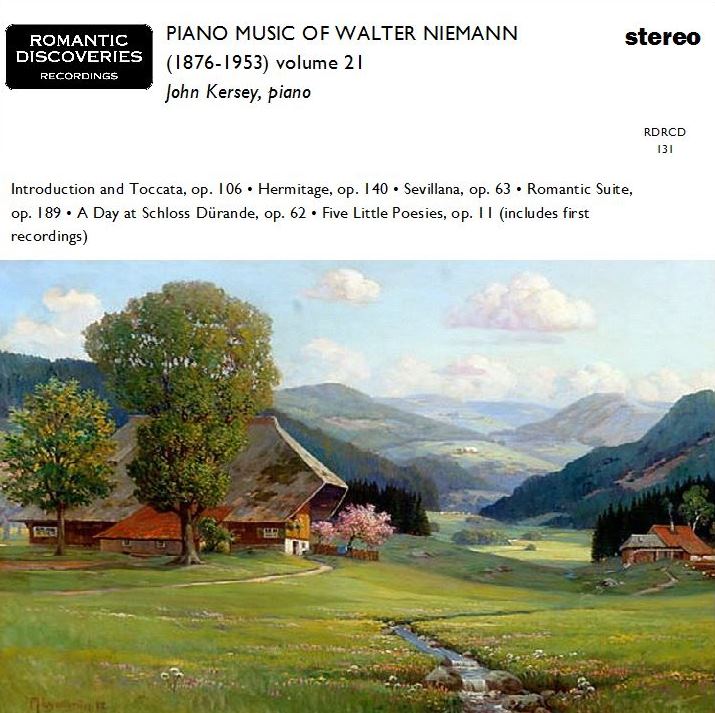
Piano Music of Walter Niemann volume 21
Introduction and Toccata, op. 106 • Hermitage, op. 140 • Sevillana, op. 63 • Romantic Suite, op. 189 • A Day at Schloss Dürande, op. 62 • Five Little Poesies, op. 11 (includes first recordings)
John Kersey, piano
RDR CD131

Total time: 72 minutes

1. Introduction and Toccata, op. 106 (5:34)

2. Eremitage – little pictures from an old park, op. 140 (15:40)
i. Menuett on the Nature-Theatre ii. Leda with the Swan iii. Little Chinese Temple iv. Little Mosque v. Rococo Pavilion vi. Gate of the Sphinx vii. Marble Fountain viii. Before a pillared bust of the young Beethoven ix. Ancient Temple Ruins

3. Sevillana, Spanish airs for piano, op. 63 (12:26)
i. Romanza ii. Mandolinata iii. Boléro iv. Serenata

4. Romantische Suite after words by Alexander Pushkin, op. 189 (10:20)
i. On the Volga – Barkarole ii. Ballet in the Garden – Gavotte iii. Horn Music – Alla Caccia iv. Fireworks Music – Folk Dance

5. Ein Tag auf Schloss Dürande, Romantic novel in six chapters after words by Eichendorff, op. 62 (15:22)
i. The Castle on the Mountain (Heroic Präludium) ii. Sarabande iii. Midday Silence in the Castle Park iv. At the Forest Spring (Idyll after the Hunt) v. Foreign Bagpiper (Burleske) vi. Gallant Entertainment (Gigue)

6. Fünf kleine Poesien, op. 11 (12:25)
i. Capriccietto ii. Mazurka iii. Little Waltz iv. Rococo (Menuetto scherzando) v. Arietta

Our thanks go to Nicolo Figowy and Steffen Herrmann for their generous loan of scores.

Walter Niemann was regarded in 1927 as “the most important living piano composer who knows how to make music from the piano in a subtle and colorful way, although he often enters the field of salon music” (H. Abert, Illustrated Music Lexicon). This most sensitive and introverted master of the piano devoted his life to composition and musical scholarship, also performing his music in concerts and radio broadcasts. Niemann’s vast output for the piano is only now starting to become more widely known. Although his style is generally unashamedly conservative, he was one of the very few German composers to explore Impressionism in music, and this also reflected a fascination with the Far East. Elsewhere, Niemann’s imagination takes us from much Baroque recreation to large-scale epic sonatas, Schumannesque miniatures and even the exploration of early jazz styles. His understanding of the capabilities of the piano was complete, and his works include both collections for young pianists and mature works that exploit the full range of pianistic effect and make significant demands on the performer.

Read Full Post »

Piano Music of Walter Niemann volume 20
Ancient Idylls, op. 99 • Merry Prelude, op. 85 • Dreams of Autumn, op. 63 • Rimsky-Korsakov transcr. Niemann: Hymn to the Sun • Theme and Variations inspired by Camoens’ Lusiaden, op. 25 • Arabeske, op. 52 • For the House, op. 34 (includes first recordings)
John Kersey, piano
RDR CD130

Total time: 77 minutes 7 seconds

1. Antike Idyllen, after poems by Elsa Bergmann, op. 99 (18:37)
i. Pompeja ii. Lalage iii. Telemachos iv. Odysseus v. Paesta vi. Erinna

2. Fröhliches Präludium, op. 85 (4:04)

3. Herbstträumereien, op. 63 or 64 (14:16)
i. Andante teneramente ii. Moderato e teneramente, con intimissimo sentimento iii. Molto moderato, un poco malinconico iv. Andante mosso v. Allegro leggierissimo ed amabile

4. Nikolai Rimsky-Korsakov (1844-1908) Hymn to the Sun from The Golden Cockerel, transcribed for piano by Walter Niemann (4:48)

5. Theme and Variations inspired by Camões’ Os Lusíadas, op. 25 (17:53)

6. Arabeske, op. 52 (3:24)

7. Fürs Haus, eight little lyric pieces after words by Johann Hinrich Faers, op. 34 (13:51)
i. Little snowbells ii. Colourful butterfly iii. Restlessness iv. Remembering you v. Dried flowers vi. At Christmas time vii. Bad mood viii. An old hunting-piece

Our thanks go to Nicolo Figowy and Steffen Herrmann for their generous loan of scores.

Walter Niemann was regarded in 1927 as “the most important living piano composer who knows how to make music from the piano in a subtle and colorful way, although he often enters the field of salon music” (H. Abert, Illustrated Music Lexicon). This most sensitive and introverted master of the piano devoted his life to composition and musical scholarship, also performing his music in concerts and radio broadcasts. Niemann’s vast output for the piano is only now starting to become more widely known. Although his style is generally unashamedly conservative, he was one of the very few German composers to explore Impressionism in music, and this also reflected a fascination with the Far East. Elsewhere, Niemann’s imagination takes us from much Baroque recreation to large-scale epic sonatas, Schumannesque miniatures and even the exploration of early jazz styles. His understanding of the capabilities of the piano was complete, and his works include both collections for young pianists and mature works that exploit the full range of pianistic effect and make significant demands on the performer.

Read Full Post »

« Newer Posts - Older Posts »