Archive for the ‘Catalogue’ Category

Piano Music of Leonard Butler

Piano Music of Leonard Butler (1869-1943)
John Kersey, piano
RDR CD109

Total time: 78 minutes 27 seconds.

1. In the Heart of the Garden (10:11)
i. In the Sunshine ii. In the Heart of the Garden iii. Song of the Sun-Dial iv. To the Maid of the Garden v. The Song of the Garden vi. May-Bells

2. Sweet Auburn, The Deserted Village, suite for piano (after Goldsmith) (13:48)
i. The Village Bells ii. A Spring Phantasy iii. On the Village Green iv. A Meditation v. A Remembrance vi. The Weeping Willow vii. The Deserted Village – A Lament

3. From the Surrey Hills: Fifteen Tone-Pictures for Piano (28:48)
i. Sunday Morning (Ranmore, Dorking) ii. The Meadow Path iii. Where Primroses Grow iv. Through “Bluebell Land” v. In the Merry Month of May vi. Through the Pines vii. Swaying Tree-Tops viii. A Song of my Homeland ix. The Song of the “Tillingbourne” x. The Song of the Old Windmill xi. In the Noontide Heat xii. The Dance in the Harvest-Field xiii. Sunset xiv. Brownies xv. As the Children Fall Asleep

4. Monastique (Tintern Abbey) (1:50)

5. On a Summer Shore (9:33)
i. On a Summer Shore ii. In Saint Martin’s Summer iii. Arietta iv. Rondel

6. Rhapsody: At Twilight (3:44)

7. Outdoor Life – five sketches for pianoforte (10:18)
i. Sunrise ii. The Bird by the Brooklet (“Bury Hill”, Dorking) iii. Through the Forest (Souvenir of a Holiday in the High Pyrenees) iv. By the River (The Fisherman’s Path – Fowey River – Bodmin Road, Cornwall) v. In the Silver Haze (Lantivet Head – Fowey)

Read Full Post »

Piano Music of Percy Elliott

Piano Music of Percy Elliott (1870-1932)
John Kersey, piano
RDR CD108

Total time: 57 minutes 16 seconds.

1. Under the summer moon; idyll (4:23)

2. The Glamour of the East – A Kashmiri Suite (13:03)
i. By the Lake of Dal ii. The Dancer of Jamu iii. In The Hills iv. The Maharajah Passes

3. My Garden of Dreams; Three Imaginations, Suite for pianoforte (9:29)
i. In My Lady’s Rose Bower ii. Hammock Song iii. Floral Dance

4. Dream Lagoon Suite (14:16)
i. Yellow Jasmine – Intermezzo Gracieuse ii. Queen of the Roses – Petite Valse Caprice iii. The Dream Lagoon – Barcarolle

5. Sunbeams and Moonbeams: Four more Contrasts for piano (15:54)
i. Dancing Sunbeams ii. Moonrise O’er the Lake iii. Flaming June iv. Moonset

Read Full Post »

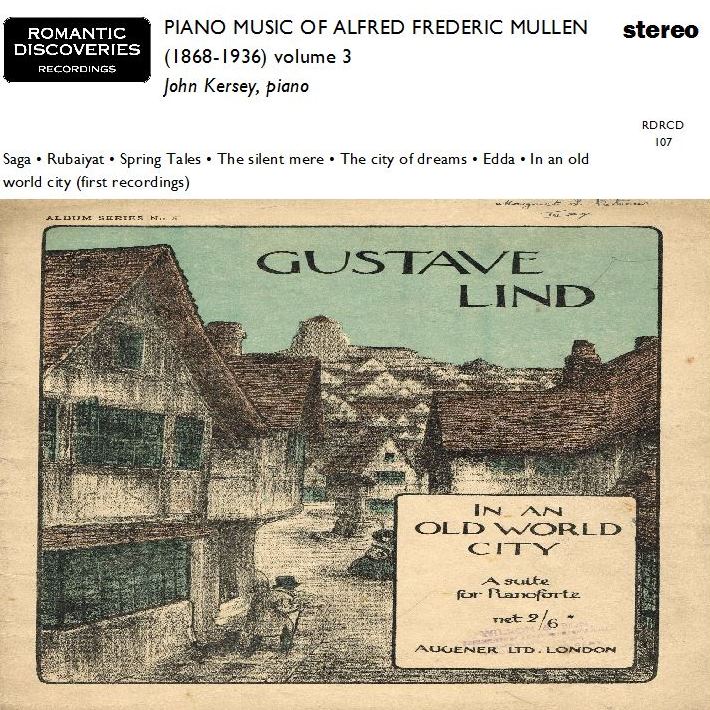
Piano Music of Alfred Frederic Mullen (1865-1936) volume 3
John Kersey, piano
RDR CD107

Total time: 63 minutes 49 seconds.

1. Saga (5:22)

2. writing as “Gustave Lind”: Rubaiyat, suite for piano (10:22)
i. Sunrise ii. The Flower Garden iii. Lovers’ Meeting iv. The Farewell

writing as “Gustave Lind”: Spring Tales – suite for piano
3. The voice of Spring (1:51) 4. One Spring morning (2:47) 5. The pleasant month of May (2:21) 6. Around the maypole (2:18)

writing as “Gustave Lind”: The silent mere, three impressions for piano
7. Once upon a time (2:26) 8. The Woodnymph (1:44) 9. Moonrise (3:10)

writing as “Pierre Lescaut”: The city of dreams
10. In the Palace of Happiness (2:47) 11. The Princess (1:37) 12. The City of Dreams (3:23) 13. Love’s Awakening (1:35)

writing as “Gustave Lind”: Edda, suite for piano
14. Frigga and the Shepherd (2:35) 15. The Magic Mead (3:52) 16. In Flower Land (2:27) 17. The New World (2:03)

writing as “Gustave Lind”: In an old world city – a suite for pianoforte
18. By the old lily pond (1:53) 19. Where the hedgeroses grow (1:29) 20. Starlight through a little window (2:52) 21. When all the world was young (1:18) 22. In a little churchyard (2:46)

Read Full Post »

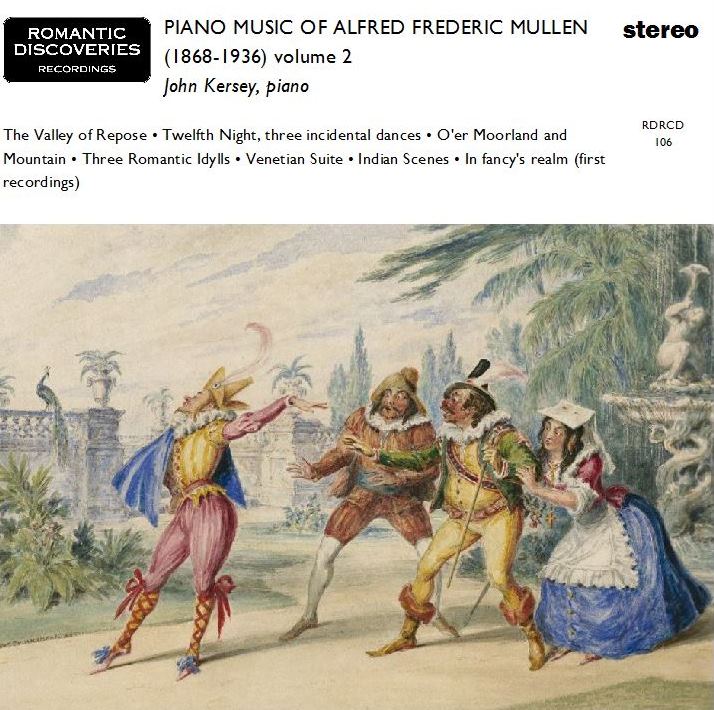
Piano Music of Alfred Frederic Mullen (1865-1936) volume 2
John Kersey, piano
RDR CD106

Total time: 72 minutes 38 seconds.

PIANO MUSIC OF ALFRED FREDERIC MULLEN (1868-1936) volume 2
John Kersey, piano

1. writing as “Pierre Lescaut” The Valley of Repose, four impressions (11.16)
i. Night Thoughts ii. The Water Nymph iii. At Twilight’s Magic Hour iv. The Meeting of the Waters

2. Twelfth Night – three incidental dances (9:50)
i. Shadow Dance ii. Twilight Dance iii. Torchlight Dance iv Roses and Rue

3. writing as “Jean Morel” O’er Moorland and Mountain, suite for pianoforte (7:49)
i. Purple Heather ii. Thistledown iii. A Passing Cloud iv. A Freshening Breeze

4. writing as “Victor Salcède” Three Romantic Idylls (9:01)
i. The River of Dreams ii. Serenade iii. Peep O’Dawn – Scène de Ballet

5. Venetian Suite (6:29)
i. On the Grand Canal ii. Serenade iii. Tarantella

6. writing as “Pierre Lescaut” Indian Scenes, four impressions (7:51)
i. Snake-charmer ii. Siva iii. By the Taj Mahal iv. Nautch Dance

7. writing as “Jean Morel” In fancy’s realm, lyric suite for piano (10:22)
i. Day-Dreams ii. Stepping Stones iii. Nature’s Mirror iv. Dragon Flies

Read Full Post »

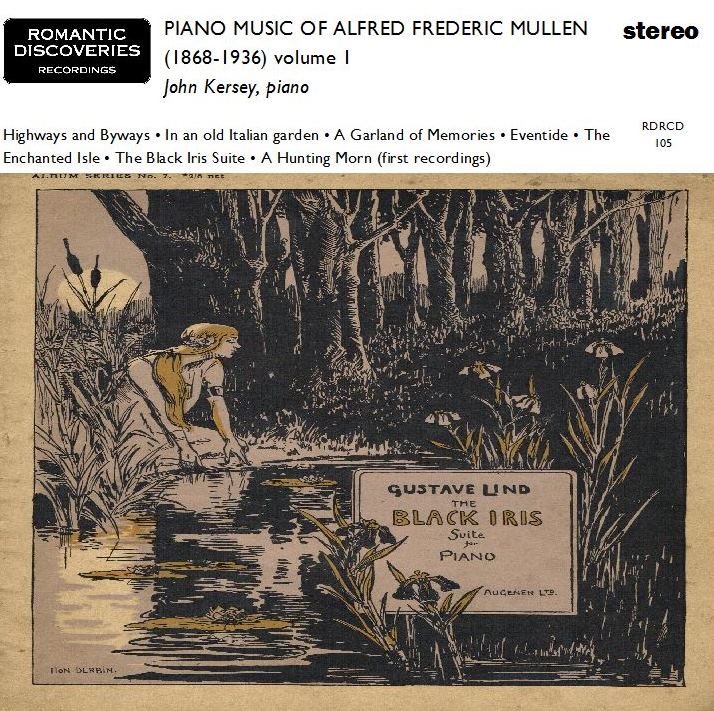
Piano Music of Alfred Frederic Mullen (1865-1936) volume 1
John Kersey, piano
RDR CD105

Total time: 62 minutes 14 seconds.

1. Highways and Byways, four sketches for piano (9:12)
a. In the Still Woodland b. The Little Shepherdess c. By the Lych-Gate d. On the Broad Highway

2. writing as “Gustave Lind”: In an old Italian garden (Piacenza, 1914) (9:14)
e. By a Forgotten Well f. In Bocaccio’s Days g. A Deserted Temple h. A Shepherd’s Song i. In Brocade and Silk

3. A Garland of Memories (7:58)
j. For Remembrance k. Columbine l.. ‘Neath the Pergola m. Snapdragon

4. writing as “Gustave Lind”: Eventide (10:38)
n. Forest Piece o. The Heart of the Sunset p. Chant Poetique q. The Queen’s Minuet

5. writing as “Pierre Lescaut”: The Enchanted Isle; four impressions (10:35)
r. By the Pools of Silence s. Elfin Glade t. Mystic Night u. Roseate Dawn

6. writing as “Gustave Lind”: The Black Iris Suite (9:15)
v. The Black Iris w. Ayesha x. The Lotus Pond
“Thus said Vikrama, the Godborn: ‘When after a thousand times thousand Karmas the black Iris will appear in the Lotus cup of the sacred lake Manassorowa, bathed by the beams of Arjana, then shall thy soul obtain the Nibhanam.” – From an old M.S. of Brahmacharya Yengar

7. A Hunting Morn (3:25)

Recorded in 2014.

Read Full Post »

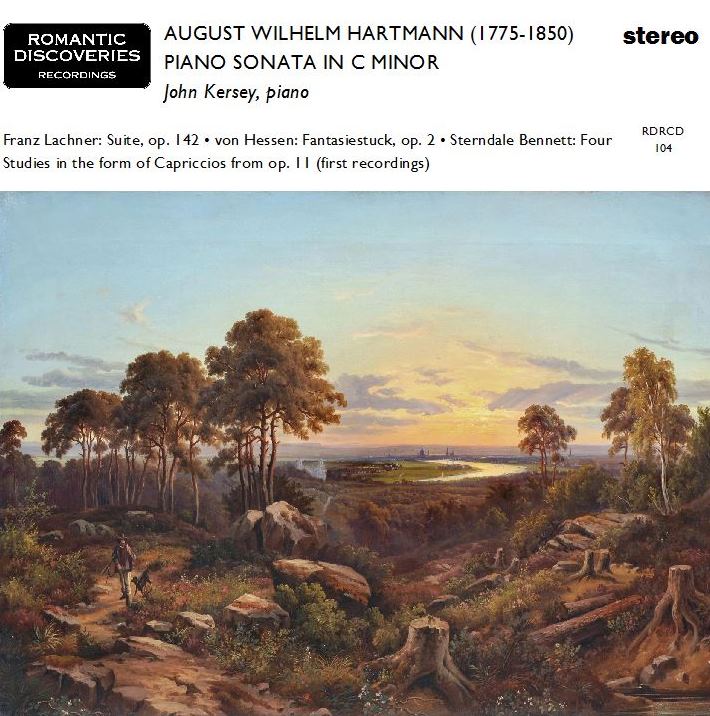
August Wilhelm Hartmann: Piano Sonata in C minor, with works by Lachner, von Hessen and Sterndale Bennett
John Kersey, piano
RDR CD104

Total time: 62 minutes 14 seconds.

A.W. Hartmann (1775-1850): Piano Sonata in C minor (unpublished, prepared from the composer’s manuscript)
1. (6:49)
2. (5:36)
3. (4:33)

4. Alexander Friedrich Landgraf von Hessen (1863-1945): Fantasiestuck, op 2 (8.36)

Franz Lachner (1803-80): Suite, op 142
5. Praeludium: Allegro moderato (3:45)
6. Andantino (6:48)
7. Menuetto: Allegretto (8:33)
8. Allegro agitato (4:04)

Sir William Sterndale Bennett (1816-75): 4 Studies in the form of Capriccios from op 11
9. no. 1 Allegro con Precisione (4:24)
10. no. 3 Allegro Brillante (2:12)
11. no. 4 Vivace Giocoso (3:05)
12. no. 6. Allegro Agitato (3:24)

Our thanks to Klaus Zehnder-Tischendorf for supplying scores of these rare works. Recorded in 2014.

Read Full Post »

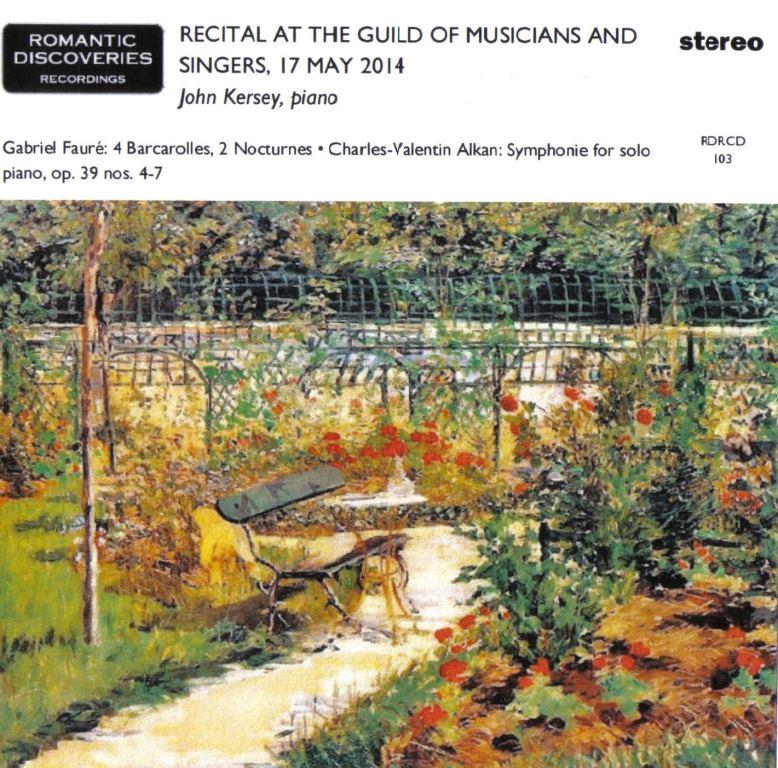
Recital at the 41st General Meeting of the Guild of Musicians and Singers, 17 May 2014
John Kersey, piano
RDR CD103

Total time: 71 minutes 15 seconds

Gabriel Fauré (1845-1924):
1. Barcarolle no. 2 in G major, op. 41 (1885) (6’16”)
2. Barcarolle no. 3 in G flat major, op. 42 (1885) (8’59”)
3. Barcarolle no. 4 in A flat major, op. 44 (1886) (4’06”)
4. Barcarolle no. 5 in F sharp major, op. 66 (1894) (6’28”)
5. Nocturne no. 6 in D flat major, op. 63 (1894) (+ applause) (10’32”)

Charles-Valentin Alkan (1813-88):
Symphonie for solo piano, from 12 Etudes in the minor keys, op. 39 nos. 4-7
6. Allegro moderato (10’14”)
7. Marcia funebre: Andantino (6’27”)
8. Menuet (5’56”)
9. Finale: Presto (+ applause) (5’28”)

10. (encore) Faure: Nocturne no. 3 and concluding remarks by Master of the Guild Dr. David Bell (6’59”)

Recorded at the concert on 17 May 2014 and the rehearsal concert preceding it.

gms 1

Membership and other details of the Guild and Musicians and Singers can be found on the Guild’s website: www.musiciansandsingers.com.

Read Full Post »

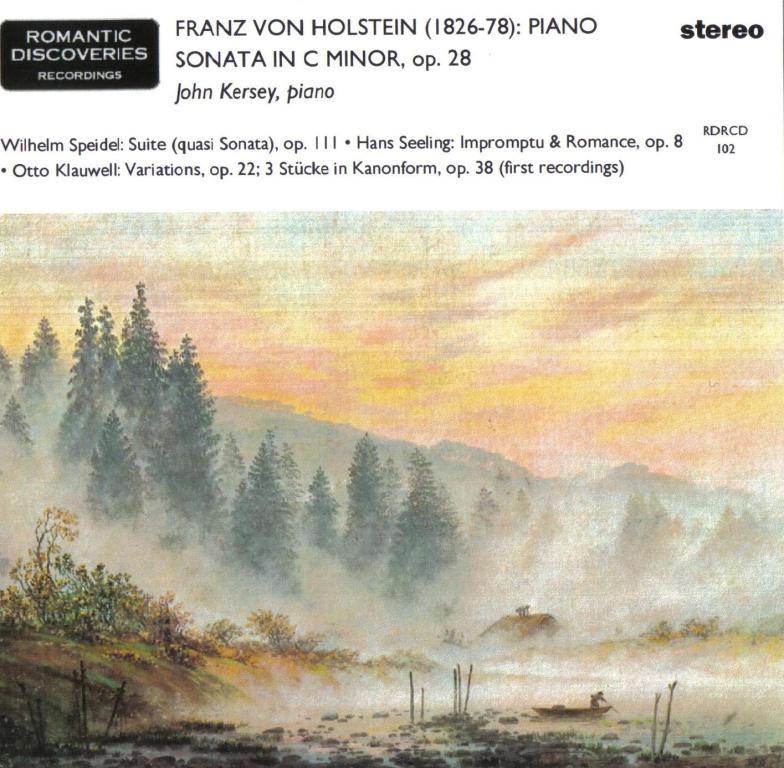
Franz von Holstein (1826-78): Piano Sonata in C minor, op. 28
John Kersey, piano
RDR CD102

Total time: 76 minutes 54 seconds

Franz von Holstein (1826-78): Piano Sonata in C minor, op. 28
1. Allegro con brio, un poco maestoso (9’58”) 2. Andante (7’35”) 3. Allegro appassionato (8’43”)
Otto Klauwell (1851-1917): Drei Stücke in Kanonform, op. 38:
4. Praeludium (2’43”) 5. Scherzo (1’13”) 6. Romanze (2’30”)
7. Variations in D minor, op. 22 (10’36”)
Hans Seeling (1828-62):
8. Impromptu, op. 8 no. 1 (1’42”) 9. Romance, op. 8 no. 2 (6’18”)
Wilhelm Speidel (1826-99): Suite (quasi Sonata), op.111:
10. Praeludium (2’24”) 11. Andante espressivo (3’03”) 12. Scherzo (3’27”) 13. Marcia funebre (9’41”) 14. Finale (6’30”)

Our thanks to Klaus Zehnder-Tischendorf for supplying scores of these rare works.

Franz von Holstein was destined for an army career at the insistence of his father, but during his officer training he composed the opera ‘Zwei Nächte in Venedig’ as well as songs and ballads, and for a time, encouraged by his friendship with Griepenkerl, continued to compose in the free time allowed by his military duties. By 1853 he was free to pursue a musical career, and came to Leipzig where he studied with Moritz Hauptmann and, as a pianist, with Plaidy and Ignaz Moscheles. He then lived for a time in Rome, Berlin and Paris before becoming manager of the Leipzig Bach-Gesellschaft. Although chiefly known as a composer of songs, he was also responsible for several operas, orchestral works and chamber music, and wrote a significant amount of poetry. During his last six years he suffered with stomach cancer, and it was his wish that a bequest should establish a fund for impecunious musicians at the Leipzig Conservatoire. His Piano Sonata is a major composition of some ambition and achievement, with a clear influence of Schumann and Brahms evident.

Wilhelm Speidel is best remembered today as founder of the Stuttgart Music School. His father was a singer and composer and it was by him that his early musical talent was first nurtured. At Munich, he became a composition pupil of Ignaz Lachner and studied piano with Christian Wanner. After spending 1846-7 as a private teacher in Alsace, he returned to Munich, where he taught, also undertaking a tour throughout Germany as a pianist. He was known as an interpreter of Beethoven, who is also a major influence on his compositions. At Ulm, he founded and conducted the Liedertafel, and became active as a choral conductor. In 1857 he moved to Stuttgart where, together with Lebert, Stark, Faisst and others the Stuttgart Music School, today the Hochschule für Musik und Darstellende Kunst in Stuttgart. Here he taught and conducted the Stuttgart Liederkranz; his pupils included the American composer Edgar Stillman Kelley. However, after a quarrel with Lebert in 1874 he resigned his post and started his own conservatoire. He accepted reinstatement at the Music School upon Lebert’s death in 1885. Speidel composed in almost every form and was chiefly known in his lifetime as a composer of songs and choral music, adopting the popular idioms of German folk song.

Hans Seeling was born and studied in Prague, and suffered from delicate health from an early age. In 1852 he made his first public appearance as a pianist, in Italy, and then toured the Orient in 1856, followed by concerts in Germany. In 1859 he came to Paris. The lung condition from which he was suffering worsened and he returned to his native town, where he died. Seeling’s youth means that his compositions, all of which are for piano, are relatively few in number, but merited comparison with Chopin and Henselt in his time.

Read Full Post »

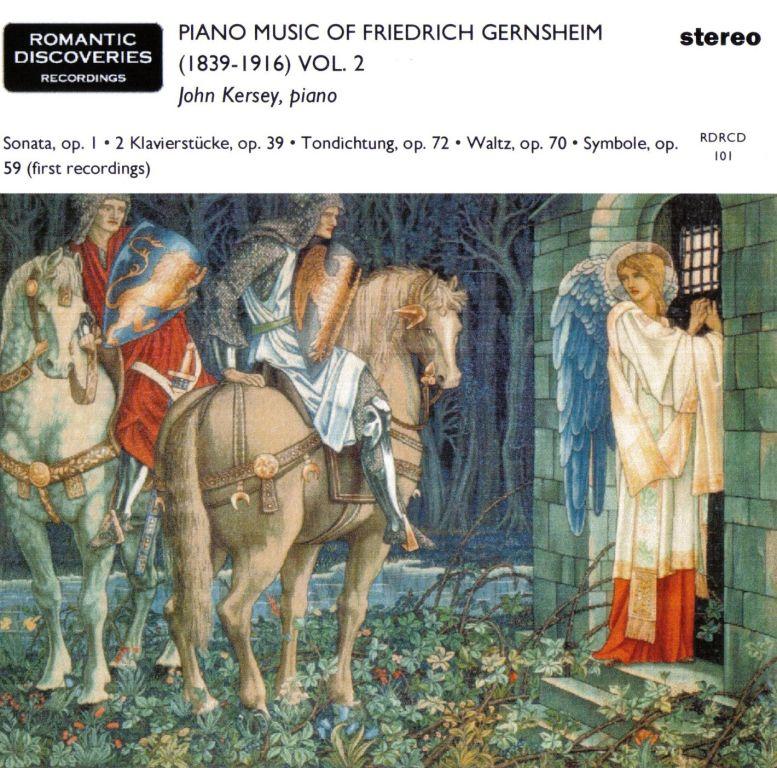
Piano Music of Friedrich Gernsheim (1839-1916), volume 2
John Kersey, piano
RDR CD100

Total time: 76 minutes 13 seconds

Sonata in F minor, op. 1
1. Langsam, getragen (7’49”) 2. Lebhaft (3’31”) 3. Leidenschaftlich bewegt (10’06”)
Zwei Klavierstücke, op. 39
4. Lied (4’34”) 5. Gavotte (4’40”)
Tondichtung, op. 72
6. Hymnus (3’11”) 7. Romanze (5’45”) 8. Intermezzo (6’25”) 9. Jubilate (5’18”)
10. Waltz, op. 70 (4’50”)
Symbole, op. 59
11. Nachtstück (5’13”) 12. Elegie (5’11”) 13. Im Schilf (3’36”) 14. Romanze (3’00”) 15. Aeolus (2’55”)

Friedrich Gernsheim was born of a Jewish family in Worms and studied there with Louis Liebe, who had been a pupil of Spohr. Following the 1848 revolutions, his father moved the family to Frankfurt, where he studied with Edward Rosenhain. His debut in 1850 was followed by two years of touring, before he undertook advanced studies with Moscheles. Between 1855-60 he was in Paris, where he met Lalo, Rossini and Saint-Saëns. In 1861 he succeeded Hermann Levi as music director in Saarbrücken, and in 1865 Hiller appointed him to the staff of the Cologne Conservatoire, where he taught Engelbert Humperdinck among others. In 1868 he met Brahms for the first time, and his compositions, which include four symphonies (the third based on the Jewish theme of the Song of Miriam), concertos and much chamber music, show a notable Brahmsian influence. He spent the years 1874-90 as director of the Rotterdam Philharmonic Society, before joining the faculty of the Stern Conservatoire in Berlin, finally leaving to teach at the Academy of Arts in 1897, the year he was elected to the senate.

Read Full Post »

Piano Music of Friedrich Gernsheim (1839-1916), volume 1
John Kersey, piano
RDR CD100

Total time: 72 minutes 16 seconds

1. Fantasie, op. 27 (21’04”)
Ins Stammbuch, op. 26
2. Andantino (1’49”) 3. Allegretto grazioso (1’40”) 4. Andante (3’39”) 5. Allegro con brio e giocoso (2’27”) 6. Andante espressivo (2’53”) 7. Allegro (6’34”) 8. Lento e sostenuto (2’57”)
9. Fantasie, op. 81 (8’11”)
10. Legende, op. 44 (12’06”)
11. Romanze, op. 15 (8’51”)

Friedrich Gernsheim was born of a Jewish family in Worms and studied there with Louis Liebe, who had been a pupil of Spohr. Following the 1848 revolutions, his father moved the family to Frankfurt, where he studied with Edward Rosenhain. His debut in 1850 was followed by two years of touring, before he undertook advanced studies with Moscheles. Between 1855-60 he was in Paris, where he met Lalo, Rossini and Saint-Saëns. In 1861 he succeeded Hermann Levi as music director in Saarbrücken, and in 1865 Hiller appointed him to the staff of the Cologne Conservatoire, where he taught Engelbert Humperdinck among others. In 1868 he met Brahms for the first time, and his compositions, which include four symphonies (the third based on the Jewish theme of the Song of Miriam), concertos and much chamber music, show a notable Brahmsian influence. He spent the years 1874-90 as director of the Rotterdam Philharmonic Society, before joining the faculty of the Stern Conservatoire in Berlin, finally leaving to teach at the Academy of Arts in 1897, the year he was elected to the senate.

Read Full Post »

« Newer Posts - Older Posts »