Archive for the ‘Catalogue’ Category

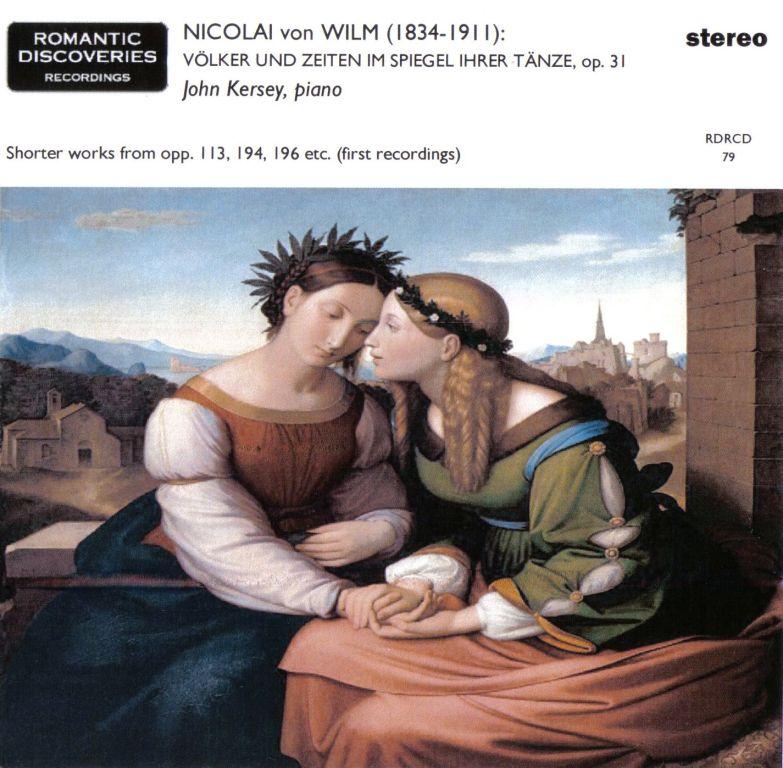
Nicolai von Wilm (1834-1911): Völker und Zeiten im Spiegel ihrer Tänze, op 31, etc.
John Kersey, piano
RDR CD79

Total time: 67 minutes 53 seconds

Völker und Zeiten im Spiegel ihrer Tänze (Nations and Epochs illustrated by their Dances), op. 31
1. Roundelay (German) (3’07”) 2. Sarabande (Spanish) (2’31”) 3. Gavotte and Tambourin (Old French) (3’01”) 4. Ländler (Bavarian) (3’15”) 5. Rigaudon (Provençal) (5’02”) 6. Mazurka (Polish) (2’36”) 7. Minuet (Old French) (3’25”) 8. Bolero (Spanish) (3’10”) 9. Bourrée (Old French) (2’42”) 10. Rustic Dance (Norwegian) (2’08”) 11. Gigue (Old French) (2’53”) 12. Dance of the Rhinelanders (German) (3’26”) 13. Csardas (Hungarian) (4’13”) 14. Loure (Old French) (3’33”) 15. Pavane (Old Spanish) and Gaillarde (Old French) (2’56”)

16. Melodie, op 113 (3’41”)
17. Bilder vom Lande, op 146: no 1Ankunft (3’43”)
18. Klage, op 194 vol 1 no 2 (3’39”)
19. Ergebung, op 194 vol 2 no 6 (2’54”)
20. Entblätterte Rose (2’10”’)
21. Loure (Old French Dance) (1’11”)
22. Frohe Botschaft, op 196 no 6 (2’21”)

Our thanks to Dr Klaus Tischendorf for supplying scores of these rare works.

Notes on the music
Nicolai von Wilm was born in Riga in 1834 and studied at the Leipzig Conservatoire between 1851 and 1856. The following year he returned to Riga to take up the position of second Kapellmeister at the State Theatre. In 1860 he moved to the Nikolai Institute in St Petersburg, where he taught until 1875, after which he made his home in Wiesbaden.

von Wilm’s output includes around 250 works, including many for piano. This disc represents the first recording of any of his piano compositions. His neglect is surprising in view of the esteem in which he was held in his lifetime, particularly during his time at St Petersburg, and the high quality of his music, which embraces both large-scale works such as the Fantaisie in F minor (recorded on CD78) and much in shorter forms.

The set of dances forming op 31 is typical of the nationalistic element that became particularly predominant in music of the later Romantic era, as music became increasingly the expression of ethnic – and often political – identity. The pleasure in such sets lies in their ready characterisation of the forms they encompass; those who consider the nineteenth-century uninterested in the baroque might well look to the number of Old French dances revived here, as they also are in the very similar suite of ancient dances op 75 by Ernst Pauer (previously recorded for RDR). von Wilm is concerned throughout with stamping his own musical personality on each miniature; although sometimes given to reflection, he comes across as a rather vigorous and energetic character with a thorough command of the piano’s capabilities.

This is then complimented with a journey through some of von Wilm’s miniatures from other groups. The first movement from his op 146 set of countryside evocations is the most extensive, being a truncated sonata form that has much of Schumann about it and whose appeal is considerable. Other works include those published in the Neuen Musik-Zeitung of 1909; calling-cards, as it were, of von Wilm’s art.

Read Full Post »

Nicolai von Wilm (1834-1911): Fantasie, op 68; Rondo, op 69 no 2, etc.
John Kersey, piano
RDR CD78

Total time: 64 minutes 21 seconds

Nicolai von Wilm: Fantasie in F minor, op 68
1. Praeludium und Recitativ (7’13”) 2. Intermezzo: Assai vivo (5’16”) 3. Adagio cantabile e sostenuto (10’11”) 4. Finale: Allegro con brio (6’48”)

Hugo Reinhold (1854-1935): Traunseebilder: 5 Tonstücke, op 55
5. Morgengruss (2’31”) 6. Abendämmerung (5’25”) 7. Echo (2’05”) 8. Barkarole (4’05”) 9. Irrlicht (1’48”)

Nicolai von Wilm: Rondo in E flat major, op 69 no 2 (7’06”)

Josef Rheinberger (1839-1901): Passacaglia: Free concert transcription of the final movement of the Organ Sonata op 132 (11’43”)

Our thanks to Dr Klaus Tischendorf and Peter Cook for supplying scores of these rare works.

Notes on the music
Nicolai von Wilm was born in Riga in 1834 and studied at the Leipzig Conservatoire between 1851 and 1856. The following year he returned to Riga to take up the position of second Kapellmeister at the State Theatre. In 1860 he moved to the Nikolai Institute in St Petersburg, where he taught until 1875, after which he made his home in Wiesbaden.

von Wilm’s output includes around 250 works, including many for piano. This disc represents the first recording of any of his piano compositions. His neglect is surprising in view of the esteem in which he was held in his lifetime, particularly during his time at St Petersburg, and the high quality of his music, which embraces both large-scale works such as the Fantaisie in F minor and much in shorter forms. The Fantaisie shows a clear Bachian influence and also perhaps something of Cesar Franck in its opening pairing of a prelude and recitative. This is music that seeks to make a significant statement, and if that statement is perhaps more notable for its echoing of more prominent composers (notably Schumann) that does not exclude some degree of von Wilm’s own compositional and pianistic individuality. The piano writing, replete with octaves and massive chords, certainly takes few prisoners, but this is counterbalanced by a nonchalant Intermezzo and a fine, deeply-felt slow movement of considerable merit. The Rondo – the second of two forming von Wilm’s op 69 – is rather more Chopinesque in places, and again represents a considerably accomplished style with plenty of melodic invention and contrast.

Hugo Reinhold was a Vienna-based composer who, under the patronage of the Duke of Saxe-Coburg-Gotha, studied at the Conservatorium der Musikfreunde under Bruckner, Felix Dessoff and Julius Epstein. He became a teacher of piano at the Akademie der Tonkunst and acquired a sound reputation as a composer, with his works being performed, inter alia, by the Vienna Philharmonic. His set of five Pictures from the Traunsee was published in 1897 and forms an effective and straightforward collection, somewhat reminiscent of Grieg in places.

The name of Joseph Gabriel Rheinberger is more familiar to organists than to pianists, although he also wrote a good deal of piano music. Rheinberger was a child prodigy, being appointed organist to the parish church of Vaduz at the age of seven. After three years at the Munich Conservatoire (1851-54) he studied privately with Franz Lachner. His appointment as professor of piano (1859) and composition (1860) at the Conservatoire was thwarted by the institution’s closure in 1860, but on its re-opening in 1867 he was reappointed as Royal Professor. Rheinberger was noted for his supreme musicianship and ability as an executant, and counted Humperdinck, Wolf-Ferrari and Furtwangler among his composition pupils.  The Passacaglia is a concert transcription for piano of the last movement of the organ sonata, op 132, and follows the form of that movement closely with many demanding passages where the counterpoint of the original is rigorously preserved despite the pianistic difficulties that result. The effect is of a profoundly serious and effective work which deserves concert revival in our own time.

Read Full Post »

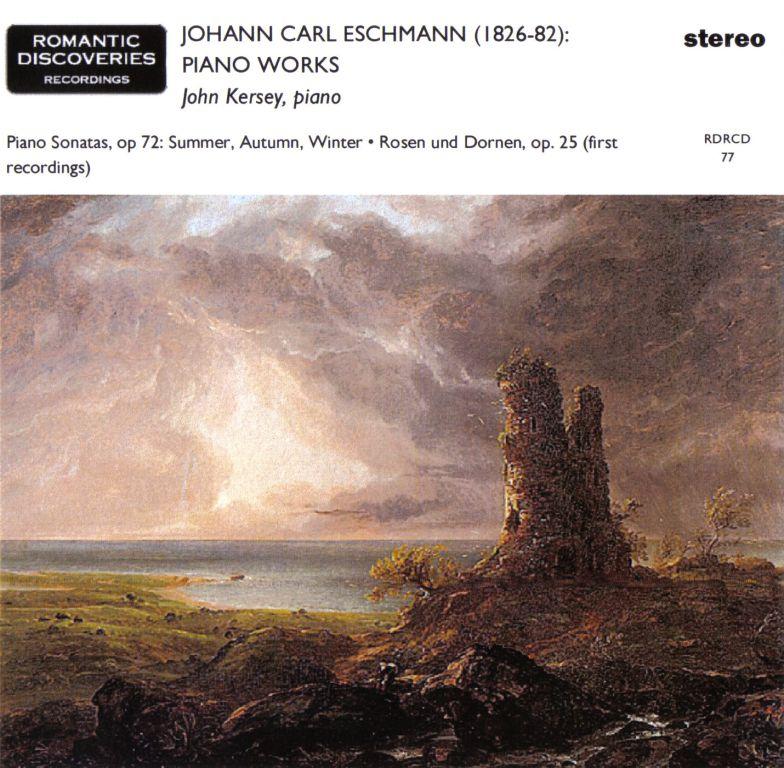
Johann Carl Eschmann: Piano Works

Johann Carl Eschmann (1826-82): Piano Works
John Kersey, piano
RDR CD77

Total time: 64 minutes 5 seconds

Piano Sonata op 72 no 3 “Summer”
1. Allegro moderato, giocoso (6’37”) 2. Andante sostenuto – Scherzo, non troppo presto, leggiero – Tempo di Andante sostenuto (5’35”) 3. Allegro non troppo (6’28”)

Rosen und Dornen (Roses and thorns), op 25
4. Sanft träumerisch, nicht schnell (2’08”) 5. Presto (00’56”) 6. Allegretto, grazioso (2’48”) 7. Sehr rasch, feurig (1’00”) 8. Polonaisen-Tempo: Fröhlich (1’37”) 9. Sehr rasch, unruhig (1’52”) 10. Ziemlich langsam, ausdrucksvoll (2’55”) 11. Rasch, flüchtig (1’11”) 12. Allegretto grazioso (1’46”)

Piano Sonata op 72 no 4 “Autumn (The Hunt)”
13. Allegro vivace, non troppo presto (3’51”) 14. Abseits: Andante con moto (5’34”) 15. Abends in der Herberge (Allegro vivace) (6’27”)

Piano Sonata op 72 no 1 “Winter”
16. Allegro moderato, risoluto (6’59”) 17. Allegretto scherzando e grazioso (1’50”) 18. Allegretto risoluto (4’17”)

Our thanks to Dr Klaus Tischendorf and Peter Cook for supplying scores of these rare works.

Notes on the music:
The Swiss composer Johann Carl Eschmann was born to a family of musicians in Zurich. He studied at the Leipzig Conservatoire between 1847 and 1849 with Mendelssohn, Moscheles and Gade, and thereafter pursued a career as composer and teacher initially in Kassel. From 1850-59 he taught in Winterthur but found competition with his friend Theodor Kirchner difficult, and between 1859-66 based himself in Schaffhausen. The latter year saw him return to Zurich where he spent the remainder of his days.

In 1871, Eschmann published his “Wegweiser durch die Klavierliteratur”, a graded survey of the piano repertoire suitable for teachers. This was republished in several editions, but by the tenth edition in 1925, Eschmann’s name as compiler and reference to all except his most basic didactic works had been entirely removed.

Eschmann was a reasonably prolific composer of piano and chamber music. His style is firmly in the mould of Mendelssohn and Schumann, and is concerned primarily with the expression of character and mood within well-defined structures. At the same time, some of his earlier works are more experimental and more technically varied that this would suggest, with some exploration of cyclical forms. The conjoined Andante and Scherzo in the Summer Sonata on this disc is one example of this tendency.

Eschmann knew Richard Wagner, and indeed Wagner referred to him on one occasion as a friend. There is a suggestion that Eschmann may have been involved in the first performance of the “Wesendonk-Lieder” and a copy of one of these songs exists with a dedication from Wagner to him. In his work “Richard Wagner’s Zurich: the muse of place”, Chris Walton suggests that Eschmann’s song “Mittags” may have provided Wagner with one of the themes from “Das Rheingold” (pp 141-148). Walton also provides much further information on Eschmann’s work. In July 1853, Liszt invited Eschmann and Kirchner to meet him at Wagner’s apartment and presumably to bring their latest compositions; unfortunately no details of the meeting have been recorded.

Later on, however, Eschmann developed an affinity with Brahms and became sharply critical of Wagner in his “100 Aphorisms” (1878). His output tended to become more conservative after his earlier works, and by and large he was content to compose within established boundaries rather than seeking to innovate, with many of his later piano pieces intended for pupils.

The cycle of four sonatas inspired by the seasons seems to have been written with able women pianists in mind, for although they contain some demanding passages, they carefully avoid the use of passages in octaves. Such music was a requirement of the period, since many women attained a high standard of piano playing while being unable to pursue a public concert career. Rather like Czerny before him, Eschmann writes in such a way as to make technical points while maintaining musical interest; the sonatas are attractive and confident in their compositional approach, with plenty of melodic inspiration and a lively spirit throughout.

The set of “Rosen und Dornen” is a cycle of miniature studies of the kind that Kirchner would make his own. Here, in works that are at times aphoristic, one might at times be listening to Schumann. The cycle is attractively varied and the beautiful cantabile melody of the seventh piece is particularly notable.

Read Full Post »

J.P.E. Hartmann: Piano Works

Johan Peter Emilius Hartmann (1805-1900): Piano Works
John Kersey, piano
RDR CD76

Total time: 71 minutes 57 seconds

Fantasy Pieces, op 54
1. Allegro poco moderato, pastorale (2’20”) 2. Allegretto capriccioso (2’51”) 3. Allegretto moderato – Canto marziale religioso (2’51”) 4. Allegro molto assai (2’00”) 5. Tempo di Menuetto moderato, con espressione (6’40”) 6. Andantino innocente quasi Allegretto (3’21”)

6 Tone Pieces in Song Form, op 37
7. Allegro agitato grazioso (5’56”) 8. Moderato (4’36”) 9. Allegro assai (3’05”) 10. Allegro moderato vigoroso (2’28”) 11. Allegretto quasi Andantino (3’01”) 12. Vekselsang (1’55”)

13. Bellmanske Billeder: Menuetter (7’46”)

8 Sketches, op 31
14. Allegro non troppo, grazioso (4’08”) 15. Canzonetta (1’39”) 16. Mazurka (1’56”) 17. Scherzo (2’15”) 18. Scherzo (4’04”) 19. Allegro assai (2’09”) 20. Introduction-Allegretto mouvement de valse (3’53”) 21. Allegro passionato assai (2’47”)

Our thanks to Dr Denis Waelbroeck for supplying scores of these rare works.

Notes on the music:
Johann Peter Emilius Hartmann succeeded his father at the Garnisons Kirke in 1824, and thereafter was successively professor at Copenhagen University and the founding director of the Conservatoire there from 1867. His studies in Europe in 1836 brought him into contact with Chopin, Rossini, Cherubini and Spohr. In musical style he successfully fused elements of Nordic nationalism with a post-Mendelssohnian style that at its most progressive clearly looks forward to Brahms. The quality of Hartmann’s inspiration and mastery of compositional and pianistic technique was considerable, and marks him out as the leading Danish composer for the piano of his generation.

This disc reflects Hartmann’s devotion to that most nineteenth-century of piano forms, the set of contrasting miniatures. For Hartmann, as for his predecessors (notably Beethoven), the miniature offers the opportunity to capture a brief mood or atmosphere without the concerns of formal development or the complex extension of structure; indeed where structure is extended, it is by simple episodic means. This distillation of musical inspiration to its essentials enables a rare intensity of experience; at their best, such pieces have the impact of the shorter forms of poetry, reflecting a more improvisatory and free-spirited art than can necessarily be present in the sonata or variations.

There is often much of Mendelssohn to be detected in Hartmann’s music, but with an individual and at times authentically Danish voice (see for example the Vekselsang that concludes op 37). This national feeling perhaps imparts a certain seriousness to his output by comparison with his contemporaries, and if not using actual folksong in his works here, he certainly often takes his inspiration from its contours and characteristic modulations.

The Fantasy Pieces op 54 are dedicated to Clara Schumann, who one feels would have readily appreciated their adventurous and intimate world. Particularly notable is the rhythmic displacement that appears in the second piece, which is both clever and effective. The fifth of the set is a dark Menuetto in A minor which at times bridges the gap with the waltz. Hartmann’s interest in the minuet, often considered antiquated by his contemporaries, can also be seen in the Bellmanske Billeder, an unusual set of two linked minuets with a virtuoso introduction, published without an opus number.

The title “Tone Pieces in Song Form” given to the set op 37 is surely a conscious reminiscence of Mendelssohn’s “Songs Without Words” of which the first piece could very easily be a continuation given its typical Mendelssohnian texture and melodic appeal. The set features a dramatic “hunting scene” as its third piece, and in its successor turns to a very Schumannesque narrative idea, answered in the last bars by a bluff “Chorus”. The ensuing Allegretto quasi Andantino flows amid complex double-note figuration, reminding us of Hartmann’s abilities in counterpoint.

The Eight Sketches op 31 date from 1842, by which time Hartmann was firmly established at the forefront of the Danish musical scene. They are notable for their pair of contrasting Scherzos that juxtapose enthusiasm and calmer polyphony. Older forms are suggested with the gigue-like movement that forms the sixth piece before the set concludes with a waltz and a fast-moving caprice in the minor.

Read Full Post »

Victor Bendix (1851-1926): Piano Sonata. Frederic Chopin (1810-49): Nocturne oubliée
John Kersey, piano
RDR CD75

Total time: 64 minutes 53 seconds

Victor Bendix (1851-1926)
Piano Sonata in G minor op. 26 (1900)
1. Allegro moderato (19’25”) 2. Intermezzo scherzando: Allegretto un poco vivo (5’10”) 3. Andante con variazioni (20’56”) 4. Allegro con fuoco, ma non troppo vivo (12’10”)

Frederic Chopin (1810-49)
5. Nocturne oubliée in C sharp minor, A.1/6 (7’08”)

Our thanks to Peter Cook for supplying scores of these rare works.

Notes on the music:
Victor Emmanuel Bendix was born to a Jewish family of music-lovers in Copenhagen in 1851. He was one of the first to study at the Royal Danish Conservatoire in Copenhagen and developed his style under the tutelage of Niels Gade, August Winding and J.P.E. Hartmann. A virtuoso pianist with a long and active career, he studied piano with Liszt in Weimar in 1881. In the last years of the nineteenth-century he toured Europe playing his piano concerto (1884), which his wife Dagmar performed in London.

Bendix belongs to the late Romantic school that stands between Brahms and Nielsen, and even to some extent Sibelius. He is concerned with the evocation of mood and atmosphere but within a formal structure that takes precedence. At times his music is rhetorical and rhapsodic; at others he presents epic drama and music of deep emotion (such as in the slow movement of his Sonata). Although well-regarded in his day (a street in Copenhagen is named after him today), Bendix’ demanding and complex works fell out of fashion in his later years and his major output, such as the four symphonies, is only just beginning to be revived.

The single piano sonata in Bendix’s output is a giant of the repertoire. The performance on this recording occupies nearly fifty-eight minutes, and it would be quite possible to imagine another interpretation that would take a broader view of some passages. However, Bendix manages this extended structure well, creating ample contrast, interest and thematic continuity. It is difficult, indeed, to imagine a work more typical of the piano sonata in the last years of Romanticism, with an enduring sense of fantasy reflected in mature musical language of great power.

The epic sweep of the first movement is indicative of Bendix’s ambitions for the work. The surging first theme is bardic and suggests a grand orchestral texture; its chordal counterpart balances not only its character but also acts as a foil to its chromaticism. The presentation is in some respects reminiscent of Chopin’s op 58 sonata, in which the structure unfolds seamlessly and gradually rather than with obvious divisions and landmarks. This long exposition is performed here with the optional repeat, before giving way to the unsettled and extensive development, which resembles an exotic and enchanted forest in its ability to create strange beauties from material that is by now familiar. Throughout, the use of chordal and octave writing maximises the expressive potential of the piano.

The second movement is seemingly lighter in tone; a gruff, rustic Intermezzo rather like a proto-Mahlerian Ländler. The humour is always somewhat on edge here, and even the comic bass section in the trio leads to chromatic filigrees that recall the uncertain atmosphere of earlier moments.

The slow movement is perhaps the emotive heart of the work, consisting of an extensive transformation of a folk-like theme in the dominant. Variations of an active, martial and scherzando character give way to an eerie, suspended Adagio. This begins a long transition to the glowing presentation of the theme in the major, though the coda reverts any sense of triumph or resolution to end disconsolately.

The finale again inhabits the sphere of action, and represents a pageant of contrasting ideas that are often reached by complex dramatic transitions. The music develops great virtuosic power and tests the performer in many strenuous passages of double-notes. Towards the end the second theme of the first movement returns accompanied by triumphant figurations; this is indicative of the increasingly confident and positive mood that dominates the coda as the sonata ends with a fanfare of massive chords.

The Nocturne oubliée is a good example of the many manuscripts discovered after Chopin’s death and (here) brought to light in the former Soviet Union; most such pieces are brief and insubstantial, but here we have a complete Nocturne that – for all that some have suggested that it is not authentic – certainly to this interpreter’s ear has many of the unmistakeable characteristics of Chopin’s early style, suggesting that it is either Chopin’s own work or that of a remarkably slavish imitator. Certain figurations are of a type that Chopin would later work out more pianistically, and we can also imagine that a certain amount of ornamentation would distinguish the otherwise-literal recapitulation. For all that it has its shortcomings, this is nevertheless an intriguing glimpse into Chopin’s compositional processes.

Read Full Post »

Piano Sonatas of Eduard Franck (1817-93)
John Kersey, piano
RDR CD74

Total time: 69 minutes 21 seconds

Piano Sonata in E flat major, op 40 no 4
1. Allegro con brio (11’01”) 2. Adagio (10’59”) 3. Allegro vivace (7’02”)

Piano Sonata in F major, op 40 no 5
4. Allegro (8’38”) 5. Andante con moto (5’12”) 6. Presto (4’01”)

Piano Sonata in E minor, op 44 no 2
7. Allegro (10’10”) 8. Scherzo (4’18”) 9. Andante (7’54”)

Our thanks to Dr Andreas Feuchte for supplying scores of these rare works.

Notes on the music:
Eduard Franck was born in Silesia into a wealthy and cultured family that numbered Mendelssohn and Wagner among its acquaintances. He studied with Mendelssohn as a private student and then began a long career as a concert pianist and teacher. He was regarded as one of the leading pianists of his day and also as an outstanding teacher.

Franck was not forthcoming about his compositions, and failed to publish many of them until late in life. He was a perfectionist and would not release a work until he was absolutely satisfied that it met his standards. Yet what survives is extremely high in quality. Writing of his chamber music, Wilhelm Altmann said, “This excellent composer does not deserve the neglect with which he has been treated. He had a mastery of form and a lively imagination which is clearly reflected in the fine and attractive ideas one finds in his works.”

The three Piano Sonatas on this disc demonstrate Franck’s varied approach to the genre. The E flat major sonata is outgoing and virtuosic, recalling both Beethoven and Haydn and the triumphant associations of the E flat major tonality. The opening movements have elements of Mendelssohn’s virtuoso piano style but are generally more emotionally charged, with an effective contrast between the first and second subjects in both movements. Indeed, this attention to formal contrast and finely-worked transition passages is entirely characteristic of Franck’s writing.

The elaborate slow movement is an extremely fine example of Franck’s mastery of extended structure. Indeed, the heart of the argument of Franck’s sonatas is frequently to be found in their slow movements, which show a level of inspiration, extension and variety within an essentially episodic format that stands with the finest of Early Romantic models. Mendelssohn is an obvious melodic reference, but Franck goes further in his exploitation of subtle and daring harmonic shifts – a device that was to become something of a trademark.

Where the E flat major sonata is predominantly music of extroversion, the canvas of the F major sonata is more intimate, recalling Beethoven’s experimental use of that key in his sonatas op 10 no 2 and op 54. Like op 54, the sonata begins with a movement with some characteristics of a minuet, though for Franck this is never more than a stylistic allusion as the work quickly develops momentum and transcends the formality of its opening motif.

The slow movement here is of the sort that Mendelssohn would have titled Venetian Gondola Song; its calm progress arrested by shifts in harmony and mood that disorient the richness of the opening material. Where the first movement had been relatively straightforward in utterance, the slow movement again for Franck is the means of introducing greater musical and emotional complexity within the sonata structure.

The Presto finale is based on a motif that could have come directly from the pen of late Haydn, and rests upon the contrast between two main groups in the major and relative minor. These develop somewhat through harmonic transformation although the mood is rarely concerned with deep matters, and a virtuosic coda ends the sonata on an exultant note.

The E minor sonata is the most ambitious of those included here. The intense opening movement is a high Romantic essay in tension and adventure, with a hymn-like second subject offering a prayerful calm in contrast. This movement shows Francks exploitation of piano technique at its most dramatic, though his “orchestral” writing is generally subtle and controlled even when expressing menace.

Such a tone-picture could only be succeeded by a lighter foil, and the scherzo that follows is playful and graceful in style, though still with an underlying anxiety and uncertainty, dispelled in part by the sustained Schubertian trio in the tonic major.

Perhaps recalling the outline of Beethoven’s op 109, Franck decides to end the sonata with a set of extended variations on a slow theme somewhat akin to that chosen by Schubert for his variations in the Sonata in A minor, D845. These begin in the unexpected key of C major and pass through a variety of textures before arriving at an elaborate and triumphant conclusion, which then dies away into nothing.

Read Full Post »

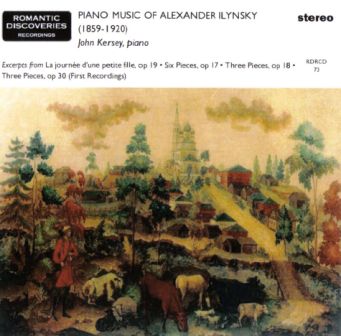
Piano Music of Alexander Ilynsky (1859-1920)
John Kersey, piano
RDR CD73

Total time: 78 minutes 49 seconds

1. Three Pieces, op 30: no. 2, Nocturne (8’40”)

La journée d’une petite fille, op 19: book 4 (nos. 19-24)
2. Rêverie (4’56”) 3. La vieille bonne (5’38”) 4. Conte (5’38”) 5. Prière (5’00”) 6. Berceuse (3’02”) 7. Sommeil (3’30”)

from Six Pieces, op 17: nos. 1-4
8. Prélude (4’28”) 9. Récit interessant (2’31”) 10. Rêverie (7’40”) 11. Menuet (3’33”)

Three Pieces, op 18
12. Romance (9’04”) 13. Valse (4’24”) 14. Nocturne (10’27”)

Biographical notes (from Wikipedia)
Alexander Ilyinsky was born in Tsarskoye Selo in 1859. His father was a physician in the Alexander Cadet Corps. His general education was in the First Cadet Corps at St Petersburg, and he served in the Artillery from 1877 to 1879. His music studies were in Berlin, under Theodor Kullak and Natanael Betcher at the Berlin Conservatory, and under Woldemar Bargiel at the Neue Akademie der Tonkunst. He returned to Russia in 1885, graduated from the St Petersburg Conservatory and taught at the music school of the Philharmonic Society in Moscow. He resigned in 1899 and started giving private lessons. In 1905 he joined the staff of the Moscow Conservatory. His students included Vasily Kalinnikov, Anatoly Nikolayevich Alexandrov and Nikolai Roslavets.

His major work, the 4-act opera The Fountain of Bakhchisaray, to a libretto based on Alexander Pushkin’s poem, was produced in Moscow in 1911. He also wrote a symphony, a Concert Overture, a string quartet, three orchestral suites, a set of orchestral Croatian Dances, a symphonic movement called Psyche, two cantatas for female chorus and orchestra (Strekoza (The Dragonfly) and Rusalka), incidental music to Sophocles’ Oedipus Rex and Philoctetes, and to Aleksey Konstantinovich Tolstoy’s Tsar Fiodor Ioannovich, piano pieces, church music, songs, etc. His name is perhaps most familiar to music students for his Lullaby from the third orchestral suite (sometimes described as a ballet), “Noure and Anitra”, Op. 13, which excerpt has appeared in many different arrangements.

Alexander Ilyinsky also wrote “A Short Guide to the Practical Teaching of Orchestration” (1917), which remained in use long after his death. In 1904 there appeared under his editorship “Biographies of all Composers from the Fourth to the Twentieth Century”. He edited the complete piano works of Beethoven for a commercial publication. He died in 1920 in Moscow.

Read Full Post »

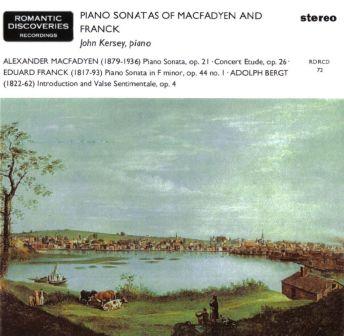
Piano Sonatas by MacFadyen and Franck
John Kersey, piano
RDR CD72

Total time: 70 mins 40 secs Alexander MacFadyen (1879-1936)
1. Concert Etude, op. 26  (6’07”)

Piano Sonata, op. 21
2. Allegro energico (9’56”)
3. Romanza: Adagio con espressione (7’29”)
4. Scherzo: Allegro con brio (3’14”)
5. Finale: Allegro maestoso (9’04”)

Adolph Bergt (1822-62)
6. Introduction and Valse Sentimentale, op. 4 (8’37”)

Eduard Franck (1817-93)
Piano Sonata in F minor, op. 44 no. 1
7. Presto (7’40”)
8. Andante con moto (9’01”)
9. Allegro (9’20”)

We are grateful to Peter Cook and Dr Klaus Tischendorf for supplying copies of scores for use in this recording.

Notes on the music
Alexander MacFadyen was born in Milwaukee, Wisconsin, and studied there under William Borchert and the theorist Julius Klauser. During his three years at the Chicago Musical College he was a pupil of Rudolph Ganz, Arthur Friedheim (who had studied with Liszt), Felix Borowski and others, winning the Marshall Field Diamond medal for graduate school work.

Making his debut with orchestra at the Chicago Auditorium with conductor Hans von Schiller in June 1905, he then concertized as soloist with the Chicago Symphony Orchestra under Frederick Stock and taught at the International Conservatory, New York, and the Wisconsin College of Music, Milwaukee.

MacFadyen’s compositions are mainly small-scale songs and piano works, but this Piano Sonata, a mature work dating from 1921 despite its opus number, is on the grandest of epic scales. It was performed in concert by legendary pianist Josef Hofmann. Stylistically, it shows a strong influence of MacDowell and Grieg, and an ambitious use of episodic form, with the outer movements comprising a set of interconnected sections. MacFadyen’s work must be reckoned among the more imposing of the sonatas of the American late Romantic era and its neglect is puzzling.

Eduard Franck was born in Silesia into a wealthy and cultured family that numbered Mendelssohn and Wagner among its acquaintances. He studied with Mendelssohn as a private student and then began a long career as a concert pianist and teacher. He was regarded as one of the leading pianists of his day and also as an outstanding teacher.

Franck was not forthcoming about his compositions, and failed to publish many of them until late in life. He was a perfectionist and would not release a work until he was absolutely satisfied that it met his standards. Yet what survives is extremely high in quality. Writing of his chamber music, Wilhelm Altmann said, “This excellent composer does not deserve the neglect with which he has been treated. He had a mastery of form and a lively imagination which is clearly reflected in the fine and attractive ideas one finds in his works.”

This Sonata, the first of three that form Franck’s op. 44, is a passionate and finely constructed work that is inventive throughout. The surging, declamatory first movement is succeeded by a slow movement which (perhaps recalling Beethoven’s op. 31 no. 2) features a passage in recitative style. The finale is a busy movement with the opening figuration contrasted with episodes that suggest both Schubertian and Mendelssohnian turns of phrase.

The recording of Adolph Bergt’s Introduction and Valse Sentimentale together with our earlier CD53 completes our survey of that composer’s known piano works, although there are also reports of as-yet lost character pieces that appear not to have survived in the libraries of Europe. This is a piece that, in its way, is absolutely typical of Bergt’s distinctive lyrical and episodic style. Extremely subtle in effect, the same melancholic atmosphere pervades this work as is the case in his longer cycles, suggesting that his approach was fully-formed even at this early point in his compositional development.

Read Full Post »

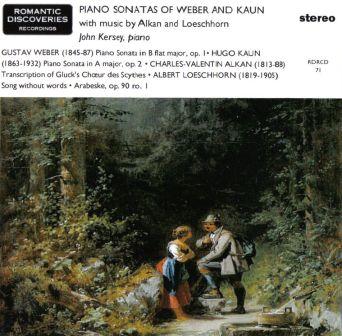
Piano Sonatas by Gustav Weber and Hugo Kaun
John Kersey, piano
RDR CD71

Total time: 66 mins 48 secs

Gustav Weber (1845-87)
Piano Sonata in B flat major, op. 1
1. Allegro (12’16”)
2. Scherzo: Presto (6’55”)
3. Andante espressivo (7’16”)
4. Allegro vivace (6’53”)

Hugo Kaun (1863-1932)
Piano Sonata in A major, op. 2
5. Allegro moderato (8’31”)
6. Andante espressivo (6’12”)
7. Intermezzo: Presto (2’34”)
8. Rondo: Allegretto grazioso (6’04”)

Charles-Valentin Alkan (1813-88)
9. Transcription of the Chœur des Scythes from Gluck’s “Iphigenia in Tauris” (5’38”)

Albert Loeschhorn (1819-1905)
10. Song without words (2’48”)
11. Arabeske, op. 90 no. 1 (1’26”)

We are grateful to Peter Cook for supplying copies of scores for use in this recording.

Notes on the music
We know little of Gustav Weber’s life other than that his lack of posthumous recognition is likely the result of his premature death aged forty-one. Born in Switzerland, he studied at the Leipzig Conservatoire and became a professional organist and conductor as well as a composer. Much of his career was spent as a teacher of singing in the Zurich public schools, and towards the end of his life he became editor of the Zurich journal Schweizerische Musikzeitung. Of his piano trio, op 5, Liszt, who was the dedicatee, wrote in 1882 that “I consider [it] an eminent work, worthy of recommendation and performance.”

The Piano Sonata op. 1 is in the grandest of styles, and occupies a similar coming-of-age role in Weber’s output to the early sonatas of Brahms. It is clear that Weber had absorbed elements of the “orchestral” piano style, with many passages featuring massive chords and double octave figurations. His melodic material recalls previous B flat Sonata monuments such as the opp. 106 by both Beethoven, and more particularly, Mendelssohn. Throughout the four movements a high level of invention and creativity is sustained, with the return of the opening motif at the end of the finale marking a satisfying cyclical aspect to the work. This sonata could well be revived in concert to good effect.

The work of Weber and Kaun is linked by a now-forgotten fellow student at the Leipzig Conservatoire and later pupil of Tausig and Liszt, Robert Freund (1852-1936), who was to become the first piano professor of the Zurich Musikschule and championed both Weber and Kaun in recital. Perhaps his extensive capabilities were an influence on their virtuosic piano writing.

By the side of Weber’s monumental work, the early Sonata by Hugo Kaun is more obviously lyrical and inward in intent. Kaun was born in Berlin and studied piano there with Oscar Raif. Around 1886, he left Germany for the United States, where he settled in Milwaukee. Here he taught at the conservatory and conducted local choirs, but was prevented from following a career as a pianist by a hand injury. Perhaps feeling the pull of his homeland, he returned to Germany at the turn of the twentieth-century and remained there for the rest of his life. He was appointed to the Prussian Academy of Arts in 1912 and in 1922 joined the staff of the Berlin Conservatoire.

Kaun’s works span all the major genres, and generally occupy a neo-Wagnerian niche that opposed the modernism of the post-First World War years. His piano concerto was dedicated to his friend Godowsky. Some of his works, particularly those for male choir, have a nationalist quality. The Piano Sonata op. 2 is a reflective, expansive work that epitomises the confident late Romantic style with a notable debt to Beethoven in its formal structure and sensitive use of texture.

Alkan’s works are generally well represented on disc today, but his transcriptions remain neglected. This is the first recording of an unusual choice of his – the Chorus of the Scythians from Act 1 of “Iphigenia in Tauris” by Gluck. The Scythians tell of having found two young Greeks shipwrecked; they demand their blood. Alkan renders the music in his customary fashion, interpolating considerable pianistic difficulties that are not immediately obvious to the listener but are all-too apparent to the performer.

Carl Albert Loeschhorn taught at Berlin from 1851 and was appointed Royal Professor of Piano in 1858. Best-known as a teacher, he also appeared often in chamber music and composed in both longer and shorter forms for piano and chamber groups. The two works here show him at his best in two lyrical encore pieces.

Read Full Post »

Piano Sonatas by Julius Röntgen (1855-1932)
John Kersey, piano
RDR CD70

Total time: 63 mins 47 secs

Sonata no. 1 in A major, op. 2
1. Allegro (9’12”)
2. Scherzo: Presto (6’53”)
3. Adagio (8’42”)
4. Vivace quasi presto (8’00”)

Sonata no. 2 in D flat major, op. 10
1. Allegretto, sempre tranquillo (10’22”)
2. Scherzo: Allegro vivace (3’52”)
3. Andante cantabile (8’09”)
4. Finale: Allegro con fuoco (8’28”)

We are grateful to Peter Cook for supplying copies of scores for use in this recording.

Notes on the music
Julius Engelbert Röntgen was the son of the first violinist in Leipzig’s Gewandhaus Orchestra and showed musical gifts from an early age, studying under Carl Reinecke. Aged fourteen, Röntgen visited Liszt in Weimar and played for him, and returning home, he was introduced to Brahms by his friend Heinrich von Herzogenberg. Piano studies continued under the aged Franz Lachner, who had known Schubert.

From 1877, Röntgen based himself in Amsterdam, where he taught at the music school and gave concerts, including a performance of Brahms’ second concerto under the composer’s baton. He was together with Coenen and de Lange founder of the Amsterdam Conservatoire in 1883, and the following year was involved in the foundation of the Concertgebouw. However, he was passed over for selection as the Concertgebouw’s first Director, and thereafter concentrated on composing and working as a collaborative pianist. Among his duo partners was the young Pablo Casals.

The First World War brought about conflict for Röntgen, since one of his sons was taken prisoner by the Germans. In 1919 he took Dutch citizenship, before retiring in 1924. This retirement in fact prompted a burst of creativity in composition, with over one hundred works (mostly chamber music and songs) produced. The last year of Röntgen’s life saw him begin to experiment with atonality, and he wrote a bitonal symphony which has yet to be published.

Röntgen’s work has  received limited attention since his death, and only parts of his compositional legacy are represented on disc today, with the solo piano music being particularly little-known. As this present issue shows, Röntgen wrote with considerable facility for the instrument and was in many respects a successor to his teacher Reinecke as well as to Brahms himself.  Röntgen’s obituary in The Times, by Donald Francis Tovey, contained the following endorsement, “Röntgen’s compositions, published and unpublished, cover the whole range of music in every art form; they all show consummate mastery in every aspect of technique. Even in the most facile there is beauty and wit. Each series of works culminates in something that has the uniqueness of a living masterpiece.”

The piano sonata was an enduring preoccupation for Röntgen and the exact number of works in that genre that he wrote cannot yet be ascertained with certainty, since a significant part of his output was completed but not published. What is certain is that from his earliest years as a composer through to his last, he was writing piano sonatas, and by the time the A major sonata recorded here was published as his op. 2 he was already fluent in his mastery of large-scale piano writing.

Beethoven, a nd in particular the sonatas op 28 and op 101, is the main influence on the opening movement of the A major sonata, and just in the later D flat example op 10, Röntgen explores material that begins in pastoral and easy-going vein only to reveal more turbulent undercurrents as the material is developed. Rather than the expected calm flow introduced by the opening, Röntgen’s unexpectedly disconnected phrases ask significant questions that will only be fully answered later in the work.

Both sonatas place the scherzo movement second, reflecting the contrast between first and slow movements of considerable import. In the A major, the material is playful, while the D flat major is more extrovert and even Busonian. The slow movement of the A major exploits the contrast between the chorale-like opening and a more agitated dotted figure that recurs periodically as an episode. The D flat major begins with a determined processional which is contrasted with more lyrical polyphonic material leading to a dramatic chordal peroration.

The finale of the A major has a gigue-like quality rather in keeping with the pastoral mood of the opening. Pianistic leaping figures are notable and in places the writing assumes orchestral dimensions. The finale of the D flat sonata, by contrast, has something of a Grieg-like quality in its rustic, uncompromising refrain, though the development into elaborate polyphony suggests no-one so much as Brahms, though the demands upon the performer (confronted with streams of double-notes and wide-ranging textures that call for considerable stamina) are distinctly progressive compared with the earlier composer.

Read Full Post »

« Newer Posts - Older Posts »