Archive for the ‘Catalogue’ Category

Piano works of Stefano Golinelli (1818-91)

Piano music of Stefano Golinelli (1818-91)
John Kersey, piano
RDR CD69

Total time: 69 mins 36 secs

1. Fantasia, op 105 (8’47”)

Sonata no. 3 in G major, op 54(b)
2. Allegro (7’15”)
3. Andante (5’24”)
4. Prestissimo (3’20”)
5. Allegro vivo (6’48”)

6. Scherzi e follie, op. 182 (4’58”)

Sonata no. 5 in E minor, op. 140
7. Andante sostenuto – Allegro agitato (8’33”)
8. Andante (6’32”)
9. Allegro (3’35”)
10. Allegrissimo (4’44”)

11. Fantasia villerecchia, op. 116 (9’25”)

We are grateful to Peter Cook for supplying copies of scores for use in this recording.

Notes on the music
Stefano Golinelli is in the process of being rediscovered as a highly significant pianist-composer of the nineteenth-century. His contemporaries were in no doubt as to his worth, with Hiller describing him as “the best pianist of his time” and Schumann praising him as an “unexpected sign of life” in Italy. The image of nineteenth-century Italy as a centre of opera should not obscure its very considerable activity as a centre of virtuoso pianism and composition for the instrument, and indeed Golinelli’s role at the forefront of both fields.

Born in Bologna, Golinelli began serious studies aged nine, according to the strict training for musicians then customary among the Bolognese, and at the age of eighteen was admitted as a signal honour to the Accademia Filharmonica in the capacity of composer; the usual examination was waived. From his mid-twenties he began a decade of concertizing as a pianist, playing not merely in the major Italian cities but also travelling to Paris and London. Meanwhile, in 1840, Rossini secured for him a position as teacher of piano at the Liceo Musicale where he was to remain until 1871. His career was thereafter divided between teaching, performing and composition, in which latter faculty he was to prove highly prolific.

We can see the same sort of range of forms in Golinelli’s compositions as in the piano works of his contemporary Liszt.  There are five large-scale sonatas, sets of variations, occasional pieces, a set of 24 preludes, etudes, albums of connected miniatures and dances of the salon forms of the day, and apart from three quartets and a few short chamber pieces, all of these works are for the piano. Almost all of these were published during Golinelli’s lifetime, as testament to his great popularity in his native land as well as abroad. Busoni was among those who became familiar with this output and regarded it favourably.

Golinelli’s style is individual and represents a development of the school of Mendelssohn, Heller and so on. He writes for the piano as a master, with a technical grasp that parallels Chopin and that exploits the instrument to the full. Even his short works tend to be technically demanding.

The Third Sonata, dedicated to Hiller, exists in two published versions, and the one here recorded is the second. Golinelli made major changes to the work between the revisions, shortening and tightening many of the transition passages and clarifying the textural writing so as to give a better effect. The slow movement was completely recomposed. Throughout, the influence of Beethoven’s Sonata op. 31 no 1 can be felt both in the melodies themselves and in their treatment, with the coda of the finale (of course also an influence on Schubert’s A major sonata D959) a particular point of contact. However, the style is very much Golinelli’s own, with some deft harmonic touches and a cogent argument throughout.

The Fifth Sonata, dating from 1858, inhabits more dramatic territory, and the opening movement’s introduction recalls Weber’s style before launching itself into a virtuosic and impassioned Allegro. The melodic material is strong and its treatment imaginative, with a notable F major episode in the development that could come from nowhere else than nineteenth-century Italy. This is followed by a slow movement whose opening calm soon develops into a more agitated demisemiquaver figure. It is the contrast and combination of these two features that makes the running for the remainder of the movement. Unusually among composers, Golinelli has a preference for placing the scherzo third in the sonata (which he also does in the Fifth) and here it is a dour little march marked “sotto voce” that meets its match in a massive fortissimo chordal motif with humorous acciaccatura garlands that takes the place of a trio (perhaps an idea influenced by Alkan’s Scherzo diabolico?). On arrival at the finale, the short introduction leads us into a complex main group in fiendish double notes that has something of the character of a tarantella.

Golinelli’s Fantasias are original works in the customary episodic form, and serve as a means for display both of compositional ingenuity and pianistic prowess. The C minor fantasia op. 105 begins in operatic fashion with its opening meditation interrupted by a distant bird-call. There follows a varied treatment of the initial theme and then a dramatic passage in massive chords and rapid figurations leading to a recitative and cantilena. More agitated material leads to the return of the main theme in grandiose style and a coda in complex arpeggiated figurations.

The Fantasia villerecchia, op. 116, is not such a striking work, but its view of the pastoral style is nevertheless attractive. Beginning with an innocent theme, it leads to a full-scale depiction of a storm worthy of Rossini’s William Tell Overture in its clever use of effect. A charming Allegretto in 6/8 time leads to the final exultant rustic dance.

The Scherzi e follie is a good example of Golinelli’s shorter works, illustrating his well-developed sense of stylistic contrast and humorous effect.
Read Full Post »

Rudolf Viole (1825-67): The Piano Sonatas vol. 3
John Kersey, piano
RDR CD68

Total time: 77 mins 50 secs

Sonata no. 7 in D minor, op 26 (dedicated to L.A. Zellner):
1. Allegretto (9’53”)
2. Andantino grazioso, Allegro scherzando (7’03”)

Sonata no. 10 in F sharp minor, op. 29 (without dedication):
3. Allegretto (10’00”)
4. Andantino (4’01”)
5. Allegro agitato molto (5’48”)

6. Sonata no. 11 in E flat major, op. 27 (dedicated to Franz Liszt):
Allegro affrettando – Maestoso – Allegro con agilita – Moderato recitativo – Allegro (12’25”)

7. Caprice héroique, op 13 (5’57”)

Bronsart: Three Mazurkas, op 4
8. Allegretto capriccioso (3’02”)
9. Moderato (5’10”)
10. Allegro ma non troppo (6’39”)

11. Bülow: Elfenjagd: Impromptu (7’17”)

We are grateful to Dr Klaus Tischendorf and Peter Cook for supplying copies of scores for use in this recording.

Notes on the music
(continued from volume 2)
The Seventh Sonata, not unlike Beethoven’s op. 54, represents a hiatus between the fully worked-out dramas of the Sixth and Eighth Sonatas and a return to a smaller canvas. There are passages here that suggest a simple rusticity, particularly in the finale, but overall the harmonic cast is definitely of Viole’s mature period. Much in the opening movement suggests an extended meditation and, as would be made most clear in the Eighth, the rhapsodic element starts to come to the fore in passages that are openly exploratory. The lack of variety in the movement (again an issue that would be addressed in the Eighth) contributes to a somewhat dour impression overall, but equally is representative to the quality of obsessive concentration that distinguishes Viole’s style from that of his contemporaries.

The second movement has something of the feeling of a minuet; its development is brief and like other Viole central movements it feels terse and somewhat odd. It soon leads into the finale, which is based on the opening theme of the work, but now develops that theme with the aid of a rhapsodic episode and an extended coda.

If the free fantasia, song and dance structure of the Seventh did little to suggest the expansiveness of the Eighth or the intense drama of the Ninth, the Tenth is surely one of Viole’s finest mature compositions. The mood of the opening is tragic and meditative, beginning with a left hand recitative and developing into an agitated cantilena that introduces a development of considerable complexity. This long movement subsides directly into an Andantino that is among the most melodic and effectively contrasted of Viole’s slow movements. After this, the exciting finale is all high drama, with massive octave passages transcending Viole’s often reticent-seeming approach to attain a genuinely orchestral virtuosity.

This vehemence carries through to the opening of the Eleventh and final sonata, whose initial march makes clear the strangeness of much of Viole’s harmonic writing in this work. Everything here is more condensed than previously, and sometimes this leads to passagework of baffling harmonic obscurity – the emergence of a B minor triad ex nihilo in this first section is a prime example of a forward-looking approach here that mostly comes off successfully. A light intermezzo marked “with agility” provides a contrast in mood before a cadenza brings us to a finale with a triumphant hunt-like motif.

Viole’s cycle of sonatas is a notable achievement, but one so strongly marked by an individual personality that it must have evoked love/hate responses even at the time. What is beyond doubt is that Viole was possessed of an extraordinary intellectual ability and also a stylistic grasp that is remarkable. Just as he and his contemporaries saw their music as representing a progression from that of earlier eras, so Viole demonstrates aspects of that progression in his Sonatas, but throughout remaining resolutely his own man. Where few of those contemporaries were drawn to the sonata format to any great extent, Viole made it his own, showing how its issues could be addressed in a way that even now retains the capacity to surprise.

As a codicil, the Caprice héroique, dedicated to “his friend, Hans von Bronsart”, is a good example of Viole in more overtly virtuosic mode. Built on a leaping figure in the left hand, it is an etude in strength and stamina.

Bronsart himself is represented by three forward-looking Mazurkas published as his op 4. He met Liszt in Weimar in 1853 and also came to know Berlioz and Brahms at that time. Such was the esteem he was held in by Liszt that he was chosen to play the solo part in the first performance of Liszt’s Second Piano Concerto, with the composer conducting, and was subsequently the dedicatee of the work. Bronsart’s main career was as a conductor and as general manager of the theatres of Hanover (1867-87) and Weimar (1887-95). His wife, Ingeborg Lena Starck, was also a composer.

Both Liszt and Bülow admired Bronsart’s compositions, Bülow describing his piano concerto as the “most significant one of the so-called Weimar school”. His Mazurkas are not particularly Chopinesque, instead looking forward with hints of Szymanowski and even Scriabin’s development of the form. The harmony again begins to escape the salon and engage directly with the modality of the folk idiom.

Bülow’s compositions are today less well-known than his work as pianist, conductor and editor. As expected, they show a strong Wagnerian influence, but also some degree of Lisztian treatment of the piano. Elfenjagd is an attractive impromptu that could be considered a spiritual companion-piece to Liszt’s Gnomenreigen. If Bülow’s gift is not notably for memorable melodic ideas, then at least their artful and pianistically varied treatment compensates to some extent.

Read Full Post »

Rudolf Viole (1825-67): The Piano Sonatas vol. 2
John Kersey, piano
RDR CD67

Total time: 75 mins 41 secs

Sonata no. 4 in F major, op 23 (dedicated to Franz Brendel):
1. Allegretto con moto (7’00”)
2. Moderato giusto (6’59”)
3. Presto agitato (3’56”)

Sonata no. 6 in B minor, op. 25 (dedicated to Carl Tausig):
4. Romanze – Andantino cantabile (3’12”)
5. Intermezzo – Allegro scherzando – Trio (5’33”)
6. Allegro appassionato (11’50”)

Sonata no. 8 in E major, op. 27 (dedicated to Dionys Pruckner):
7. Allegro (15’20”)
8. Romanze – Andantino con moto (4’05”)
9. Presto (5’23”)

8. Sonata no. 9 in F minor, op 28 (dedicated to Richard Wagner) (11’51”)

We are grateful to Peter Cook for supplying copies of scores for use in this recording.

Notes on the music
(continued from volume 1)
Where the Third Sonata had begun with determined objectivity, treating its first subject as if it were early Beethoven, its concluding perpetuum mobile surely represented a ne plus ultra of obsessive triplet-figuration finales for Viole. How to follow something so seemingly final? Well, the Fourth Sonata begins with an enigmatic but insistent figure over a pedal point, at once establishing harmonic instability and making it clear that we have moved forward in our stylistic purview to a definite Romanticism. Changing figurations, but not interrupting the constant movement of quavers, Viole introduces dolorous scalic cantilenas that will provide the main motivic material of the exposition, contrasting this with mini-episodes of staccato accompaniment and melody. Later on, the texture will expand to positively symphonic proportions with angular octaves followed by the return of the pedal point in a tense tremolando. As will become common with Viole, development is more or less integrated within the exposition and recapitulation.

Viole’s issues with slow movements have already been noted. Here there is no slow movement at all, but in fact a very similarly paced foil for the opening, marked Moderato giusto. This odd movement is built around a similar legato figuration to that seen previously, and indeed it feels like a continuation of that movement’s development, such is the thematic kinship.

The movement eventually develops into a dramatic virtuoso peroration, decorating the melody with rapid arpeggios, octaves and chords, before quickly dying away into nothing. Then Viole returns to the compound-time triplet finale of which he had shown such mastery in the Third Sonata. This time there is an added twist, for the main theme of the first movement swiftly returns in the new movement’s figuration, to be followed by allusions to previous motifs within more developmental episodes. Again, the perpetual motion rarely lets up, even if the Germanic formality of the motivic style adopted rather dispels otherwise-tempting comparisons with Chopin’s finale from op 58, for example. On paper, this is a long movement, and even though its Presto pace means that it passes by quickly, it remains packed with ideas and events so that it acquires a greater emphasis in the overall structure than is usual for a finale. A rather Brahmsian figuration introduces a coda replete with virtuoso double octaves and increasing in pace to the concluding prestissimo bars.

After the dramatically unified Fifth Sonata, Viole’s Sixth appears more conventional, and indeed evokes the approach of Schumann, Hiller and Mendelssohn to that form. Beginning with a short Romanze that resembles a Mendelssohnian Song without Words both in its cantilena style and brevity of treatment, this leads after just two pages into a scherzo-like Intermezzo. Here we are reminded of both Mendelssohn, and of Schumann’s scherzino from op. 26. The trio is more exploratory and introduces material of greater emotional depth and harmonic richness.

In the Fourth, the import of the work had been more equally shared with the finale than is usual; in the Sixth that feature is exaggerated, with the finale being the only developed movement and encompassing a full dramatic argument. This movement recalls Heller’s Second Sonata (also available on RDR) with which it shares a key and much else stylistically. Based on two motifs, the second of which gives rise to variants in both dotted and triplet rhythms, the texture and material are varied to a greater extent than hitherto. The writing at times approaches the Lisztian orchestral style that had been suggested in the Fifth, but throughout with a feeling of formal restraint. An interesting passage based on shifting pedal points and leading to a chromatic descent is somewhat reminiscent of Alkan. Yet the work does not end in this energetic mood, but with a quiet, still coda that, like Liszt’s Sonata, suggests significant major/minor ambiguity.

The Eighth Sonata steps beyond Mendelssohn’s world and can, at least in its first movement, be seen as a response to the first movement of Chopin’s op. 58 in its embracing of the rhapsodic style. Here the concentration is much more on cantabile than hitherto, with the mood one of greater emotional warmth and informality of approach. The varied textures noted in the Sixth are prominent here within a grand design that stretches out over a fifteen-minute span. Both the exposition and recapitulation codas end with restrained chordal passagework marked cantabile religioso – a fitting contrast to the activity that had preceded them.

Just as the Fourth had followed a first movement with one that is very similar in mood and tempo, so Viole’s central Romanze in the Eighth does not break the spell, but sees it from a different perspective, here from the tonic minor. The form is ternary, but with variation of the melody taking the place of significant development (another Chopinesque feature). Where the first movement had mostly concentrated on intensity, this movement is relatively simple and direct by comparison.

No such simplicity attends the finale, a complex and extremely demanding fugato whose subject plays with the alternation between major and minor in a forward-looking way. The movement can be seen as a study in double-notes; not merely the commonly-found sixths and thirds, but chains of fourths and diminished fifths abound. A maestoso central episode in the remote key of E flat major presents the subject in a chordal guise, before the opening material returns and leads to an expanded coda. Despite its ambiguity, the movement concludes triumphantly in the major.

The Ninth Sonata is dedicated to Wagner, and something of that composer’s style can be felt in the mood and execution of the piece. The work begins with a dramatic cadenza in martellato double octaves guaranteed to daunt all but the hardiest virtuosi (the infamous transition passage in Liszt’s Sonata is probably a model for this). Then we begin the movement proper, with the central theme treated under extended triplets which do not loose their grasp until the second cadenza. The succeeding Allegretto con moto, which follows without a break, is again concerned with treating the theme against triplets, but this time more developmentally, leading to a memorable chordal climax against a series of pedal points. After a return to the initial texture, Viole treats the theme in octaves against sweeping arpeggios in the manner of Liszt, leading to a third cadenza and the recapitulation of the opening theme, treated fully and with plenty of allusions to the previous textural explorations.  A dramatic succession of trills and tremolandi leads to the final explosion of arpeggios.

Read Full Post »

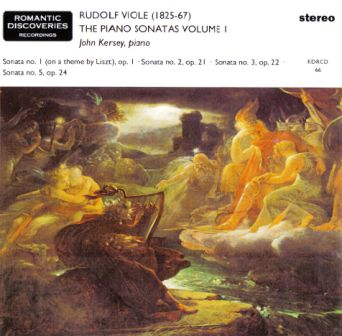
Rudolf Viole (1825-67): The Piano Sonatas vol. 1
John Kersey, piano
RDR CD66

Total time: 77 mins 32 secs

1. Grande Sonate no. 1 in B flat minor (on a theme by Franz Liszt), op. 1 (dedicated to Hans von Bülow) (30’33”)

Sonata no. 2 in C major, op. 21 (dedicated to Ernst Hentschel):
2. Allegretto (5’18”)
3. Andante. Alla Marcia funebre (5’44”)
4. Presto (4’02”)

Sonata no. 3 in A minor, op. 22 (dedicated to Countess Louise von Ahlimb-Saldern):
5. Allegro (9’13”)
6. Andante (3’57”)
7. Prestissimo (4’23”)

8. Sonata no. 5 in D minor, op. 24 (dedicated to Franz Bendel) (13’58”)

We are grateful to Dr. Klaus Tischendorf and Peter Cook for supplying copies of scores for use in this recording.

Notes on the music
With this disc, Rudolf Viole half-emerges from the shadows. We know only bare details of his biography: studies with Henszchel in Berlin took him to Liszt in Weimar after 1850, and then a career as a piano teacher and on the staff of the Neue Zeitschrift fuer Musik in Berlin from 1857. And of the music, we are told by Prosnitz that there are some 91 works, mostly instructive in nature, but including eleven piano sonatas that occupy op 1 and opp 21-30. After his early death, Liszt edited a collection of 21 Etudes called Gartenlaube.

Things began well. The publication of Liszt’s B minor Sonata must have had a galvanic effect on Viole – as indeed it was to have on many others subsequently – for Viole’s op. 1 is effectively as much a tribute to Liszt’s work as Lyapunov’s later Transcendental Etudes were to Liszt’s eponymous studies. Liszt himself provided the motto theme for Viole during a lesson; bold and arresting, it has clear symphonic and heroic overtones. Within a year of the first appearance of the Liszt sonata, Viole’s own work was ready, and was dedicated to fellow Liszt pupil Hans von Bülow. Bülow reviewed Viole’s sonata in the Neue Zeitschrift für Musik, 95 (1856), describing it as “sweepingly innovatory, music of the future in the highest degree.” Indeed, the work is forward-looking, at times anticipating Reger, and (a characteristic of Viole’s style here) is much more formal in its approach to motivic development than Liszt (for example, the fugato section is considerably extended on lines that are more Beethovenian than Liszt’s own truncated example). Also striking is the extent of the unrelieved darkness and seriousness of the material – there is little to match Liszt’s scherzando moments, and instead a profundity anticipating Wagner is in effect throughout.

Viole’s melancholic and serious temperament may hold some clue as to why the reception of his op 1 did not lead to a more overt public acclaim. However, we know nothing of his life and character other than that which is betrayed by what limited amount of his music is available for review.

Some twenty opus numbers beyond op. 1, Viole returned to the sonata to begin a cycle of what was eventually to be eleven works in the form. William S. Newman, in “The Sonata Since Beethoven” wrote as follows:

“Four reviews ….. of the first six in Viole’s cycle of ten sonatas tell of a planned increase in complexity of form, treatment, harmonic richness and exploration, and technical difficulty, from one sonata to the next.”

However, Newman had never heard any of these works, nor had access to scores, which have only surfaced recently by way of Switzerland via England. His analysis was nevertheless correct in its broadest implications. The cycle of sonatas is almost designed as an exploration of the different problems that the form elicits and the various means by which those problems can be solved. These works, too, are entirely different in style and character from op. 1, which really should be considered an entirely separate achievement. Viole is clearly keenly aware of the heritage of the sonata throughout the Classical era and into that of his contemporaries, and references to the styles of other composers are cleverly integrated into his own personal outlook.

That outlook is at times highly surprising. Could the first movement of the Second Sonata be the first work in a neo-classical style? It sounds almost like a parody of Clementi or Galuppi, but with little touches here and there that quickly remind us of our real vantage-point. It was Erik Satie who would show, in his ‘Sonatine bureaucratique’, how the conventions of the Alberti bass, sequence and other stock devices could be subverted; his intention was humorous, where Viole’s is somewhat more philosophical. By the time we get to the extended and still developmental coda (a favourite formal device of Viole) there is no doubt that the aim is to reveal the expansion of convention to encompass Viole’s own distinctive stylistic traits.

Defining, rather than merely recognizing, those traits remains a challenge. The listener is unlikely to appreciate Viole at a first hearing. His music seems withdrawn, abstract and lacks emotionality. Only on repeated acquaintance does one start to realise that this constraint is the whole point of Viole’s world, with the music arranged according to elaborate formal patterns and often a complex, though rarely over-extended, philosophical design. Just as in Reger’s music, passages which might appear obscure are revealed to have strong motivic roles or to be transformative in a rhetorical style that actually owes not a little to Liszt and early Wagner. This conscious tension between the expressively loose and structurally tight is at the heart of the drama and contrast that typify Viole’s approach to the sonata, and it is only when we reach Prokofiev that these elements are once again balanced in this way.

The slow movements of the sonatas are enigmatic, rarely resting on obvious melody, and tersely stated without much development, unlike the extension of the first movements and episodic forms usually chosen for the finales. They are not generally the emotional epicentres of the works, but rather recall the role of Beethoven’s brief slow movement in op. 53 as a bridge between different worlds. The obsessive little funeral march in the Second only reluctantly lets go its dotted rhythm before an exploratory, angular passage introduces the germ that will form the main body of the argument of the finale.

The finales show a tendency towards the compound-time rondo, but with some degree of complexity both in the treatment of episodes (often developmental) and the return of earlier material. In the Second, the rhythm again becomes obsessive; in the Third, that obsession turns into a demonic virtuoso ride, with episodes driven to the edge and beyond.

The reader will by now have made an obvious comparison with Alkan in terms of this particular trait of obsession, the often-demanding writing for the instrument and the essential reticence and inwardness of the music’s ambit. It is largely Viole’s preference for Germanic rhetoric and the rhapsodic that separates the two composers, as well as a harmonic palette that with Viole is less adventurous, though by the standards of his time certainly not altogether conventional.

With the Fifth Sonata, Viole breaks through into a strongly unified structure in three main sections, uniting the fast-slow-fast model with the structure of exposition, development and recapitulation. The writing has become more characteristic of the Romantic virtuoso school, with several powerful octave passages, but Viole’s tendency towards classicism is still evident in the motivic material. The slow movement is reduced to a truncated recitative that is little more than heightened relief from the otherwise constant tension and conflict. Intensity is a prime characteristic of this music; where others would lighten the mood from time to time, Viole simply views a particular emotional world – and usually a tragic one – from varying perspectives. This vision may ultimately appear bleak, and in that establishing another connection with Alkan’s exploration of the farther reaches of human experience; yet it is certainly unlike anyone else of Viole’s time, and represents a considerable compositional achievement.

Read Full Post »

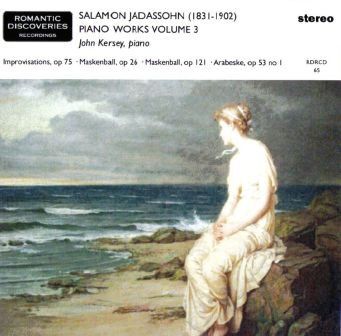
Piano music of Salomon Jadassohn (1831-1902) volume 3
John Kersey, piano
RDR CD65

Total time: 74 mins 12 secs

Maskenball (Masked ball): 7 Airs de Ballet, op 26:
1. Tempo di bolero (3’45”) 2. Allegretto un poco vivo (1’44”) 3.  Andantino quasi Allegretto (2’47”) 4. Mouvement de valse (2’56”) 5. Tempo di mazurka (3’10”) 6. Allegro moderato (2’22”) 7. Molto Allegro agitato (3’00”)

Improvisations, op 75:
8. Bolero (5’07”) 9. Ländler (3’21”) 10. Zwiegespräch (Duologue) (3’57”) 11. Frühlingslied (Spring Song) (2’07”) 12. Bitte (Entreaty) (2’44”) 13. Capriccio (3’14”)

Maskenball: 7 Characterstücke, op 121
14. Entrata (4’15”) 15. Arlecchino (4’34”) 16. Intermezzo (1’24”) 17. Promenade (4’00”) 18. Divertimento (6’52”) 19. Siciliana (1’52”) 20. Finale (4’12”)

21. Arabeske, op 53 no 1 (reconstruction by John Kersey) (5’40”)

We are grateful to Dr. Klaus Tischendorf, Prof. Luca Chierici and Peter Cook  for supplying copies of scores for use in this recording.

Notes on the music
According to Jadassohn scholar Klaus-Peter Koch, there are two major reasons why the music of Salomon Jadassohn is not better known today. One is that, as a Jew, he was a victim of the anti-Semitism of Wilhelmine Germany, in which critics labelled his music as academic and dry, and the other is that he was overshadowed by his colleague at the Leipzig Conservatoire, Carl Reinecke.

As this recording hopefully shows, Jadassohn was far from dry, instead being a composer of melodic felicity and great harmonic imagination, with his unexpected use of chords at times drawing parallels with Alkan and Jadassohn’s own pupil Busoni. There are around 140 works in total, written for every medium from symphonic works to lieder and characteristic pieces for the piano.

Jadassohn studied with Moritz Hauptmann and Moscheles at the Leipzig Conservatoire and also for three years (1849-51) with Liszt in Weimar. He admired the music of Liszt and Wagner greatly. In 1893 he was awarded a professorship at the Leipzig Conservatoire, a post which he held until his death. His pupils included Grieg (some of whose Lyric Pieces show a Jadassohn influence), Busoni, Delius and Karg-Elert. He was considered a master of counterpoint.

Jadassohn’s works vary in form and tone from broadly Schumannesque tone-pictures to more ambitious extended works. This disc focusses on the former style, with his two Masked Ball sets paired with the mid-period Improvisations

The depiction of the masked ball in music has a noble antecedent in Schumann’s Carnaval, and Jadassohn’s essays in this form show this influence clearly, particularly in the op 121 set with its reference to Arlecchino of commedia dell’arte fame. The op 26 set begins boldly with a Bolero, one of the few dance forms that Schumann did not exploit to any extent, and already the lyrical quality of Jadassohn’s inspiration makes itself felt in a cantabile central section. Familiar dances such as the waltz and mazurka follow, but are placed alongside novelties such as the sixth piece, a study in rapid arpeggios that is both arresting and distinctive. The last piece is more mordant in tone than its predecessors; a darkly syncopated chase through a sometimes-aggressive minor tonality.

The set op 121 is explicitly marked as a successor to op 26, and its miniatures, now titled, are rather more extended and deeper than their predecessors. The emotive Divertimento is particularly notable, interrupted by rapid passagework in a way that is purely Schumannesque. Jadassohn’s finale also has something of the swagger of Schumann’s conclusory movements, although he is more concise in expression as well as more refined in his use of pianistic texture and effect.

Jadassohn’s Improvisations, op 75, are mature character-pieces forming an effectively varied set. The duologue that forms the third piece reminds us of Jadassohn’s particular prowess in canon form. Elsewhere, we are met by a composer whose understated style had reached a point of maturity and assurance, so that his works were at once capable of appreciation for their attractive melodic qualities and capable of satisfying on a deeper compositional level as supremely well-written works of their era.

The Arabeske is the first of three forming op. 53. The only score available for this recording is missing most of the recapitulatory section and so this has been reconstructed, assuming a literal repeat of the opening.

Read Full Post »

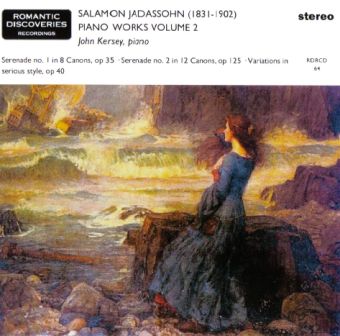
Piano music of Salomon Jadassohn (1831-1902) volume 2
John Kersey, piano
RDR CD64

Total time: 73 mins 54 secs

Serenade no. 1 in 8 Canons, op 35
1. Marsch (4’50”) 2. Adagio (4’24”) 3. Scherzo (2’31”) 4. Steyrisch (4’11”) 5. Intermezzo (1’19”) 6. Andantino (5’04”) 7. Minuetto (4’19”) 8. Finale (4’44”)

9. Variations in serious style upon an original theme, op 40 (17’30”)

Serenade no. 2 in E major in 12 Canons, op 125
1. Allegretto amabile (2’34”) 2. Andantino (2’02”) 3. Allegretto scherzando (1’48”) 4. Humoreske (1’19”) 5. Andante (1’18”) 6. Appassionato (2’11”) 7. Adagio (3’32”) 8. Capriccietto (2’00”) 9. Minuetto (2’46”)  10. Intermezzo (1’01”) 11. Allegretto grazioso (1’22”) 12. Allegretto di marcia (2’01”)

We are grateful to Dr. Klaus Tischendorf, Prof. Luca Chierici and Peter Cook  for supplying copies of scores for use in this recording.

Notes on the music
According to Jadassohn scholar Klaus-Peter Koch, there are two major reasons why the music of Salomon Jadassohn is not better known today. One is that, as a Jew, he was a victim of the anti-Semitism of Wilhelmine Germany, in which critics labelled his music as academic and dry, and the other is that he was overshadowed by his colleague at the Leipzig Conservatoire, Carl Reinecke.

As this recording hopefully shows, Jadassohn was far from dry, instead being a composer of melodic felicity and great harmonic imagination, with his unexpected use of chords at times drawing parallels with Alkan and Jadassohn’s own pupil Busoni. There are around 140 works in total, written for every medium from symphonic works to lieder and characteristic pieces for the piano.

Jadassohn studied with Moritz Hauptmann and Moscheles at the Leipzig Conservatoire and also for three years (1849-51) with Liszt in Weimar. He admired the music of Liszt and Wagner greatly. In 1893 he was awarded a professorship at the Leipzig Conservatoire, a post which he held until his death. His pupils included Grieg (some of whose Lyric Pieces show a Jadassohn influence), Busoni, Delius and Karg-Elert. He was considered a master of counterpoint.

Jadassohn’s works vary in form and tone from broadly Schumannesque tone-pictures to more ambitious extended works, and to some extent this disc showcases both of these aspects of his creative personality.

We are used to meeting masters of the fugue form among post-Beethovenian Romantics, but there are few (with the exception of Schumann) who turned their hand to the complexities of canon form.

Jadassohn’s two Serenades are examples of his inventiveness and consummate craft. Collections of canons might appear to the outsider to be merely dry, academic exercises, but with Jadassohn the truth is more complex. Jadassohn sees in canon form a key to the creation of effective designs that work almost like an elaborate aural and visual puzzle as lines intertwine, self-reference and mirror each other. The effect is music that can be appreciated on several levels at the same time; firstly as attractive melodic material often full of life, and secondly as a quasi-architectural accomplishment satisfying to the intellect and fully deserving of the phrase “compositional virtuosity”. Many of the pieces have the appealing quality of Beethoven’s Bagatelles, treating a novel motif or phrase in a way that transcends its apparent limitations, but with the additional rigour imposed by the canonic form. For Jadassohn, what would in other hands become a straitjacket becomes a challenge to be surmounted, and if anything his second Serenade achieves an even greater liberation and subtlety than the first.

The Variations in serious style, op 40, see Jadassohn in serious mode, treating a theme of his own composition that is dark and harmonically rich, lying some way between Schumann and Brahms. This work shows Jadassohn’s abilities within an extended structure requiring both overarching unity and variety between its constituent sections. There is a pleasing balance between passion and reflection, although as is usual with Jadassohn, formal clarity takes precedence ahead of more visceral concerns. The energetic figurations in the finale are a no-doubt conscious reminiscence of Mendelssohn’s Variations serieuses of some years earlier.

Read Full Post »

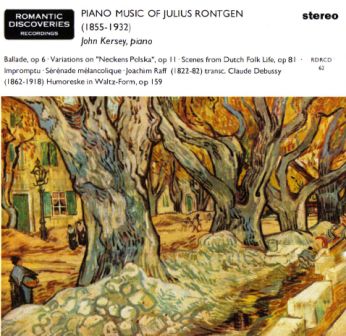
Piano music of Julius Röntgen (1855-1932)

Piano music of Julius Röntgen (1855-1932)
John Kersey, piano
RDR CD62

Total time: 67 mins 49 secs

1. Ballade in D minor, op 6 (7’04”)
2. Impromptu (4’38”)
3. Variations on the Swedish folk song “Neckens Polska”, op 11 (16’04”)
4. Sérénade mélancolique (2’42”)

Scenes from Dutch Folk Life (Uit Neerlands Volksleben), op 81:
5. Spring Dance (3’17”) 6. Easter Bells (2’15”) 7. Lazybones (1’15”) 8. Wedding Dance (1’12”) 9. Easter Song (1’29”) 10. Polish Sara (2’33”) 11. Cramignon I (1’31”) 12. Cramignon II (1’54”) 13. Procession (2’05”) 14. Dance of the Cobblers (00’42”) 15. Scotch Dance (1’38”) 16. An English Melody (1’34”) 17. The Carillon of Sneek (00’46”) 18. The May Flute (1’18”) 19. Flight of the Seagulls (1’55”)

Joseph Joachim Raff (1822-82) transc. Claude Debussy (1862-1918)
Humoreske in Waltz Form, op 159 (11’11”)

We are grateful to Dr. Klaus Tischendorf for supplying copies of scores for use in this recording.

Notes on the music
Julius Engelbert Röntgen was the son of the first violinist in Leipzig’s Gewandhaus Orchestra and showed musical gifts from an early age, studying under Carl Reinecke. Aged fourteen, Röntgen visited Liszt in Weimar and played for him, and returning home, he was introduced to Brahms by his friend Heinrich von Herzogenberg. Piano studies continued under the aged Franz Lachner, who had known Schubert.

From 1877, Röntgen based himself in Amsterdam, where he taught at the music school and gave concerts, including a performance of Brahms’ second concerto under the composer’s baton. He was together with Coenen and de Lange founder of the Amsterdam Conservatoire in 1883, and the following year was involved in the foundation of the Concertgebouw. However, he was passed over for selection as the Concertgebouw’s first Director, and thereafter concentrated on composing and working as a collaborative pianist. Among his duo partners was the young Pablo Casals.

The First World War brought about conflict for Röntgen, since one of his sons was taken prisoner by the Germans. In 1919 he took Dutch citizenship, before retiring in 1924. This retirement in fact prompted a burst of creativity in composition, with over one hundred works (mostly chamber music and songs) produced. The last year of Röntgen’s life saw him begin to experiment with atonality, and he wrote a bitonal symphony which has yet to be published.

Röntgen’s work has  received limited attention since his death, and only parts of his compositional legacy are represented on disc today, with the solo piano music being particularly little-known. As this present issue shows, Röntgen wrote with considerable facility for the instrument and was in many respects a successor to his teacher Reinecke as well as to Brahms himself.  Röntgen’s obituary in The Times, by Donald Francis Tovey, contained the following endorsement, “Röntgen’s compositions, published and unpublished, cover the whole range of music in every art form; they all show consummate mastery in every aspect of technique. Even in the most facile there is beauty and wit. Each series of works culminates in something that has the uniqueness of a living masterpiece.”

Of the piano works collected here, the variations on “Neckens Polska” are probably the most ambitious, showing a thorough absorption of Brahm’s style as well as some individuality in the treatment of form and texture. The seriousness of the work in maintaining an atmosphere of persistent melancholy is notable. The early Ballade in D minor inhabits similar ground within a more direct and less complex treatment.

The two shortest works are also the most forward-looking. The Impromptu becomes entangled in an almost Regerian counterpoint before subsiding in a shocked aftermath. The Sérénade mélancolique displays a typical mock-orientalism for its period, but also destabilises the tonal centre to the point where the uncertainty of the improvisatory melodic line sounds authentically Eastern.

The suite Scenes from Dutch Folk Life inhabits similar ground to Röntgen’s Six Old Netherlands Dances, once popular and recorded by the Concertgebouw and Willem Mengelberg in 1940. Here are brief tone-pictures of a varied rural life, inhabiting similar territory to Grieg’s Lyric Pieces and demanding a similar range of pianistic equipment. Of particular note are the second, an impressionistic evocation of bells mixed with a traditional hymn, and the two Cramignons, a peasant dance of varied character.

Röntgen was a particular admirer of Debussy, and it is perhaps fitting that this disc should close with one of Debussy’s few transcriptions of music by another composer, his version for two hands of Raff’s four-hand Humoreske. This work was first recorded on disc and released on Romantic Discoveries Recordings RDR20 (now deleted), having escaped the attention of even “complete” sets of Debussy’s piano works, and is here presented in a new recording made in 2008. The work is a chain of waltzes, contrasting in character and featuring some ingenious pianistic (and unpianistic) writing that places it among the more technically awkward of Debussy’s works. Its considerable charm makes its revival all the more welcome.

Read Full Post »

Emil Hartmann (1836-98): Skandinavisk Folkemusik
Viser og danser, op 30.
Volume 1 (nos. 1-37)

John Kersey, piano
RDR CD61

Total time: 79 mins 52 secs

1. Mellem Fjeldene (Between the mountains) (2’18”) 2. Amagerdans (Amager Dance) (1’17”) 3. „Go Kvel, mi Mari!” (Vexelsang) (2’20”) 4. Springdans (Spring Dance) (2’13”) 5. Agnete (1’34”) 6. Polska (Mazurka) (2’23”) 7. Nattergalen (Nightingales) (2’46”) 8. Halling (2’24”) 9. Edmund og Benedict (1’38”) 10. Domara-Dansen (2’01”) 11. Norsk Bondedans (Norwegian Leaping Dance) (1’44”) 12. Den første Kjaerlighed (The first love) (2’25”) 13. I Dansen (In the dance) (3’04”) 14. Hymne (1’27”) 15. Polska (2’12”) 16. I Morgenstunden (In the morning) (2’25”) 17. Dans og Skjæmtevise (Dance and Skjæmtevise) (1’42”) 18. En Sommerdag (One summer) (2’47”) 19. Dans i Borgegaard (Dance in the castle keep) (2’35”) 20. I Kvæld (At eve) (2’35”) 21. „Allt under himmelens fäste” (All under heavens fixed) (2’58”) 22. Ved Arnen (By Arnen) (1’45”) 23. „En yndig og frydefuld Sommertid” (A sweet and delightful summertime) (2’09”) 24. Norsk Folkedans (Norwegian folkdance) (1’58”) 25. Reel (1’24”) 26. Til Sæters (On the set) (3’05”) 27. Sjællandsk Bondedans (Sjællandish Leaping Dance) (1’38”) 28. Paa Fjorden (On the fjord) (3’11”) 29. Dans og Vise (Dance and scene) (2’05”) 30. Polska (1’36”) 31. Gangerpilten (Noble boy) (1’18”) 32. Elverskud (The elves’ shoot) (1’22”) 33. Polska (1’34”) 34. Svend Vonved (1’47”) 35. Halling og Vise (1’40”) 36. Kulldansen (2’25”) 37. Klagesang (Song of complaint) (2’35”)

We are grateful to Dr. Denis Waelbroeck for supplying copies of scores for use in this recording.

Notes on the music
Emil Hartmann’s work was eclipsed in his lifetime by the fame of his father, J.P.E. Hartmann, and his brothers-in-law Niels Gade and August Winding. He composed music before he could talk, and developed into a confident master of the Danish expressive style of the mid-nineteenth-century.

Hartmann worked as a church musician, but this forms only one aspect of his musical output, which is extremely varied. The piano music explores a number of styles ranging from nationalistic folksongs and dances to virtuoso display-pieces such as the Caprice op 16 no 2, and balances an extrovert sensibility with a fine command of melody and expressive shading.

The set of fifty dances and scenes that forms the extended set of Scandinavian Folkmusic, op 30, represents a conscious evangelism on Hartmann’s part towards the folk tradition that was at the heart of emergent Scandinavian nationalism. Most familiar from Grieg’s work, this trend was also taken up by Hartmann with a wider reach to encompass the music of Denmark as well as that of Norway and Sweden.

Hartmann describes his work as “freely arranged” and in most cases what he has done is to present the material concerned as sympathetically as possible, without extraneous development or over-elaboration. This is not the approach, for example, of Liszt’s Hungarian Rhapsodies, but rather that of his settings of Hungarian folksongs in a deliberately intimate and minimalist style, allowing the original music to speak clearly rather than attempting to transform it into the orthodox virtuoso tradition.

This is not to say that Hartmann’s work is not pianistic – the numerous mazurkas, for example, prompt obvious comparison with Chopin. However, the emphasis is on clarity, simplicity and the creation of a vibrant and distinct atmosphere within a structure that rarely extends much beyond a couple of minutes. Such aphorisms are a mark of compositional skill as much in what they exclude as what they include; the art is a distillation of what in less capable hands would appear over-extended or out of proportion. To journey through Scandinavia with Hartmann as guide is to experience a gentle art, and to understand the social function of such music as the expression not merely of community identity but also of a burgeoning nationalist school in composition.

Read Full Post »

Piano music of Ferdinand Hiller (1811-85)

Piano music of Ferdinand Hiller (1811-85)
Huit mésures variées, op 57; La Sérénade, op 11; 3 Marches, op 55; 6 Klavierstücke, op 130; Fantaisie, op 110; Bagpipe, op 198

John Kersey, piano
RDR CD60

Total time: 70 mins 40 secs

1. Huit mésures variées, op 57 (13’39”)

Sechs Klavierstücke, op 130:
2. Ballade (4’51”)
3. Idylle (4’11”)
4. Romanze (3’55”)
5. Rondino (2’20”)
6. Ghazel (2’30”)
7. Toccata (3’23”)

Fantaisie, op 110
8. Allegro espressivo un poco agitato (4’15”)
9. Allegro ma non troppo (4’51”)
10. Allegro con fuoco (5’41”)

La Sérénade, op 11
11. Prelude (Poco agitato) – Romance (Andante espressivo) (4’50”)
12. Finale (Non troppo vivace e grazioso) (2’42”)

Three Marches, op 55
13. Marcia giocosa (Vivo) (2’46”)
14. Marcia elegiaca (Moderato) (4’26”)
15. Marcia scherzosa (Vivace) (2’47”)

16. Bagpipe (An Imitation), op 198 (2’39”)

We are grateful to Dr. Klaus Tischendorf and Robert Commagère for supplying copies of scores for use in this recording.

Notes on the music by Dr. Tischendorf
Ferdinand Hiller wurde am 24. Oktober 1811 in Frankfurt als Sohn einer vermögenden Kaufmannsfamilie geboren. Seine Ausbildung erhielt er zunächst bei Schmitt und Vollweiler, dann ab 1825 bei Hummel in Weimar. Dort fand er nicht nur Eingang in den Goethe-Kreis, sondern lernte auf Reisen mit seinem Lehrer auch Grössen wie Beethoven

und Schubert noch persönlich kennen. Von 1828 bis 1835 lebte er in Paris, wo er sich mit den meisten namhaften Künstlern seiner Zeit befreundete. Die Jahre von 1836 bis 1846 waren Hillers Wanderjahre, die ihn nach Italien, Frankfurt, Leipzig und Dresden führten. 1847 wurde er als Vorgänger Schumanns Städtischer Musikdirektor in Düsseldorf, und 1850 schliesslich Beherrscher des Kölner Musiklebens, als Dirigent der Gürzenichkonzerte und Direktor des Konservatoriums, bis zu seiner Pensionierung 1884. Seine wichtigsten Schüler waren Bruch, Gernsheim und Humperdinck.  In Köln ist Hiller am 11. Mai 1885 gestorben.

Er unternahm ausgedehnte Konzertreisen als Pianist und Dirigent und war mehrfach Leiter der Niederrheinischen Musikfeste. Der Glanz, mit dem sich Hillers Spur im 19. Jahrhundert verband, hat lange Zeit den Blick für sein kompositorisches Schaffen verstellt. Reinhold Sietz nannte ihn eine der repräsentativsten Musikerpersönlichkeiten des Jahrhunderts, in seiner gesellschaftlichen Überlegenheit, künstlerischen Vielseitigkeit und organisatorischen Begabung seinem Freunde Mendelssohn vergleichbar. Mit diesem war Hiller seit Jugendjahren befreundet, Schumann widmete ihm sein Klavierkonzert op.54 und Brahms war einer der wenigen Duzfreunde von Hiller. Etwas bekannter wurde Hillers Name, dessen Reputation –  ähnlich wie im Falle Mendelssohn – seit Wagners Tagen unter antisemitischer Hetze litt, in unseren Tagen durch Buch und Filmdokumentation über Beethovens Locke. Der umfangreiche Nachlass Hillers (sein wertvolles Autographenalbum, sowie die Korrespondenz mit mehr als 10.000 Briefen berühmter Zeitgenossen an Hiller), ist seit dem Einsturz des Historischen Archivs in Köln im März 2009 in seinem Bestand hochgefährdet.

Hiller, der sich trotz seiner vielfältigen Aktivitäten (er war auch ein brillanter und streitbarer Musikjournalist), immer in erster Linie als Komponist verstand, schrieb in rastloser Folge mehr als 200 Werke aller Gattungen, die weitgehend unerforscht sind. Die schon von Schumann und anderen Zeitgenossen beklagte Ungleichwertigkeit seiner Produktion, legt eine strenge Auswahl nahe. Wenn Hiller, der um Einfälle nie verlegen war, einmal die Sammlung und Ruhe zur sorgfältigen Ausformung und kritischen Überarbeitung seiner Gedanken fand, entstanden nahezu idiomatische Formulierungen, die seine grossen Fähigkeiten als Improvisator ebenso wie seinen Fantasiereichtum aufs Schönste belegen. So finden sich unter seinen Klavierwerken ganz neuartige Schöpfungen wie seine Ghaselen und hochkomplizierten Rhythmischen Studien und Skizzen.

John  Kersey  legt nun erstmals eine repräsentative Auswahl aus Hillers umfangreichem Klavieroeuvre vor. Die delikate frühe Serenade op.11 (1834) atmet die Nähe von Chopin, mit dem Hiller eng befreundet war und der ihm seine Nocturnes op.15 widmete. Auf ein knappes Prelude folgt eine leidenschaftliche Romanze und ein graziöses Finale. Das Werk ist eine Liebeserklärung an eine Dame der Pariser Gesellschaft, die auf dem Titelblatt als Madame de XXX bezeichnet wird.

Alle übrigen Werke entstammen der Kölner Zeit. Darunter sind drei leichter gewichtige Märsche op.55 (1854), mit Ausnahme der zweiten Nummer möglicherweise Reminiszenzen an den Kölner Karneval (Hiller schrieb auch einen Karnevalsgalopp für Orchester). Eines seiner bedeutendsten Klavierwerke lieferte Hiller mit den 8 Mésures varieés op.57 (gedruckt 1859). Der überaus anspruchsvolle, hochvirtuose Zyklus ist seinem Freunde Charles Alkan gewidmet. Den Ausgangspunkt bilden die 32 Variationen c-moll WoO von Beethoven. Bei Hiller sind es 31 Variationen und ein etwas ausgedehnteres Finale. Neben der Reverenz an die virtuose Technik des Widmungsträgers, finden sich auffällige Parallelen zu Alkans herausragendem Variationenwerk, der Etüde op.39 Nr.12 Le Festin d’Esope. Selbst auf den Rachmaninoff der Paganini-Variationen finden sich einige Vorausblicke. In Variation 13 zitiert Hiller sein eigenes Klavierkonzert op.69 (1843). Das Werk bildet einen der wichtigsten der knapper gefassten Variationszyklen in der Mitte des 19. Jahrhunderts.

In eine andere Welt führen die 6 Klavierstücke op.130 (1867). Sie hätten durchaus den Beisatz Vermischte tragen können, denn es ist eine typisch romantische Sammlung von Charakterstücken voll unterschiedlicher Stimmungen und Ausdrücke. Als Höhepunkte können die Ballade und die Ghasele gelten. Im selben Jahr erschien auch die schöne,  Stephen Heller gewidmete Fantasie op.110. Wie so oft in der Romantik, handelt es sich um einen knappen und verkappten Versuch zur Romantischen Sonate in drei Teilen. Durch eleganten und lockeren Klaviersatz gelingt es Hiller in erstaunlicher Weise, sich dem Geist des Widmungsträgers anzunähern, ohne diesen zu imitieren. Im Menuett-artigen Mittelteil überraschen zudem einige leise Schubert-Reminiszenzen. Das zauberhafte Dudelsackstücklein op.198 (1882) zählt zu Hillers letzten Werken. Er beschliesst damit die Trias seiner Instrumentenimitationen, mit dem Capriccio Tambourin op.160 und dem bekannten Impromptu Zur Gitarre op.97, einem der bevorzugten Encores von Clara Schumann.

Read Full Post »

Piano music of Stephen Heller (1813-88)

Piano music of Stephen Heller (1813-88)
Sonata no. 2, op 65; Fantasie in the form of a Sonata, op 69; other works

John Kersey, piano
RDR CD59

Total time: 76 mins 6 secs

Piano Sonata no. 2 in B minor, op 65
1. Feurig, und mit kräftigem Ausdruck (10’19”)
2. Ballade – Mässig (7’54”)
3. Intermezzo – Mässig schnell (6’57”)
4. Epilog – Ausserst lebendig, und mit characterischem Ausdruck (6’17”)

5. Aux mânes de Frédéric Chopin. Élégie et Marche funebre, op 71 (16’41”)

Three Songs without Words, op 105
6. Assai lento (3’27”)
7. Vivamente (2’23”)
8. Allegro (1’39”)

“Es ist bestimmt in Gottes Rath” – Volkslied by Mendelssohn. Fantasie in the form of a Sonata, op 69
9. Poco sostenuto – Allegro vivace (7’51”)
10. Scherzo – Presto (2’38”)
11. Lento – Poco maestoso (In the style of a folksong) (4’23”)
12. Finale – Allegro assai (5’00”)

We are grateful to Dr. Klaus Tischendorf for supplying copies of scores for use in this recording.

Notes on the music
This disc will surprise those who think of Heller only as a delicate miniaturist. Certainly, he was that, and his surprisingly experimental Songs without Words op 105 prove the point, but our other works in this selection are built on the grandest of scales and the most extreme levels of emotional expression and technical facility. Here is evidence that Heller’s ambition extended to a sonata whose relentless drive, scale and sustained tragedy are more Brucknerian than much of the work of his contemporaries, an extended paraphrase that is the antithesis of a Lisztian transcription in its philosophical and structural concentration, and one of the finest deep meditations on Chopin and his music ever committed to paper.

The young Heller was sent to Austria to study with Czerny, but could not afford the maestro’s fees and so became a pupil of Anton Halm instead. His mid-teens saw him undertake a successful tour of Western Europe, and consolidate this reputation with his arrival in Paris ten years later where he came to know all of the significant musical figures. Both a noted performer and teacher, Heller was regarded highly by his peers, some of whom considered him equal or even superior to Mendelssohn, but was eclipsed by the rise of Wagner and died in relative obscurity. Revival of Heller’s music has been patchy, concentrating mainly on the shorter works.

A long article appeared discussing both Heller and his place in contemporary composition in the Musical World of 1850, and this periodical also carried a perceptive review of his Second Sonata, quoted from The Athenaeum.

“This is a noticeable production; full of thought, full of energy – original in style, and excessively difficult: as highly-finished an example of the new manner of composition applied to the old forms as occurs to us. There are chords in it which would have made the timid hearts of our grandfathers ache, – extensions of hand (to be commanded at a moment’s warning) such as the Mozarts, Clementis and even Hummels never dreamed of, – passages of melody as richly laden with accompaniment as if every player possessed the composure, force and tone of Thalberg; but also, throughout the entire composition there is that je ne sais quoi of picturesque and romantic taste which reminds us that we are living in a time when Music runs some danger of being pushed across the boundaries which separate it from Poetry and Picture…As a whole, this sonata is too symphonic in style: and not merely so, but also, for a symphonic work, it is too little relieved by contrast and episode. This characteristic is generic to the new school of writers…In this ambitious work…so much genius and science are evidenced, such unmistakeable traces of individuality present themselves, that  he well merits strict truth and plain remonstrance conjointly with high praise.”

This contrasted with the measured and less enthusiastic view taken by Barbedette in his biography of Heller, although he concedes that it is “the work of one who knows his own power. Its style is decisive and concentrated, and there is a loftiness about the whole work.” Indeed there is, and viewing this work from the perspective of hindsight allows us to see the development of its material throughout each movement in a way that foreshadows Bruckner and the Wagnerians, albeit unacknowledged by them. Heller not only understands the complexities of thematic transformation, but is also skilled at creating an atmosphere that often sounds starkly modern because of that very lack of variety that troubled the reviewers of his time. The Sonata is often aggressive, tragic and pessimistic in a way that few of Heller’s contemporaries would have attempted; its edges are hard and its emotional world uncompromising. Seldom can the accusations of sentimentality applied by some to Heller’s music have rung more hollow.

The Elegy and Funeral March on the death of Chopin is an extended meditation on some of his more familiar themes, again showing Heller’s great skill in combining these into something quite new. Heller knew Chopin personally, and perhaps in this work we gain some sense of how Chopin might improvise and develop ideas off the cuff. Certainly it is one of the most powerful and effective tributes from one composer to the spirit of another.

The Fantasy in the form of a Sonata op 69 takes as its theme a song by Mendelssohn which can be found in a piano transcription by Kirchner on RDR CD58. Heller deconstructs each aspect of this melody and creates from it the grandest of structures, the whole both the product of a virtuoso instinct and an ingenious compositional imagination. The work is as much a philosophical tract as it is a transcription; Heller’s commentary illuminates and expands the material into its farthest reaches, producing an intellectual challenge that even Liszt and Thalberg would find difficult to match in their own works. Frequent references to the Mendelssohn style are supplanted by complex figuration that prove that Heller’s outlook was determinedly progressive, even if as time went on that progression was in a different direction from the musical mainstream.

Read Full Post »

« Newer Posts - Older Posts »