Theodor Kirchner (1823-1903)
Old Memories

John Kersey, piano
RDR CD38

Total time: 69 mins 53 secs

Alte Erinnerungen (Old Memories), op 74:
1) Poco lento, espressivo (2’20”) 2) Allegretto (3’03”) 3) Andantino espressivo (poco lento) (1’46”) 4) Moderato (3’21”) 5) Andantino (2’43”) 6) Con espressione (1’46”) 7) Cantabile (3’07”) 8) Allegretto (1’20”) 9) Andantino (2’30”) 10) Vivace scherzando (00’38”) 11) Comodo (2’21”) 12) Poco lento (2’30”).

13) Scherzo no. 2, op 54 (5’27”).

“Aus der Jugendzeit” (From Childhood), op 88:
14) Allegro moderato (00’53”) 15) Poco Allegro (1’24”) 16) Moderato (1’41”) 17) Risoluto (1’18”) 18) Vivace scherzando (00’59”) 19) Poco Allegro (1’02”) 20) Lento (1’17”) 21) Vivace (1’06”) 22) Poco lento (1’14”) 23) Allegretto (1’12”).

Federzeichnungen (Pen and Ink Sketches), op 47:
24) Moderato (2’45”) 25) Allegro ma non troppo (3’00”) 26) Moderato (3’04”) 27) Poco lento (2’14”) 28) Allegro vivace (1’58”) 29) Andantino (3’06”) 30) Moderato, cantabile (1’39”) 31) Poco lento (2’06”) 32) Intermezzo (Allegretto con moto) (1’03”) 33) Zum Schluss (Poco lento) (1’36”)

Fürchtegott Theodor Kirchner, a pupil of Mendelssohn at the newly-founded Leipzig Conservatoire, composed over 1,000 original works for piano, most of which are sets of miniatures. Kirchner expert Dr. Klaus Tischendorf, who has kindly provided the scores and 1890 cover photograph for these recordings, has described Kirchner as “the piano miniaturist of the Romantic era”.

Kirchner was recommended by Mendelssohn for the post of organist of Winterthur in Switzerland in 1843, and remained there for the next twenty years. The position gave him the opportunity to travel throughout Germany, and there he came into contact with Brahms and the Schumanns (he had first met Robert Schumann aged fourteen), who recognised in him an arch-Romantic and kindred spirit. He appears to have had a brief affair with Clara Schumann in the 1860s.

In 1862, Kirchner became director of the subscription concerts in Zurich, but remained there for only three years before returning to freelance life. He was appointed court pianist at Meiningen in 1872 and became director of the conservatoire in Würzburg the following year. Again, he did not stay long, and in 1876 moved to Leipzig for seven years, before going on to Dresden, where he taught score-reading. The year 1890 was a climactic one for him, for he abandoned his wife and family and went to live in Hamburg, where he was looked after by a former pupil. Four years later he suffered the first of two strokes that left himparalysed, and began to go blind.

“In his character there is no stability” wrote Clara Schumann. Kirchner’s career suffered because of his addiction to gambling and an extravagant lifestyle that was beyond his means, and his musical friends had periodically to bail him out from financial ruin. In 1884 a group including Brahms, Grieg, Gade and von Bülow raised thirty thousand marks to help him pay off his gambling debts.

Kirchner’s op 74, dating from 1885, is one of his finest mature sets of pieces, and inhabits his favourite mood of reminiscent Innigkeit. Most of the pieces are quiet, reflective and concentrate on the expression of subtle and restrained emotion. By contrast, Kirchner the virtuoso appears in the Second Scherzo (1881), whose trio was described in a contemporary review as “one of the most beautiful movements that have ever come from Kirchner’s pen. The beauty of sound of this simple cantilena, which at times flowers with a finely Chopin-like arabesque, cannot be put into words.” Kirchner’s op 88 (1889) follows Schumann’s op 15 example in that it is a set of pieces describing childhood in retrospect, rather than intended for children to perform. The Federzeichnungen (1880) are more ambitious, calling upon a richly expressive palette to create interior landscapes of lasting melodic and harmonic quality.
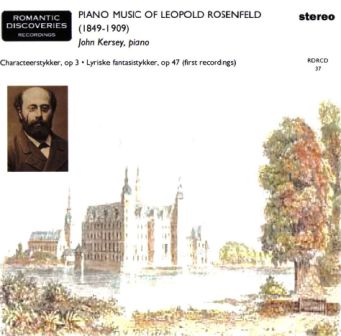
Leopold Rosenfeld (1849-1909)
Lyric Fantasy Pieces

John Kersey, piano
RDR CD37

Total time: 71 mins 54 secs

Characteerstykker (Character Pieces), op 3:
1) Allegro moderato e agitato (4’18”) 2) Fra Gammel Tid (3’43”) 3) Slot I Skoven (4’32”) 4) Allegro agitato (2’24”) 5) Latter (3’26”)

Lyriske fantasistykker (Lyric Fantasy Pieces), op 47:
Book 1:
6) Humoreske (1’53”) 7) Legende (3’36”) 8) Cracovienne (1’14”) 9) Bondedans (1’58”) 10) Sylfelet (2’29”) 11) Valse érotique (3’12”) 12) Scherzino (1’07”)

Book 2:
13) Hilsen (1’22”) 14) Stille Tider (1’53”) 15) Alene (2’22”) 16) Foraarsmorgen (1’02”) 17) Af et Digt (2’29”) 18) Vekselsang (2’53”)  19) I Dag (2’24”) 20) Hilsen (1’37”) 21) Til Afsked (1’12”) 22) Hvorfor? (3’27”) 23) Forsilde (2’03”) 24) Øde (2’00”) 25) Farvel (2’40”) 26) Langfredag (1’24”) 27) Et Gravmæle (4’43”) 28) Epilog (1’43”)

We are grateful to Robert Commagere for the supply of scores for use in this project.

Danish composer Leopold Rosenfeld was born in Copenhagen on 21 July 1849, and at first was compelled by his father to enter commercial employment. However, his love of music caused a change of heart, and he then spent the years 1872-75 studying composition at the Copenhagen Conservatoire of Music. He won a travelling scholarship in 1881 and the title of professor was conferred on him in 1889. He was mainly active as a teacher of singing at the Royal Conservatoire and an author of a noted pedagogical work on voice-training, and also as critic of the newspaper Dannebrog among other periodicals.

Rosenfeld’s output is principally in the areas of piano music and song, but significant orchestral works include the once-popular Henrik og Else (1885). The early set of Characteerstykker show a clear influence of Schumann and his fellow Scandinavians Grieg and Ludvig Schytte within a particular strain of Nordic pessimism that was to make itself felt constantly within Rosenfeld’s work. The set of Lyriske fantasistykker op 47 takes us further into this world, in particular through Book 2 whose dark, reflective nature at times foreshadows Sibelius. The piano writing is sometimes orchestral in character, but throughout the emphasis is on melodic invention, creating a memorable impression. The theme of the final Epilog somehow manages to anticipate Bart Howard’s popular song Fly Me To The Moon by half a century.

Each of the Lyriske fantasistykker is preceded by a romantic vignette or short verse by Baroness Gudrun Reedz-Thott (1873-1917), who also provided the text for one of Rosenfeld’s op 46 songs. The subject matter is often melancholy, dealing with parting and death, so that the whole set forms a unified cycle travelling from the more energetic opening to the elegiac music of its conclusion.

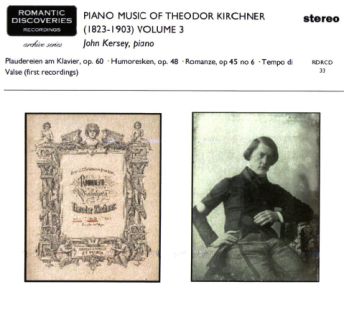
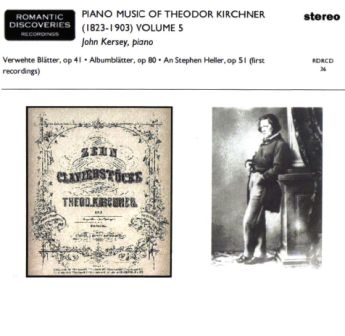
Theodor Kirchner (1823-1903)
Fallen Leaves

John Kersey, piano
RDR CD36

Total time: 62 mins 5 secs

Verwehte Blätter (Fallen Leaves), op 41:
1) Moderato (3’00”) 2) Allegretto (2’17”) 3) Poco Allegretto (2’27”) 4) Allegro (1’36”) 5) Ziemlich langsam, zart (4’01”) 6) Andante (2’01”)

Albumblätter (Albumleaves), op 80:
7) Lento espressivo (2’25”) 8) Allegro (0’57”) 9) Moderato assai (3’33”) 10) Allegretto (3’23”) 11) Poco lento (1’10”) 12) Poco animato (1’15”) 13) Comodo (1’20”) 14) Vivace (1’06”) 15) Lento (2’20”)

An Stephen Heller (To Stephen Heller), op 51:
16) Andantino (4’06”) 17) Moderato (1’15”) 18) Allegro moderato (2’02”) 19) Etwas langsam und still (1’52”) 20) Poco Allegretto (1’57”) 21) Ruhig (2’05”) 22) Allegretto (1’22”) 23) Moderato (2’07”) 24) Sanft bewegt. Nicht schnell. (2’18”) 25) Sehr zart, nicht schnell (2’49”) 26) Con comodo (3’03”) 27) Langsam, ausdrucksvoll (2’22”)

Fürchtegott Theodor Kirchner, a pupil of Mendelssohn at the newly-founded Leipzig Conservatoire, composed over 1000 original works for piano, most of which are sets of miniatures. Kirchner expert Dr. Klaus Tischendorf, who has kindly provided the scores and 1861 cover photograph for these recordings, has described Kirchner as “the piano miniaturist of the Romantic era”.

Kirchner was recommended by Mendelssohn for the post of organist of Winterthur in Switzerland in 1843, and remained there for the next twenty years. The position gave him the opportunity to travel throughout Germany, and there he came into contact with Brahms and the Schumanns (he had first met Robert Schumann aged fourteen), who recognised in him an arch-Romantic and kindred spirit. He appears to have had a brief affair with Clara Schumann in the 1860s.

In 1862, Kirchner became director of the subscription concerts in Zurich, but remained there for only three years before returning to freelance life. He was appointed court pianist at Meiningen in 1872 and became director of the conservatoire in Würzburg the following year. Again, he did not stay long, and in 1876 moved to Leipzig for seven years, before going on to Dresden, where he taught score-reading. The year 1890 was a climactic one for him, for he abandoned his wife and family and went to live in Hamburg, where he was looked after by a former pupil. Four years later he suffered the first of two strokes that left him paralysed, and began to go blind.

“In his character there is no stability” wrote Clara Schumann. Kirchner’s career suffered because of his addiction to gambling and an extravagant lifestyle that was beyond his means, and his musical friends had periodically to bail him out from financial ruin. In 1884 a group including Brahms, Grieg, Gade and von Bülow raised thirty thousand marks to help him pay off his gambling debts.

The music on this disc dates from 1879 (op 41), 1880 (op 51) and 1887 (op 80), a time when Kirchner was reliant almost entirely on new compositions to provide his living expenses. The Fallen Leaves were reviewed at the time of their publication by Arnold Niggli in the Schweizerische Musikzeitung und Sängerblatt, who wrote “We must thus reckon the Fallen Leaves to be amongst the most delicately subtle of this master’s creations.” The high standard of this music is easily maintained in Kirchner’s tribute to the great pianist Stephen Heller, then very much in his twilight years, who responded “[Kirchner’s] works are my uncommon love. They give me true rest.” The op 80 set belongs to the same spirit of Innigkeit, and at its end quotes Kirchner’s first set of Albumleaves, op 7, which had been written some thirty years earlier.

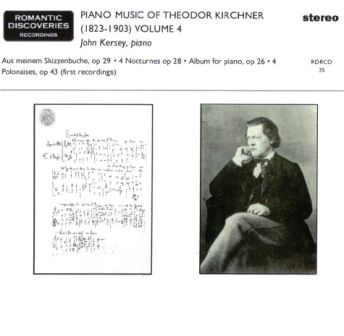
Theodor Kirchner (1823-1903)
From my Sketchbook

John Kersey, piano
RDR CD35

Total time: 66 mins 3 secs

Four Nocturnes, op 28:
1) Ruhig, singend (5’25”) 2) Con sentimento (3’18”) 3) Moderato (3’07”) 4) Molto moderato (4’13”)

Aus meinem Skizzenbuche, op 29:
5) Ungarisch (1’56”) 6) Deutscher Walzer (3’00”) 7) Humoreske (3’26”) 8) Frühlingsgesang (2’21”) 9) Ständchen (3’25”) 10) Jagdstückchen (0’53”)

Album for piano, op 26 (19’29”):
11) Moderato (1’30”) 12) Allegretto scherzando (1’32”) 13) Ruhig (1’23”) 14) Allegretto (1’18”) 15) Moderato (2’17”) 16) Allegretto semplice (1’21”) 17) Vivace (00’59”) 18) Comodo (1’15”) 19) Ziemlich bewegt (1’45”) 20) Nicht zu schnell (1’24”) 21) Allegretto comodo(2’29”) 22) Ziemlich schnell (1’14”)

Four Polonaises, op 43:
12) Maestoso (2’25”) 13) Allegro ma non troppo (3’58”) 14) Lebhaft (4’59”) 15) Moderato (3’07”)

Fürchtegott Theodor Kirchner, a pupil of Mendelssohn at the newly-founded Leipzig Conservatoire, composed over 1000 original works for piano, most of which are sets of miniatures. Kirchner was recommended by Mendelssohn for the post of organist of Winterthur in Switzerland in 1843, and remained there for the next twenty years. The position gave him the opportunity to travel throughout Germany, and there he came into contact with Brahms and the Schumanns (he had first met Robert Schumann aged fourteen), who recognised in him an arch-Romantic and kindred spirit. He appears to have had a brief affair with Clara Schumann in the 1860s.

In 1862, Kirchner became director of the subscription concerts in Zurich, but remained there for only three years before returning to freelance life. He was appointed court pianist at Meiningen in 1872 and became director of the conservatoire in Würzburg the following year. Again, he did not stay long, and in 1876 moved to Leipzig for seven years, before going on to Dresden, where he taught score-reading. The year 1890 was a climactic one for him, for he abandoned his wife and family and went to live in Hamburg, where he was looked after by a former pupil. Four years later he suffered the first of two strokes that left him paralysed, and began to go blind.

“In his character there is no stability” wrote Clara Schumann. Kirchner’s career suffered because of his addiction to gambling and an extravagant lifestyle that was beyond his means, and his musical friends had periodically to bail him out from financial ruin. In 1884 a group including Brahms, Grieg, Gade and von Bülow raised thirty thousand marks to help him pay off his gambling debts.

Many of Kirchner’s original works were written for accomplished women pianists. They demand not merely a sound and sometimes virtuosic technique, but also a poetic imagination befitting the intimate setting of the nineteenth-century salon. His Sketchbook and Album showcase the creation of drama within the miniature in a way that foreshadows Grieg, and also develop the miniature into a larger-scale connected cycle. The Nocturnes and Polonaises (the latter of which also exist in versions for four hands) owe little to Chopin’s models, but rather offer an insight into the way the Germanic school made those forms their own at the height of their popularity. The Nocturnes in particular provide the ground for some novel harmonic effects in their agitated central sections.

Friedrich Burgmüller (1806-74)
Original piano works and fantasies

John Kersey, piano
RDR CD34

Total time: 77 mins 18 secs

1) Les Patineurs – Valse brillante from Le Prophète by Meyerbeer (8’02”)
2) Memoria speranza, valse expressive (6’27”)
3) Rondo for pianoforte or harp, op 1 (5’39”)
4) Chanson de Fortunio – valse de salon (5’05”)
5) Valse sentimentale du ballet Lady Henriette (1’40”)
6) Les Parisiennes, 3 Nouvelles Polkas no 1 -L’Enjouée (2’22”)
7) Les Parisiennes, 3 Nouvelles Polkas no 2 – La Coquette (2’45”)
8) Les Parisiennes, 3 Nouvelles Polkas no 3 – La Gracieuse (2’39”)
9) Rondino sur une Tyrolienne de Ch.M. de Weber, op 48 no 2 (3’51”)
10) Pharsalia, valse brillante, op 89 (3’17”)
11) Valse pastorale en forme de rondeau, op 24 (7’55”)
12) 6 Morceaux caracteristiques no 1 – On the Spanish Girls (2’03”)
13) 6 Morceaux caracteristiques no 2 –  Sea Picture (1’45”)
14) 6 Morceaux caracteristiques no 3 – Ave Maria(1’07”)
15) 6 Morceaux caracteristiques no 4 – Having Oranges (1’32”)
16) 6 Morceaux caracteristiques no 5 – Morning Sea (1’54”)
17) 6 Morceaux caracteristiques no 6 – By the beach (1’28”)
18) La Peri, ballet pantomime in 2 acts – valse favorite (4’45”)
19) La Peri, ballet pantomime in 2 acts – Le Rêve (4’32”)
20) Fantaisie sur le Père Gaillard d’Henri Reber, op 103 (7’06”)

This CD has been made possible by the kind support of Dr. Klaus Tischendorf of the Norbert Burgmüller-Society, Dusseldorf, to whom we are grateful for providing copies of the extremely rare scores used in this recording. Programme notes on the works included in the recording (in German) by Dr. Tischendorf are enclosed. Information on the Society and on Norbert and Friedrich Burgmüller may be accessed at www.burgmueller.de.

Friedrich Burgmüller was born in Regensburg, the elder brother of the highly original composer Norbert Burgmüller. He attempted unsuccessfully to succeed his father as music director in Dusseldorf and around 1826 moved to Basel and Mühlhausen, where he taught piano and cello. At this stage his compositions were ambitious in scale, including a lost cello concerto. However, around 1830, his style changed in response to the influence of Franz Hünten, and he began to write many simple piano pieces intended for children and amateurs. This recital concentrates on his more elaborate and virtuosic works intended for public performance.

From around 1834, Burgmüller settled in Paris where he acquired considerable fame and apparently was piano teacher to the children of King Louis-Philippe. Despite his success as a pedagogue, Burgmüller was extremely shy and retiring; the cover photograph (dating from c.1845) is the only one known of him.

Julius von Beliczay (1835-93)
Original piano works and Hungarian national music by his contemporaries

John Kersey, piano
RDR CD33

Total time: 68 mins 36 secs

1) Hermann Adolf Wollenhaupt (1827-65): Marche hongroise, op. 66 (4’04”)
2) Beliczay: from Stammbuchblätter, op. 31 (5’52”): 1. Träumerei; 2. Intermezzo
3) Beliczay: Gavotte op. 43 (3’56”)
4) Beliczay: Aquarellen, op. 26 (15’44”): 1. Moderato; 2. Andantino; 3. Allegretto; 4. Andante con moto; 5. Allegretto grazioso “Es lächelt der See”; 6. Vivace; 7. Allegretto vivace
5) Benjamin Egressy (1814-51) arr. Ferdinand Beyer (1803-63): Ungarische Volkshymne no. 61: Szosat (2’17”)
6) Beliczay: Nocturno, op. 24 (5’31”)
7) Beliczay: from Miniaturen, op. 67 (12’36”): 1. Allegretto; 2. Allegro; 3. Moderato; 4. Allegro scherzando; 5. Vivace; 6. Allegretto 8. Adagio rubato – Allegro; 9. Tempo di Valse; 10. Vivace; 11. Andante; 12. Moderato “Égböl szólok”
8) Beliczay: Novellette and Romanze, op. 2 (5’13”)
9) Beliczay: 8 Variations on a Hungarian theme, op. 23 (9’27”)
10) Ferenc Erkel (1810-93) arr. Ferdinand Beyer: Ungarische Volkshymne no. 60: Gott erhalt Ungarn (3’11”)

Julius, or Gyula in Hungarian, von Beliczay de Belic was one of the most important of Hungarian composers of the generation after Liszt. He was a composer in almost all the major forms of the day, including songs, chamber music, sacred music, opera, symphonic works (2 symphonies, written in 1888 and 1892 respectively) and a wide variety of piano music.

Beliczay was born in Révkomárom and studied piano there. During the 1850s he came into contact with Czerny and Nottebohm and was later a correspondent of Liszt, to whom he dedicated a cadenza.

Beliczay was an arch-Romantic and a man of profoundly sensitive disposition. His predominant style was within the Germanic heritage, with Schumann’s influence predominant in the works on this disc. Although there are nationalistic elements in his music, Beliczay was in general more drawn to the absolute than the programmatic, with a clear form obvious throughout his work and no piece outstaying its welcome.

When the Academy of Music opened at Budapest in 1875, Franz Liszt was its President and Ferenc Erkel its Director. Erkel’s famous national hymn “Gott erhalt Ungarn”, which is the Hungarian national anthem, concludes this disc. Beliczay was appointed Professor of the Academy and continued in this post until his death.

The other contributors to this disc, like Beliczay and Erkel, died prematurely, perhaps accounting for their posthumous neglect. Beyer was chiefly known as a pedagogue, and his exercises are still very popular in piano teaching in South America. Benjamin or Beny Egressy composed the “other” Hungarian national anthem, Szosat (often played at the end of ceremonies while Erkel’s anthem is played at the beginning), whose arrangement by Beyer is dramatic and effective. Wollenhaupt was a Leipzig-trained pianist who later pursued a career in New York with great success. His Hungarian March is full of pomp and drama.

Theodor Kirchner (1823-1903)
Conversations with the Piano

John Kersey, piano
RDR CD32

Total time: 68 mins 36 secs

1) Humoresken, op 48 (12’44”)
1. Allegro non troppo 2. Con moto 3. Allegretto 4. Allegretto 5. Allegretto grazioso 6. Allegretto

2) Romanze, op 45 no 6 (3’00”)

3) Plaudereien am Klavier, op 60 (47’56”)
1. Con moto 2. Allegretto 3. Allegro 4. Nicht zu schnell 5. Poco Allegretto 6. Poco Allegro 7. Mässiges Tempo 8. Con moto 9. Allegretto 10. Allegro 11. Allegretto 12. Poco Andante 13. Con troppo vivace 14. Zart nicht schnell 15. Poco moderato 16. Allegro ma non troppo 17. Comodo 18. Molto moderato 19. Poco animato 20. Comodo 21. Tempo di Gavotta 22. Con fuoco 23. Poco Allegro 24. Allegretto (Gavotten tempo) 25. Andantino

4) Tempo di Valse (2’51”)

Fürchtegott Theodor Kirchner, a pupil of Mendelssohn at the newly-founded Leipzig Conservatoire, composed over 1000 original works for piano, most of which are miniatures, but is best known for his arrangements today. He was a master of piano texture and his transcriptions show great craft.

Kirchner was recommended by Mendelssohn for the post of organist of Winterthur in Switzerland in 1843, and remained there for the next twenty years. The position gave him the opportunity to travel throughout Germany, and there he came into contact with Brahms and the Schumanns (he had first met Robert Schumann aged fourteen). He appears to have had a brief affair with Clara Schumann in the 1860s.

In 1862, Kirchner became director of the subscription concerts in Zurich, but remained there for only three years before returning to freelancing. He was appointed court pianist at Meiningen in 1872 and became director of the conservatoire in Würzburg the following year. However, in 1876, he moved to Leipzig for seven years, before going to Dresden, where he taught score-reading. The year 1890 was a climactic one for him, for he abandoned his wife and family and went to live in Hamburg, where he was looked after by a former pupil. Four years later he suffered the first of two strokes that left himparalysed, and began to go blind.

“In his character there is no stability” wrote Clara Schumann. Kirchner’s career suffered because of his addiction to gambling and an extravagant lifestyle that was beyond his means, and his musical friends had periodically to bail him out from financial ruin. In 1884 a group including Brahms, Grieg, Gade and von Bülow raised thirty thousand marks to help him pay off his gambling debts.

Here we encounter Kirchner as composer of original works, many written for accomplished women pianists. Kirchner’s works demand not merely a sound technique but a poetic imagination. The Plaudereien am Klavier constitute a cycle of wit and subtlety of invention and are as pleasing to play as to listen to. Elsewhere, his Romanze shows a creation of drama within the miniature that foreshadows Grieg. The Humoresken are a particularly attractive set, showing Kirchner’s mastery of harmony and sense of humour throughout.

Theodor Kirchner (1823-1903)
Robert Schumann transcriptions

John Kersey, piano
RDR CD31

Total time: 71 mins 32 secs

1) Kirchner: Ein Gedenkblatt: Serenade op 15 (3’47”)

2) Schumann trans. Kirchner: Romanzen und Balladen (40’22”). 1) Der Schatzgräber op 45 no 1 2) Frühlingsfahrt op 45 no 2 3) Abends am Strande op 45 no 3 4) Die Beiden Grenadiere op 49 no 1 5) Die Nonne op 49 no 3 6) Blondel’s Lied op 53 no 1 7) Loreley op 53 no 2 8) Der Arme Peter op 53 no 3 9) Die Soldatenbraut op 64 no 1 10) Das verlassene Mägdelein op 64 no 2 11) Tragödie op 64 no 3

3) Kirchner: In stillen Stunden, op 56 Heft IV (6’35”) 1) Klage 2) Freundliches Erinnern

4) Schumann trans. Kirchner: Bilder aus Osten: 6 Impromptus (20’46”) 1) Lebhaft 2) Nicht schnell und sehr gesangvoll zu spielen 3) Im Volkston 4) Nicht schnell 5) Lebhaft 6) Renig, andächtig

Fürchtegott Theodor Kirchner, a pupil of Mendelssohn at the newly-founded Leipzig Conservatoire, composed over 1000 original works for piano, most of which are miniatures, but is best known for his arrangements today. He was a master of piano texture and his transcriptions show great craft.

Kirchner was recommended by Mendelssohn for the post of organist of Winterthur in Switzerland in 1843, and remained there for the next twenty years. The position gave him the opportunity to travel throughout Germany, and there he came into contact with Brahms and the Schumanns (he had first met Robert Schumann aged fourteen). He appears to have had a brief affair with Clara Schumann in the 1860s.

In 1862, Kirchner became director of the subscription concerts in Zurich, but remained there for only three years before returning to freelancing. He was appointed court pianist at Meiningen in 1872 and became director of the conservatoire in Würzburg the following year. However, in 1876, he moved to Leipzig for seven years, before going to Dresden, where he taught score-reading. The year 1890 was a climactic one for him, for he abandoned his wife and family and went to live in Hamburg, where he was looked after by a former pupil. Four years later he suffered the first of two strokes that left himparalysed, and began to go blind.

“In his character there is no stability” wrote Clara Schumann. Kirchner’s career suffered because of his addiction to gambling and an extravagant lifestyle that was beyond his means, and his musical friends had periodically to bail him out from financial ruin. In 1884 a group including Brahms, Grieg, Gade and von Bülow raised thirty thousand marks to help him pay off his gambling debts.

On this disc, Kirchner is shown as far more than a dutiful transcriber, but as an artist with a complete understanding of Schumann’s most profound and intimate works. His transcriptions are pianistically inventive while being faithful to the emotional import of the score. One no more misses the voice than in Liszt’s more famous transcriptions of Schubert’s Lieder. Where Kirchner adds interpretative touches, they are discreet and entirely in keeping with the Romantic freedom that Schumann advocated in performance.

The transcription of Bilder aus Osten (Pictures from the East) is a particular delight; the original is for piano duet, but Kirchner’s version rearranges the work so that it is playable by a single pianist with no loss of effect. His original works are distinctive and full of emotion, particularly “Freundliches Errinern”, punningly dedicated to Robert Freund.

Charles-Valentin Alkan (1813-88)
Unknown Piano Music of Alkan – Original works and transcriptions

John Kersey, piano
RDR CD30

Total time: 75 mins 6 secs

1. Handel trans. Alkan: Chœur des Prêtres de Dagon from ‘Samson’ (3’08”)
2. Alkan: ‘Il était un p’tit homme’: Rondoletto, op. 3 (7’59”)
3. Weber trans. Alkan: Chœur-Barcarolle d’Obéron (Les filles de la mer) (3’48”)
4. Beethoven trans. Alkan: Chant d’Alliance (Wedding Song) (3’25”)
5. Alkan: Désir, petit fantaisie (4’50” )
6. Alkan: Variations quasi fantaisie sur une barcarolle napolitaine, op. 16 no. 6 (7’47”)
7. Grétry trans. Alkan: Marche et Chœur des Janissaires (4’06”)
8. Alkan: Nocturne no 3 in F sharp major, op. 57 (4’30”)
9. Marcello trans. Alkan: ‘I cieli immensi narranno’ from Psalm 18 (3’48”)
10. Gluck trans. Alkan: ‘Jamais dans ces beaux lieux’ from ‘Armide’ (5’55”)
11. Alkan: Variations on ‘La tremenda ultrice spada’ from Bellini’s ‘Montagues and Capulets’, op. 16 no. 5 (7’21”)
12. Alkan: Réconciliation: petit caprice mi-partie en forme de zorcico, ou Air de Danse Basque à cinq temps, op. 42 (8’20”)
13. Alkan: Variations on ‘Ah! segnata è la mia morte’ from Donizetti’s ‘Anna Bolena’, op. 16 no. 4 (6’06”)
14. Anon. trans. Alkan: Rigaudons des petits violons et hautbois de Louis XIV (2’48”)

This disc presents works by Alkan that are either receiving their first recording or which were first recorded on the erstwhile Romantic Discoveries disc CD8 and that are now presented in new recordings made in 2007.

To understand Alkan demands not merely an appreciation of his musical language but also of his other deep passion, theology. A Jewish scholar of both Old and New Testaments, Alkan devoted himself to translation and research during his mature years when not involved in musical composition and performance (he re-emerged on the concert platform late in life, after a long absence). His compositions are shot through with a deep humanity and an unflinching spiritual quality, tempered by an energetic sense of humour.

The choice of material for Alkan’s partitions is revealing of his tastes in sacred music, from Marcello to Handel’s ‘Samson’, as well as showing adventurous repertoire interests in an obscure Beethoven chorus and the Rigaudons of Louis XIV’s violin and oboe band. His early variation sets also show inspiration in the famous operas of the day, though the treatment is authentically Alkanesque in its vigorous pianism.

It goes without saying that Alkan’s music is highly challenging in both technical and musical terms. However, particularly in the partitions, Alkan’s aim is often to create an effect that is extremely difficult to execute but that sounds straightforward. The aim is always a fidelity to the chosen effect rather than that of display for its own ends. And as the pianos of Alkan’s day developed in compass and strength, so his writing adapted, with the high and low notes in ‘Samson’ prefiguring the approach of his admirer Busoni.

In his unknown original works, Alkan proves himself to be consistently intriguing. The Nocturne op. 57 is a fast piece, belying the genre, and surprisingly impassioned, with Alkan’s trademark harmonic novelties. In the Réconciliation op. 42, Alkan experiments with quintuple time, a subject which fascinated him and which was the subject of theoretical correspondence with Fétis as to whether there could be a ‘pure’ five-beat bar as opposed to one made up of groupings of two and three beats.

Theodor Kirchner (1823-1903)
Robert Schumann: The Song Cycles transcribed for solo piano

John Kersey, piano
RDR CD29

Total time: 76 mins 56 secs

1) Frauenliebe und -Leben, op 42 (22’43”): Seit ich ihn gesehen; Er, der Herrlichste von Allen; Ich kann’s nicht fassen, nicht glauben; Du Ring an meinen Finger; Helft mir, ihr Schwestern; Süsser Freund, du blickest; An meinem Herzen, an meiner Brust; Nun hast du mir den ersten Schmerz getan.

2) Liederkreis, op 39 (23’27”): In der Fremde; Intermezzo; Waldesgespräch; Die Stille; Mondnacht; Schöne Fremde; Auf einer Burg; In der Fremde; Wehmuth; Zwielicht; Im Walde; Frühlingsnacht.

3) Dichterliebe, op 48 (30’36”): Im wunderschönen Monat Mai; Aus meinen Thränen spriessen; Die Rose, die Lilie; Wenn ich in deine Augen seh’; Ich will meine Seele tauchen; Im Rhein, im heil’gen Strome; Ich grolle nicht; Und wüssten’s die Blume; Das ist ein Flöten und Geigen; Hör’ ich das Liedchen klingen; Ein Jüngling liebt ein Mädchen; Am leuchtenden Sommermorgen; Ich hab’ im Traum geweinet; Allnächtlich im Traume; Aus alten Märchen winkt es; Die alten bösen Lieder.

Fürchtegott Theodor Kirchner, a pupil of Mendelssohn at the newly-founded Leipzig Conservatoire, composed over 1000 original works for piano, most of which are miniatures, but is best known for his arrangements today. He was a master of piano texture and his transcriptions show great craft.

Kirchner was recommended by Mendelssohn for the post of organist of Winterthur in Switzerland in 1843, and remained there for the next twenty years. The position gave him the opportunity to travel throughout Germany, and there he came into contact with Brahms and the Schumanns (he had first met Robert Schumann aged fourteen). He appears to have had a brief affair with Clara Schumann in the 1860s.

In 1862, Kirchner became director of the subscription concerts in Zurich, but remained there for only three years before returning to freelancing. He was appointed court pianist at Meiningen in 1872 and became director of the conservatoire in Würzburg the following year. However, in 1876, he moved to Leipzig for seven years, before going to Dresden, where he taught score-reading. The year 1890 was a climactic one for him, for he abandoned his wife and family and went to live in Hamburg, where he was looked after by a former pupil. Four years later he suffered the first of two strokes that left himparalysed, and began to go blind.

“In his character there is no stability” wrote Clara Schumann. Kirchner’s career suffered because of his addiction to gambling and an extravagant lifestyle that was beyond his means, and his musical friends had periodically to bail him out from financial ruin. In 1884 a group including Brahms, Grieg, Gade and von Bülow raised thirty thousand marks to help him pay off his gambling debts.

On this disc, Kirchner is shown as far more than a dutiful transcriber, but as an artist with a complete understanding of Schumann’s most profound and intimate works. His transcriptions are pianistically inventive while being faithful to the emotional import of the score. One no more misses the voice than in Liszt’s more famous transcriptions of Schubert’s Lieder. Where Kirchner adds interpretative touches, they are discreet and entirely in keeping with the Romantic freedom that Schumann advocated in performance.