Piano Music of Walter Niemann volume 19
Music for an old castle, op. 147 • To be sung on the gondola – Barcarole, op. 64 • Amoretten, op. 15 • From Forest and Field, op. 17 • Fairy Tales from the Forest, op. 29 • La Cascade, Etude-Poésie, op. 14 • Suite composed to words by Friedrich Hebbel, op. 23 • Fountains, op. 69 • Waltzer-Kaprice, op. 79 (includes first recordings)
John Kersey, piano
RDR CD129

Total time: 73 minutes 51 seconds

1. Musik für ein altes Schlösschen, op. 147 (9:13)
i. Giocoso animato ii. Poco Andante, quasi Andantino iii. Alla Giga. Presto assai e giocoso

2. Auf der Gondel zu singen – Barcarole, op. 64 (4:46)

3. Amoretten, three little recital pieces, op. 15 (9:16)
i. Valse-Rêverie ii. Gavotte à la Reine iii. Roses from the South – Waltz-Arabeske

4. Aus Wald und Flur, three rondinos for little pianists, op. 17 (4:41)
i. On the way to the forest ii. The young shepherd (Pastorale) iii. In the village inn

5. Waldmärchen, five miniatures for the piano, op. 29 (9:17)
i. The King of the Elves a-Hunting is Gone ii. In the Twilight iii. What the Brooklet Murmurs iv. The Princess of the Forest v. The Sun is Rising

6. La Cascade, Etude-Poésie, op. 14 (2:34)

7. Suite composed to words by Friedrich Hebbel, op. 23 (20:25)
i. Prelude – ‘Mid rain and tempest ii. Idyl – Genevieve of the brook iii. Ballad – On the heath iv. Romance – In the spring v. Nocturne – Evening thoughts

8. Wasserspiele, op. 69 (8:53)

9. Waltzer-Kaprice, op. 79 (4:25)

Our thanks go to Nicolo Figowy and Steffen Herrmann for their generous loan of scores.

Walter Niemann was regarded in 1927 as “the most important living piano composer who knows how to make music from the piano in a subtle and colorful way, although he often enters the field of salon music” (H. Abert, Illustrated Music Lexicon). This most sensitive and introverted master of the piano devoted his life to composition and musical scholarship, also performing his music in concerts and radio broadcasts. Niemann’s vast output for the piano is only now starting to become more widely known. Although his style is generally unashamedly conservative, he was one of the very few German composers to explore Impressionism in music, and this also reflected a fascination with the Far East. Elsewhere, Niemann’s imagination takes us from much Baroque recreation to large-scale epic sonatas, Schumannesque miniatures and even the exploration of early jazz styles. His understanding of the capabilities of the piano was complete, and his works include both collections for young pianists and mature works that exploit the full range of pianistic effect and make significant demands on the performer.

Piano Music of Walter Niemann volume 18
Voices of the Wood, op. 184 • Bunte Lampions, op. 186 • Valse-Impromptu, op. 183 • The Spring Morning, op. 167 • Ciacona – The Church Window, op. 169 • Pavane and Gavotte, op. 108 • Three Poetical Waltzes op 182 • Christmas Bells, op 129 • Präludium, Menuett and Capriccio, op. 133 (includes first recordings)
John Kersey, piano
RDR CD128

Total time: 78 minutes 53 seconds

1. Waldweben, op. 184 (4:16)

2. Coloured Lanterns; 12 little pictures from old China (inspired by A. Gervais’ “A doctor experiences China”), op. 186 (20:03)
i. Merry journey in the sedan chair ii. Garden in the evening iii. The stumbling lantern-bearer iv. Fog over the city v. Inn vi. Curved roofs vii. Twilight viii. Rickshaw coolies in the rain ix. Distant voices of the city by night x. Theatre xi. Junks xii. Farewell to China

3. Valse-Impromptu, op. 183 (2:54)

4. Der Frühlingsmorgen, eight little flower-pieces, op. 167 (13:32)
i. Tulip ii. Violet iii. Daffodil iv. Pansy v. Hyacinth vi. Liverwort vii. Wallflower viii. Cowslip
“Fragrant in pure blue, the early red melted like silver And the garden was already glowing sunnier with coloured ropes” – Johann Heinrich Voss

5. Ciacona – Das Kirchenfenster, op. 169 (5:04)
“…pure church windows in which the colours of the rainbow have become images of saints” – Felix Timmermanns, Das schöne Lier

6. Pavane and Gavotte, op. 108 (7:52)
i. Pavane (In memory of my parents) – Un poco largamente lamentoso ii. Gavotte

7. Drei poetische Waltzer, op. 182 (7:44)
i. Blue Syringa ii. Coloured Asters iii. Vetches and Convulvulus

8. Weihnachtsglocken (Christmas Bells); little variations on an English air by Matthew Camidge (1795), op. 129 (5:30)

9. Präludium, Menuett and Capriccio, op. 133 (11:39)
i. Präludium (Allegro marcato) ii. Menuett (Tempo di minuetto) – Musette (Poco più mosso) iii. Capriccio (Allegro non troppo, ma marcato)

Our thanks go to Nicolo Figowy and Steffen Herrmann for their generous loan of scores.

Walter Niemann was regarded in 1927 as “the most important living piano composer who knows how to make music from the piano in a subtle and colorful way, although he often enters the field of salon music” (H. Abert, Illustrated Music Lexicon). This most sensitive and introverted master of the piano devoted his life to composition and musical scholarship, also performing his music in concerts and radio broadcasts. Niemann’s vast output for the piano is only now starting to become more widely known. Although his style is generally unashamedly conservative, he was one of the very few German composers to explore Impressionism in music, and this also reflected a fascination with the Far East. Elsewhere, Niemann’s imagination takes us from much Baroque recreation to large-scale epic sonatas, Schumannesque miniatures and even the exploration of early jazz styles. His understanding of the capabilities of the piano was complete, and his works include both collections for young pianists and mature works that exploit the full range of pianistic effect and make significant demands on the performer.

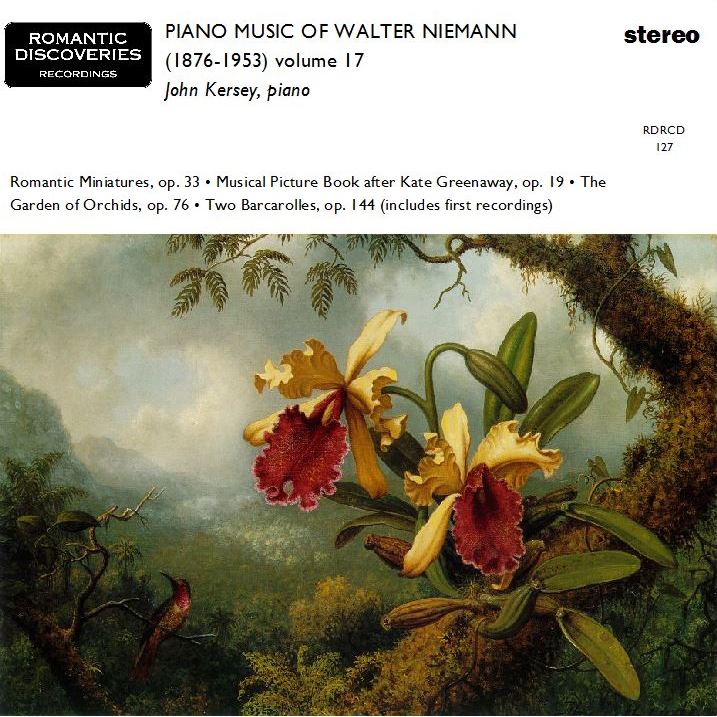
Piano Music of Walter Niemann volume 17
Romantic Miniatures, op. 33 • Musical Picture Book after Kate Greenaway, op. 19 • The Garden of Orchids, op. 76 • Two Barcarolles, op. 144 (includes first recordings)
John Kersey, piano
RDR CD127

Total time: 78 minutes 11 seconds

1. Romantische Miniaturen, inspired by poems of Jens Peter Jacobsen, op. 33 (19:33)
i. Yellow Roses ii. Old Roman Pastorale iii. Dreams iv. Silent Love v. Beautiful Autumn Day vi. Butterfly vii. Shadows viii. In the flower garden ix. Death in Springtime x. On the Elves’ Hill

2. Musikalisches Bilderbuch after Kate Greenaway, op. 19 (23:22)
i. The Doll’s Lullaby ii. Christmas Eve iii. The little Soldier iv. The Mill v. Grandma’s Fairy Tales vi. Lisette dances a Minuet vii. Dolly is sick viii. The first time to school ix. A little Tyrolean Ländler x. Mary’s Birthday Bouquet xi. The callow youth xii. A Hunting Piece xiii. The Brooklet in the Forest xiv. The Sleigh Ride xv. The Circus xvi. Mother Hubbard and her Dog

3. Der Orchideengarten, Ten Impressions from the Far East, op. 76 (25:50)
i. Javanese Dance ii. Song of the Malay Fishermen iii. In a green porcelain tea-house iv. Lotus Flower v. Bird of Paradise at a Waterfall vi. Blossoming Liana-Vines vii. The Indian Magician viii. In the Chinese City ix. Moonlight beneath the Palms x. A Rickshaw Ride

4. Zwei Barkarolen, op. 144 (9:39)
i. Poco Allegretto tranquillo (in anmutigem Fliessen) ii. Molto moderato, ma con anima
“There, on a May evening, when his light boat after a hot day glided late under the silent tree vault, from which the moonlight trickled into the water, towards the Alster…” – Rudolf G. Binding (Der Opfergang)

Our thanks go to Nicolo Figowy and Steffen Herrmann for their generous loan of scores.

Walter Niemann was regarded in 1927 as “the most important living piano composer who knows how to make music from the piano in a subtle and colorful way, although he often enters the field of salon music” (H. Abert, Illustrated Music Lexicon). This most sensitive and introverted master of the piano devoted his life to composition and musical scholarship, also performing his music in concerts and radio broadcasts. Niemann’s vast output for the piano is only now starting to become more widely known. Although his style is generally unashamedly conservative, he was one of the very few German composers to explore Impressionism in music, and this also reflected a fascination with the Far East. Elsewhere, Niemann’s imagination takes us from much Baroque recreation to large-scale epic sonatas, Schumannesque miniatures and even the exploration of early jazz styles. His understanding of the capabilities of the piano was complete, and his works include both collections for young pianists and mature works that exploit the full range of pianistic effect and make significant demands on the performer.
Piano Music of Walter Niemann volume 16
24 Preludes, op. 55 • Im Kinderland, op. 46 • Yule Slumber Lilt, op. 143 (includes first recordings)
John Kersey, piano
RDR CD126

Total time: 74 minutes 18 seconds

1. 24 Preludes, op. 55 (43:15)
Book I:
i. (C major) Off to a Happy Start ii. (A minor) An Evening in Seville (Spanish Dance-Song) iii. (G major) The Brook in the Green iv. (E minor) Shapes in the Fog v. (D major) A Dream vi. (B minor) Brooding and Musing vii. (A major) Silent Happiness viii. (F sharp minor) The Three Shepherds ix. (E major) The Babbling Meadow-Spring x. (C sharp minor) At Robert Schumann’s Grave xi. (B major) Devotion xii. (G sharp minor) Autumnal Thoughts
Book II
xiii. (G flat major) In Festive Splendour xiv. (E flat minor) Funeral Procession at Night xv. (D flat major) In the Gloaming xvi. (B flat minor) Fleeting Shadows xvii. (A flat major) Lassie with thy Locks of Gold xviii. (F minor) Hardened Hearts xix. (E flat major) To Adolph Henselt xx. (C minor) Old Harpsichord Tunes xxi. (B flat major) Dialogue xxii. (G minor) Anger xxiii. (F major) Onward, onward, never resting! xxiv. (D minor) Lament

2. In Children’s Land, nineteen pieces in progressive sequence, op. 46 (20:44)
i. Morning Prayers ii. Christmas-Bells iii. Chinese Lanterns! iv. Prince Suso and Princess Susi dance a minuet v. Schoolmaster Morose with a long nose vi. With a birthday bouquet vii. Very melancholic viii. Little Willy and the Wind ix. The little Mermaid in the shell x. Hans on the ice xi. Cradlesong for Dolly Dora xii. In an aeroplane xiii. Dolly’s Washingday xiv. Falling Flakes xv. The brave hen xvi. Little brother and little sister xvii. The three little chatterboxes xviii. Evening Prayers xix. Dreams

3. Krippenmusik zur Weihnacht, op. 143 (10:14)
i. Snowy Night ii. Come, O ye Shepherds! iii. Pastorella (The Shepherds’ Lay at the Cradle) iv. The Adoration of the Holy Child v. Joyous Dance of Children and Shepherds vi. Wing-dance of Angels

Our thanks go to Nicolo Figowy and Steffen Herrmann for their generous loan of scores.

Walter Niemann was regarded in 1927 as “the most important living piano composer who knows how to make music from the piano in a subtle and colorful way, although he often enters the field of salon music” (H. Abert, Illustrated Music Lexicon). This most sensitive and introverted master of the piano devoted his life to composition and musical scholarship, also performing his music in concerts and radio broadcasts. Niemann’s vast output for the piano is only now starting to become more widely known. Although his style is generally unashamedly conservative, he was one of the very few German composers to explore Impressionism in music, and this also reflected a fascination with the Far East. Elsewhere, Niemann’s imagination takes us from much Baroque recreation to large-scale epic sonatas, Schumannesque miniatures and even the exploration of early jazz styles. His understanding of the capabilities of the piano was complete, and his works include both collections for young pianists and mature works that exploit the full range of pianistic effect and make significant demands on the performer.

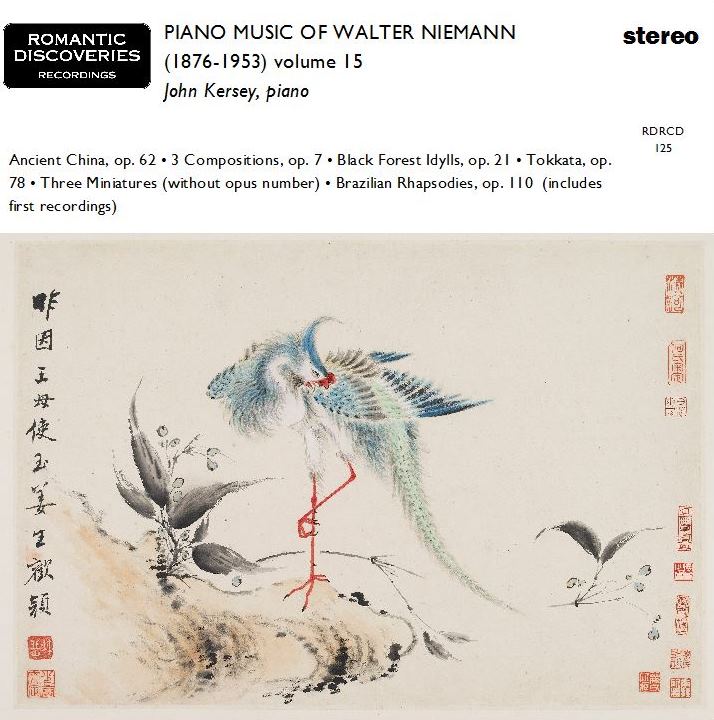
Piano Music of Walter Niemann volume 15
Ancient China, op. 62 • 3 Compositions, op. 7 • Black Forest Idylls, op. 21 • Tokkata, op. 78 • Three Miniatures (without opus number) • Brazilian Rhapsodies, op. 110 (includes first recordings)
John Kersey, piano
RDR CD125

Total time: 66 minutes 56 seconds

1. Alt-China; five dream-poems for piano, op. 62 (22:28)
i. The Pagoda Bells – Prelude ii. The Chinese Nightingale – Elegy iii. Little Li-Li-Tse – Scherzo-Caprice iv. The Sacred Barque – All Souls’ Day – Nocturne v. A Garden Fete – Finale (19:21)
“The Composer, having in a dream joined the Poet, Paul Claudel (author of “Aus der Erkenntnis des Ostens”, translated into German by Jakob Hegner, and published by Insel-Verlag), on a journey to China, relates here in music some of his experiences. They do not pretend to be Chinese, as the Composer does not deliberately employ the five-tone scale, whole-tone combinations with abstention from the leading-note, strange rhythms, and other primitive auxiliary means of producing exotic music; they are intended to be Chinese only in so far as they reproduce the delicate, exotic, fairy-tale atmosphere of the Far East, occasionally coloured with the primitive element in music. The work should be regarded as a musical picture of Ancient China, as conceived in a dream-fantasy by a modern German composer.”

2. Drei Kompositionen for the Pianoforte, op. 7 (7:14)
i. Intrata ii. Remembrance iii. Arabeske

3. Schwarzwald-Idyllen, 10 Character-Pieces for Piano, op. 21 (19:42)
i. Morning-glories and Eglantine ii. Butterfly iii. On a poem by Hebbel iv. The bairn v. On a sunny bank vi. Whims and fancies vii. A picture by Thoma viii. Little bare-foot ix. A gloomy hour x. The woodland brook

4. Tokkata, op. 78 (3:29)

5. Three Miniatures (without opus number) (10:33)
i. Träumerei ii. Schweizer Kuhreigen (Ranz des vaches) | “Hark! the note, (The Shepherd’s pipe in the distance is heard) The natural music of the mountain reed–For here the patriarchal days are not A pastoral fable — pipes in the liberal air, Mix’d with the sweet bells of the sauntering herd” – Byron – “Manfred” Act 1, Scene 2
3. Kleiner Waltzer (07:07)

6. Brasilianische Rhapsodien, op. 110 (9:25)
i. In the Form of a Tango ii. In the Form of a Fandango (based on a melody collected by Alexandre and Alice Rey Colaço in “Cantigas de Portugal”)

Our thanks go to Nicolo Figowy and Steffen Herrmann for their generous loan of scores.

Walter Niemann was regarded in 1927 as “the most important living piano composer who knows how to make music from the piano in a subtle and colorful way, although he often enters the field of salon music” (H. Abert, Illustrated Music Lexicon). This most sensitive and introverted master of the piano devoted his life to composition and musical scholarship, also performing his music in concerts and radio broadcasts. Niemann’s vast output for the piano is only now starting to become more widely known. Although his style is generally unashamedly conservative, he was one of the very few German composers to explore Impressionism in music, and this also reflected a fascination with the Far East. Elsewhere, Niemann’s imagination takes us from much Baroque recreation to large-scale epic sonatas, Schumannesque miniatures and even the exploration of early jazz styles. His understanding of the capabilities of the piano was complete, and his works include both collections for young pianists and mature works that exploit the full range of pianistic effect and make significant demands on the performer.
Piano Music of Walter Niemann volume 14
Holstein Idylls, op. 8 • Hans und Grete, op. 36 • Suite, op. 87 • Kocheler Ländler, op. 135 • 3 Nocturnes, op. 28 (includes first recordings)
John Kersey, piano
RDR CD124

Total time: 66 minutes 56 seconds

1. Holsteinische Idyllen, op. 8 (17:21)
i. Early spring ii. In blossom-snow iii. In the deep forest (East Holstein) iv. Evening atmosphere v. North Sea landscape
“And suddenly an idyll lay before him. Over by the pond the stately courtyard with the mighty residential building and the linden-shaded living rooms, the green panelwork of the walls, the bright red of their bricks reflected in the clear water, the bridge rolling and roaring dully under the wheels, the dusting mill wheel and in the background the vast radiant and bursting forest in the spring sun.” – Timm Kröger

2. Hansel and Gretel, op. 36 (14:17)
i. Gretel ii. Hansel iii. A fairground serenade iv. “Suse, Peter Kruse” (from an old Schleswig-Holstein childrens’ song) v. A hard holiday task vi. The nightwatchman’s round vii. In the garden under the lilac viii. On the railway ix. The first great sorrow x. Wicked Friedrich from the village xi. The Woodman and Kitty xii. Uncle Theobald and Aunt Doris – A Gavotte from the good old days xiii. Farewell

3. Suite for piano, op. 87 (13:29)
i. Praeludium – Molto moderato, in modo d’un Preambulo ii. Sarabande – Poco adagio iii. Menuett – Un poco Allegretto amabile iv. Rigaudon – Allegro con spirito

4. Kocheler Ländler, op. 135 (15:29)
i. Lieblich und gemessen ii. Munter und scharf markiert iii. Anmutig wiegend iv. Feurig und scharf markiert v. Mit schelmischer Grazie vi. Heimlich und gedämpft vii. Feurig und rhythmisch markiert (nach altbayrischen Originalmotiven) viii. Träumerisch versonnen und ein wenig gehalten im Tempo ix. Mässig, doch lieblich bewegt x. Unmutig erregt und pathetisch, frei im Tempo xi. Heimlich und versonnen xii. Heiter, doch gemessen im Tempo und scharf markiert (Altbayrischer Schuhplattler)

5. Three Nocturnes, op. 28 (10:58)
i. Alhambra (Granada) ii. Nach glücklichem Tage iii. Ave Maria (Frauenchiernsee)

Our thanks go to Nicolo Figowy and Steffen Herrmann for their generous loan of scores.

Walter Niemann was regarded in 1927 as “the most important living piano composer who knows how to make music from the piano in a subtle and colorful way, although he often enters the field of salon music” (H. Abert, Illustrated Music Lexicon). This most sensitive and introverted master of the piano devoted his life to composition and musical scholarship, also performing his music in concerts and radio broadcasts. Niemann’s vast output for the piano is only now starting to become more widely known. Although his style is generally unashamedly conservative, he was one of the very few German composers to explore Impressionism in music, and this also reflected a fascination with the Far East. Elsewhere, Niemann’s imagination takes us from much Baroque recreation to large-scale epic sonatas, Schumannesque miniatures and even the exploration of early jazz styles. His understanding of the capabilities of the piano was complete, and his works include both collections for young pianists and mature works that exploit the full range of pianistic effect and make significant demands on the performer.
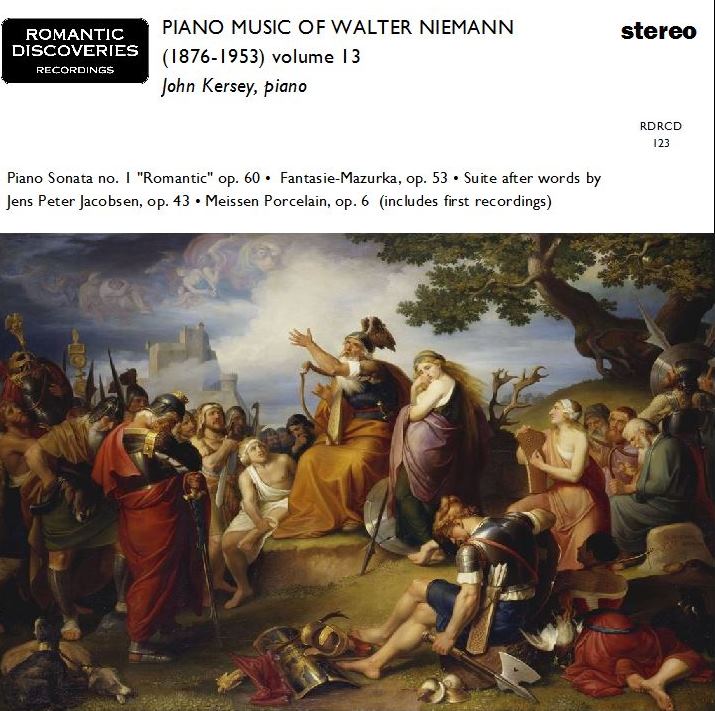
Piano Music of Walter Niemann volume 13
Piano Sonata no. 1 “Romantic” op. 60 • Fantasie-Mazurka, op. 53 • Suite after words by Jens Peter Jacobsen, op. 43 • Meissen Porcelain, op. 6 (includes first recordings)
John Kersey, piano
RDR CD123

Total time: 66 minutes 56 seconds

1. Piano Sonata no. 1 in A minor, op. 60 “Romantic” (25:17)
i. Allegro moderato – In the spirit of a Romantic Ballade ii. Poco Adagio iii. Non troppo allegro e poco giocoso

2. Fantasie-Mazurka, op. 53 (4:25)

3. Suite after words by Jens Peter Jacobsen, op. 43 (17:49)
i. Präludium – The old fountains ii. Romanze – Rose time iii. Barkarole – In the boat iv. Ballade – Finale – Phantom in the mist

4. Meissner Porzellan; little suite in the old style for the piano, op. 6 (19:17)
i. Praeludium – Allegro risoluto, ma non troppo ii. Sarabande – Andante sostenuto iii. Gavotte – Allegretto tranquillo, ma grazioso e scherzando iv. Air – Adagio cantabile v. Rigaudon – Allegro vivace e giocoso

Our thanks go to Nicolo Figowy and Steffen Herrmann for their generous loan of scores.

Walter Niemann was regarded in 1927 as “the most important living piano composer who knows how to make music from the piano in a subtle and colorful way, although he often enters the field of salon music” (H. Abert, Illustrated Music Lexicon). This most sensitive and introverted master of the piano devoted his life to composition and musical scholarship, also performing his music in concerts and radio broadcasts. Niemann’s vast output for the piano is only now starting to become more widely known. Although his style is generally unashamedly conservative, he was one of the very few German composers to explore Impressionism in music, and this also reflected a fascination with the Far East. Elsewhere, Niemann’s imagination takes us from much Baroque recreation to large-scale epic sonatas, Schumannesque miniatures and even the exploration of early jazz styles. His understanding of the capabilities of the piano was complete, and his works include both collections for young pianists and mature works that exploit the full range of pianistic effect and make significant demands on the performer.
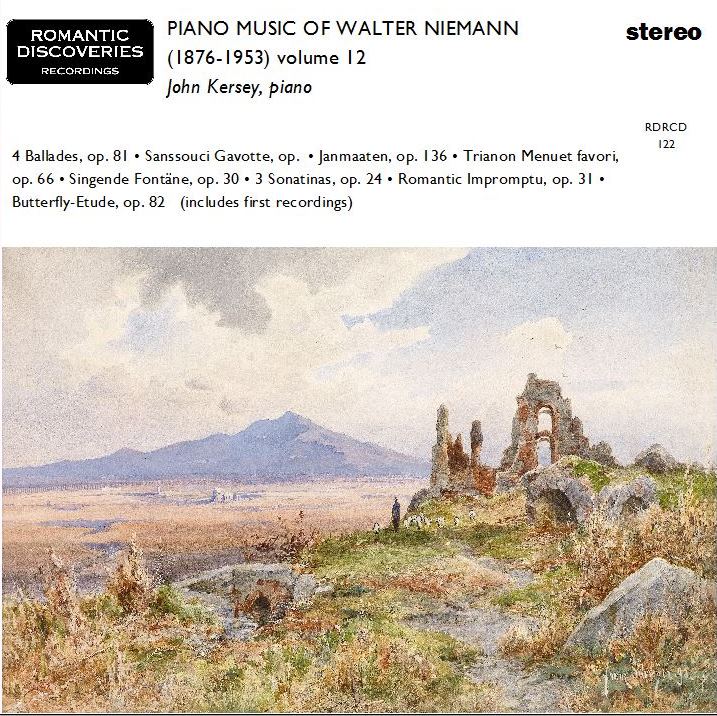
Piano Music of Walter Niemann volume 12
4 Ballades, op. 81 • Sanssouci Gavotte, op. 65 • Janmaaten, op. 136 • Trianon – Menuet favori, op. 66 • Singende Fontäne, op. 30 • 3 Sonatinas, op. 24 • Romantic Impromptu, op. 31 • Butterfly-Etude, op. 82 (includes first recordings)
John Kersey, piano
RDR CD122

Total time: 74 minutes 36 seconds

1. Four Ballades, op. 81 (27:38)
i. Römische Campagna | Dem Wanderer steigt vor den Trümmern eines alten Tempels eine leuchtende Vision antiken Lebens auf. Sie bricht auf ihrem dithyrambischen Höhepunkt zusammen; wieder liegt die römische Campagna in schwermütiger Verlassenheit da. | ii. Nordische Heide | Das düstere Grauen einer unheimlichen Mordstelle unterbricht die Erinnerung an altes frohes Jagdleben. | iii. Sonntag in Lissabon | Die helle heitere (Ständchen) und die dunkle leidenschaftliche Seite (Mittelsatz) des Volkslebens schliessen sich unter leisem Klang der Kirchenglocken zur Ballade zusammen. | iv. Nordische Meerfahrt
2. Sanssouci Gavotte, op. 65 (3:49)

3. Janmaaten (Shipmates) – two humoresques from the Hamburg harbour, op. 136 (6:32)
i. Thetje and his little daughters ii. With Jan Hinnerk in the “Merry Seal”

4. Trianon – Menuet favori, op. 66 (3:05)
5. The Singing Fountain (Nocturne), op. 30 (4:55)

6. Sonatina in C major, op. 24 no. 1 (6:07)
i. Allegro commodo e non troppo ii. Little variations on a Danish folksong (“Ich legte mein Haupt auf dem Elfenhügel” from Friedrich Kuhlau’s opera “Elves’ Hill”) iii. Rondo. Molto giocoso quasi Presto

7. Sonatina in A minor, op. 24 no. 2 (7:20)
i. Molto moderato ii. Andantino tranquillo iii. Rondo. Vivace e giocoso

8. Sonatina in D major, op. 24 no. 3 (8:38)
i. Allegro molto moderato e tranquillo, quasi Allegretto ii. Andantino cantabile e tranquillo iii. Allegro molto con brio

9. Romantisches Impromptu, op. 31 (4:59)
10. Schmetterling – Etude, op. 82 (1:11)

Our thanks go to Nicolo Figowy and Steffen Herrmann for their generous loan of scores.

Walter Niemann was regarded in 1927 as “the most important living piano composer who knows how to make music from the piano in a subtle and colorful way, although he often enters the field of salon music” (H. Abert, Illustrated Music Lexicon). This most sensitive and introverted master of the piano devoted his life to composition and musical scholarship, also performing his music in concerts and radio broadcasts. Niemann’s vast output for the piano is only now starting to become more widely known. Although his style is generally unashamedly conservative, he was one of the very few German composers to explore Impressionism in music, and this also reflected a fascination with the Far East. Elsewhere, Niemann’s imagination takes us from much Baroque recreation to large-scale epic sonatas, Schumannesque miniatures and even the exploration of early jazz styles. His understanding of the capabilities of the piano was complete, and his works include both collections for young pianists and mature works that exploit the full range of pianistic effect and make significant demands on the performer.

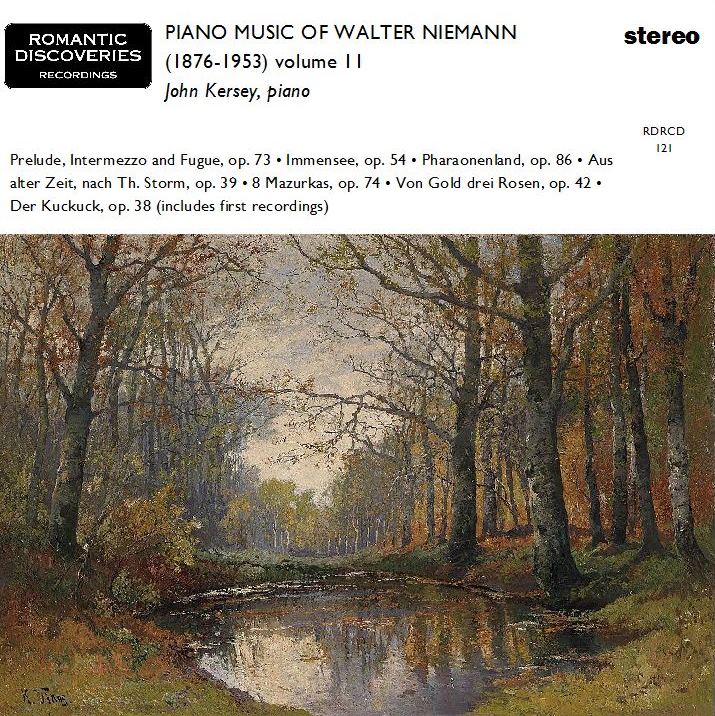
Piano Music of Walter Niemann volume 11
Prelude, Intermezzo and Fugue, op. 73 • Immensee, op. 54 • Pharaonenland, op. 86 • Aus alter Zeit, nach Th. Storm, op. 39 • 8 Mazurkas, op. 74 • Von Gold drei Rosen, op. 42 • Der Kuckuck, op. 38 (includes first recordings)
John Kersey, piano
RDR CD121

Total time: 71 minutes 13 seconds

1. Präludium, Intermezzo und Fuge, op. 73 (9:27)
i. Präludium – Moderato ii. Intermezzo – Come una Cadenza, vivo a capriccio iii. Fuga – Moderato, ma sempre poco giocoso

2. Immensee – romantic fantasy after Theodor Storm, op. 54 (14:25)

3. Land of the Pharaohs, three pictures, op. 86 (10:48)
i. Evening on the Nile (Elegie) – Andante poco sostenuto e languido ii. Sphinx (Basso ostinato) – Lento misterioso iii. Ancient Egyptian Temple Dance – Molto moderato solenne

4. From olden times: little suite after words of Theodor Storm, op. 39 (8:26)
i. Pavane (In the ballroom) – Solenne con gravita ii. Allemande (Spring Sunday in the old garden) – Moderato ed amabile iii. Hornpipe (Sailors’ Dance) – Spirituoso iv. Capriccio (The Farewell) – Un poco sostenuto ed agitato

5. Eight Mazurkas, op. 74 (15:48)
i. Ruhig und ein wenig gehalten ii. Hell und frisch bewegt iii. In trübem Sinnen iv. Mässig, mit Anmut und Grazie v. Mit stiller, edler Trauer, sehr gehalten und gedämpft vi. Zart und anmutig, im ruhigen naiven Pastoralton vii. Mit sinniger Grazie viii. Frisch, herrisch und markiert

6. Three Golden Roses, op. 42 (5:06)

7. The Cuckoo: little suite, op. 38 (6:58)
i. Präludium – Moderato, ma con anima ii. Tempo di Minuetto iii. Tokkatina – Vivace iv. Arietta – Andantino amabile v. Gigue (Little Hunting Piece) – Alla caccia, molto vivace e giocoso
“Nu harr de Kukuk Hochtid makt/Und lach opt allerbest” – Claus Groth

Our thanks go to Nicolo Figowy and Steffen Herrmann for their generous loan of scores.

Walter Niemann was regarded in 1927 as “the most important living piano composer who knows how to make music from the piano in a subtle and colorful way, although he often enters the field of salon music” (H. Abert, Illustrated Music Lexicon). This most sensitive and introverted master of the piano devoted his life to composition and musical scholarship, also performing his music in concerts and radio broadcasts. Niemann’s vast output for the piano is only now starting to become more widely known. Although his style is generally unashamedly conservative, he was one of the very few German composers to explore Impressionism in music, and this also reflected a fascination with the Far East. Elsewhere, Niemann’s imagination takes us from much Baroque recreation to large-scale epic sonatas, Schumannesque miniatures and even the exploration of early jazz styles. His understanding of the capabilities of the piano was complete, and his works include both collections for young pianists and mature works that exploit the full range of pianistic effect and make significant demands on the performer.

Piano Music of Walter Niemann volume 10
Porcelain, op. 120 • Chaconne, op. 44 • Suite after pictures by Carl Spitzweg, op. 84 • Japan, op. 89 (includes first recordings)
John Kersey, piano
RDR CD120

Total time: 72 minutes 8 seconds

1. Porzellan – Figures from famous china manufactories, op.120 (23:46)
i. The Little Shepherdess (Meissen) ii. An English Rustic Couple Dancing (Old Chelsea) iii. Athenian Dance at a Sacrificial Festival (Vienna) iv. Danish Spring (Copenhagen) (Dedicated to the memory of Niels Gade) v. Rice-Birdie (Japan) vi. The Little Dutch Belfry (Delft) vii. Beppo, the Serenade-Singer (Naples) viii. Hunting-Piece (Rosenthal) ix. Madame la Marquise (Sevres) x. The Yellow-Porcelain Mandarin (China) xi. The Fountain at Sans-Souci (Old Berlin)

2. Chaconne, op. 44 (6:15)

3. Suite after pictures by Carl Spitzweg, op. 84 (19:56)
i. Serenade ii. Flute concerto iii. The Guards iv. Post in the forest v. Italian street-singer

4. Japan – A Cycle of Pieces for Piano, op. 89 (22:04)
i. The Tea House ii. Twilight at Sea iii. The Feast of Cherry Blossoms iv. Fudsiyama (The Holy Mount) v. Dance of the Geisha

Our thanks go to Nicolo Figowy and Steffen Herrmann for their generous loan of scores.

Walter Niemann was regarded in 1927 as “the most important living piano composer who knows how to make music from the piano in a subtle and colorful way, although he often enters the field of salon music” (H. Abert, Illustrated Music Lexicon). This most sensitive and introverted master of the piano devoted his life to composition and musical scholarship, also performing his music in concerts and radio broadcasts. Niemann’s vast output for the piano is only now starting to become more widely known. Although his style is generally unashamedly conservative, he was one of the very few German composers to explore Impressionism in music, and this also reflected a fascination with the Far East. Elsewhere, Niemann’s imagination takes us from much Baroque recreation to large-scale epic sonatas, Schumannesque miniatures and even the exploration of early jazz styles. His understanding of the capabilities of the piano was complete, and his works include both collections for young pianists and mature works that exploit the full range of pianistic effect and make significant demands on the performer.